


VISION mobility kostenlos Probelesen

Die Zeitschrift VISION mobility richtet sich an mobilitätsbegeisterte Menschen bzw. Flottenmanager und begleitet den Technologiewandel in Sachen Automotive und Mobilität.
Aktueller Termin

Meist gelesen
EV charging network: Europe misses its 2030 target – large regional differences
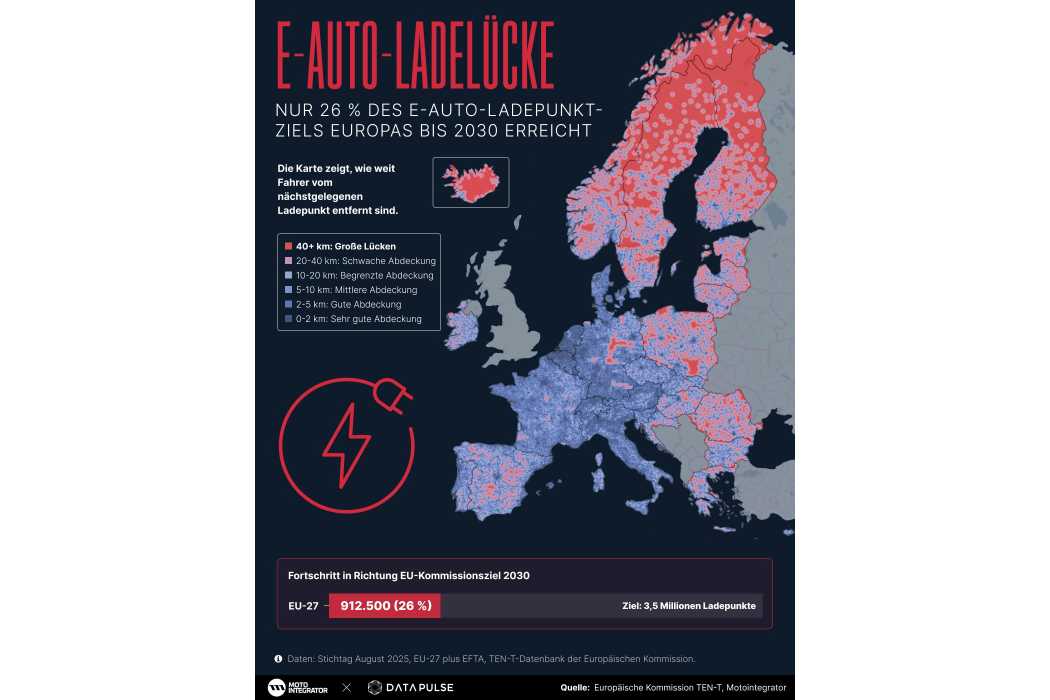
Five years before the 2030 deadline, fewer than one million publicly accessible charging points are available to European drivers. In the EU-27 there are around 910,000 – roughly only about a quarter of the European Commission's target of 3.5 million charging points. With the current expansion of around 150,000 charging points per year, the total number would reach only about 1.7 million by 2030.
To close the current gap, more than 500,000 new charging points would have to be installed annually. The practical problem, however, is not only the quantity but also the distribution and the charging speed.
Key Findings
- Slow progress: Only 26.1 percent of the European Commission's 3.5-million target has been reached.
- Retailers outpace countries: Lidl has more charging points (8,855) than Ireland or Romania.
- Slow charging: Fewer than 10 percent of charging points enable High Power Charging (>150 kW).
- Regional differences: Particularly large gaps exist in Northern Scandinavia, Central Germany, inland Spain, and Southern Poland.
Charging Deserts in Europe
The study shows clear gaps in the European charging network. While cities are usually well supplied, there are often only a few charging points in between. In dark red-marked regions, the distance to the next charging point is more than 40 km.
Supply gaps are even more pronounced in Northern Scandinavia and Central Germany, complemented by rural regions of France, the interior of Spain, the Alpine regions, secondary roads in the Baltic region, as well as on islands.
Quantity versus Quality
The countries differ in the number of charging points (per 100,000 inhabitants) and the share of High Power Charging (HPC) stations (>150 kW).
- Norway leads with an HPC share of 30.8 percent, but the charging-point density is only in the middle of the pack (462 per 100,000 inhabitants).
- The Netherlands leads with the highest charging-point density (684 per 100,000 inhabitants), but shows only a 2.3 percent share of fast charging.
- Germany sits in the middle with 217 per 100,000 inhabitants and a 15.9 percent fast-charging share.
Supermarkets as Drivers
Retail chains are developing into important players in the charging infrastructure. The Schwarz Group (Lidl and Kaufland) has built thousands of charging points across Europe. Lidl alone operates 8,855 charging points and thus more than entire countries such as Ireland (4,842) or Romania (6,670). This shows: private companies play a central role in closing the charging gap.
Turkey with the Highest Growth
Turkey recorded in 2024 the fastest growth in Europe, from around 11,800 charging points at the end of 2023 to about 26,000 by the end of 2024.
The Road to 2030
It takes more than just pins on the map. What matters are performance, reliability and user-friendliness. AFIR (Alternative Fuels Infrastructure Regulation) therefore demands: real performance on main roads, Tap & Go payments, transparent prices and a live status that is not fiction.
To reach the EU Commission's target of 3.5 million charging points, around 520,000 new charging points are needed annually. Subsidies help, but ultimately approvals, grid connections and operating hours determine the success.
About the Study
The study is based on the TEN-T database of the trans-European transport network (as of: August 2025) and covers 30 countries (EU-27, EFTA, United Kingdom, Turkey). Growth data were supplemented with information from the European Alternative Fuels Observatory (EAFO). The charging point density was calculated using Eurostat population figures per 100,000 inhabitants.
Content automatically translated.


Taxi-Fahrzeuge (Pkw) , Taxi-Newsletter, Taxameter, Taxi-Fahrer , BZP – Deutscher Taxi- und Mietwagenverband , Straßenverkehrsordnung (StVO) , Krankenbeförderung , Weiterbildung , Taxi-Konzessionen , Verkehrspolitik , Mietwagenbranche , Taxi-Apps , Berufskraftfahrer-Qualifikations-Gesetz BKrFQG) , Taxizentralen , Personal, Gehälter, Arbeitsschutz , Wirtschaftsnachrichten , Werbung , Taxi-Folierung , Taxi-Umrüster , Straßenverkehr , Elektromobilität, Taxifuhrpark und -flottenmanagement , Taxi-Versicherungen , Hybrid, Diesel, Erdgas , Taxi-Magazin







