2 Ausgaben kostenlos für Sie

Fachmagazin taxi heute: Ihr Zugang zu exklusiven Inhalten rund um die Taxi- und Mietwagenbranche.
Aktueller Termin

Meist gelesen
Winter costs driving range - ADAC tests winter suitability of electric cars

Even the selection of the vehicles shows what the car club was aiming for. The models had to promise at least 500 kilometers WLTP range, in the ADAC car test the 'Family' category with at least a grade of 3.0, and cost under €100,000 new. No exotica then, but vehicles that could actually be parked in front of single-family houses, in supermarket parking lots, and at school parking lots.
WLTP value in winter is utopian
The good news first: Electric cars also reach their destination in winter on long-distance journeys. The bad news follows on the heels: The deviation between the standard and real-world reality remains substantial. On average, the extra energy consumption in the ADAC winter test was 57 percent higher than the WLTP figure. The value is determined at 23 degrees Celsius and moderate pace – conditions that have little to do with a January drive on the A9. The strongest outlier was 69 percent; even the most economical candidate deviated upward by 40 percent.
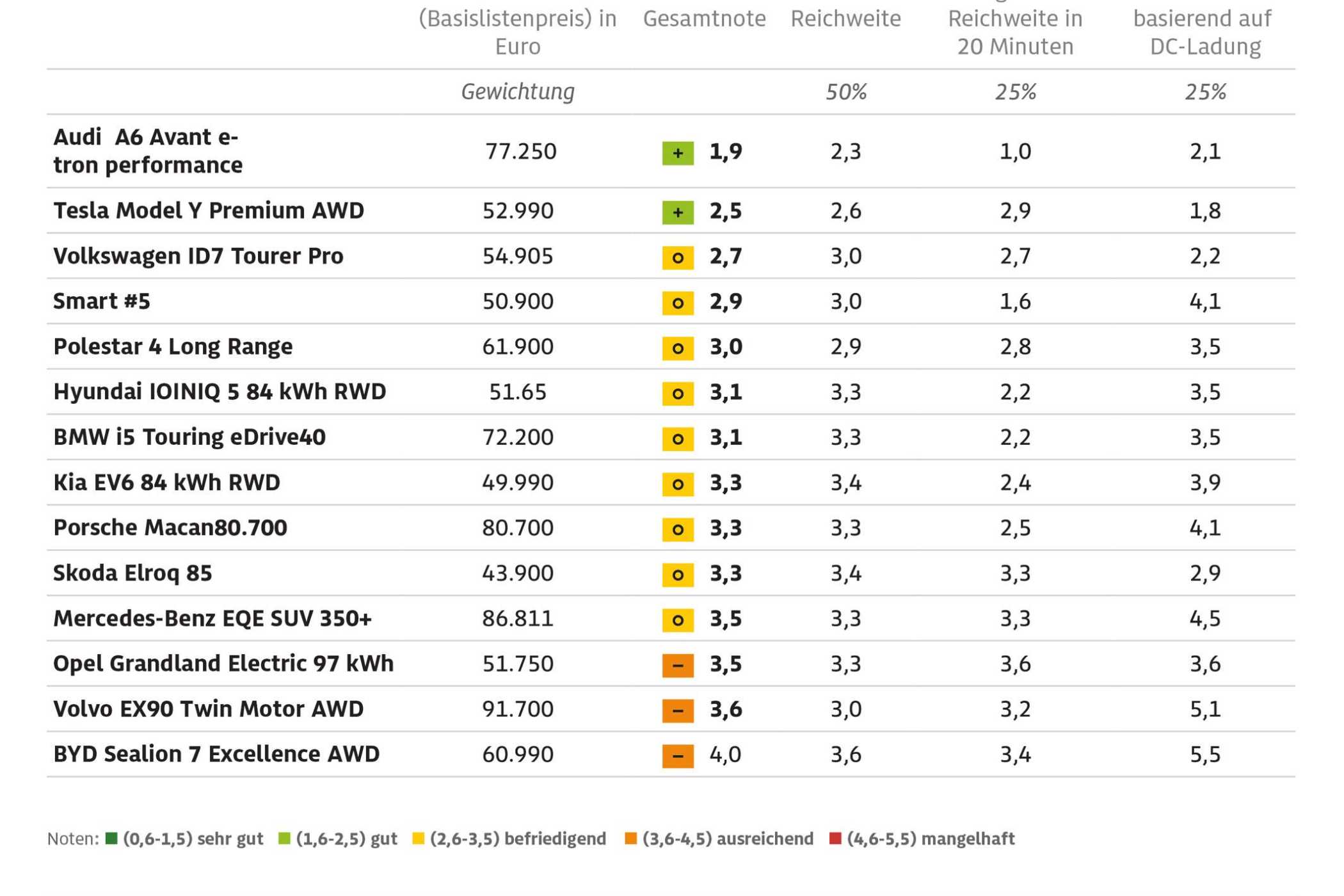



Thus the question “How far can I go?” quickly becomes the more pragmatic: “How often do I need to charge?” For the 582 kilometers from Munich to Berlin, most test vehicles require two charging stops. Only two manage to reach the destination with a single stop of around 20 minutes: the Audi A6 Avant e-tron performance and the Smart #5 Premium. A detail that on the long-distance run makes the difference between a relaxed arrival and efficient time management.
Audi leads the field
With an ADAC rating of 1.9, it earns—being one of only two vehicles—the verdict “good.” After almost four hours of driving, 441 kilometers are on the clock, and consumption stands at 23.2 kWh per 100 kilometers. For the remaining distance, a short charging stop is enough, delivering energy for around 300 kilometers. In the combination of achieved range and charging speed, the Audi sets the benchmark—not with magic, but with efficient technology.
With the Tesla Model Y and the VW ID7, two taxi models at the front
In terms of consumption itself, it must concede defeat. The Tesla Model Y Maximum Range AWD consumes 22.2 kWh per 100 kilometers and finishes in second place with a grade of 2.5. Again, it shows: efficiency helps in winter more than large batteries. Close behind are the VW ID.7 Tourer Pro and the Smart #5 Premium, both rated 'satisfactory'. In total, seven of the 14 vehicles receive this verdict; three only achieve an 'adequate'.
What is interesting is the look at price and placement. Unlike the previous year, it's not automatically the most expensive models that go the furthest. Although the test winner is in the upper price range at 77,250 euros, the following three vehicles cost between roughly 51,000 and 55,000 euros. The most expensive test car at 91,700 euros ends up only in the penultimate place. Range cannot be bought easily.
Particularly clear is the discrepancy between brochure and practice when comparing individual models. The Audi A6 Avant e-tron promises 719 kilometers WLTP, in the winter test only 441 remain. For the Tesla Model Y, 600 drops to 406 kilometers, for the VW ID.7 Tourer 593 to 360. The Smart #5 and the Polestar 4 land with just over 360 kilometers in a similar range. That is sufficient for long-distance travel – but only with a realistic charging plan.
Winter reduces range
The ADAC test thus shows less a weakness of individual models than a fundamental truth of electric mobility: winter reduces range. Those who factor this in still manage to get by well. Those who blindly rely on standard values will be surprised. Electric cars are already capable for long-distance travel, just not under ideal conditions.
Content automatically translated.


Taxi-Fahrzeuge (Pkw) , Taxi-Newsletter, Taxameter, Taxi-Fahrer , BZP – Deutscher Taxi- und Mietwagenverband , Straßenverkehrsordnung (StVO) , Krankenbeförderung , Weiterbildung , Taxi-Konzessionen , Verkehrspolitik , Mietwagenbranche , Taxi-Apps , Berufskraftfahrer-Qualifikations-Gesetz BKrFQG) , Taxizentralen , Personal, Gehälter, Arbeitsschutz , Wirtschaftsnachrichten , Werbung , Taxi-Folierung , Taxi-Umrüster , Straßenverkehr , Elektromobilität, Taxifuhrpark und -flottenmanagement , Taxi-Versicherungen , Hybrid, Diesel, Erdgas , Taxi-Magazin