Ihr kostenloser Branchen-Newsletter

Lassen Sie sich von unseren Fachjournalisten einmal wöchentlich über die wichtigsten aktuellen Entwicklungen der Taxi-Branche informieren, bequem direkt in Ihre Mailbox.
Aktueller Termin

Meist gelesen
Robotaxis in China: Xpeng may drive Level 4 across Guangzhou, VW tests Level 3
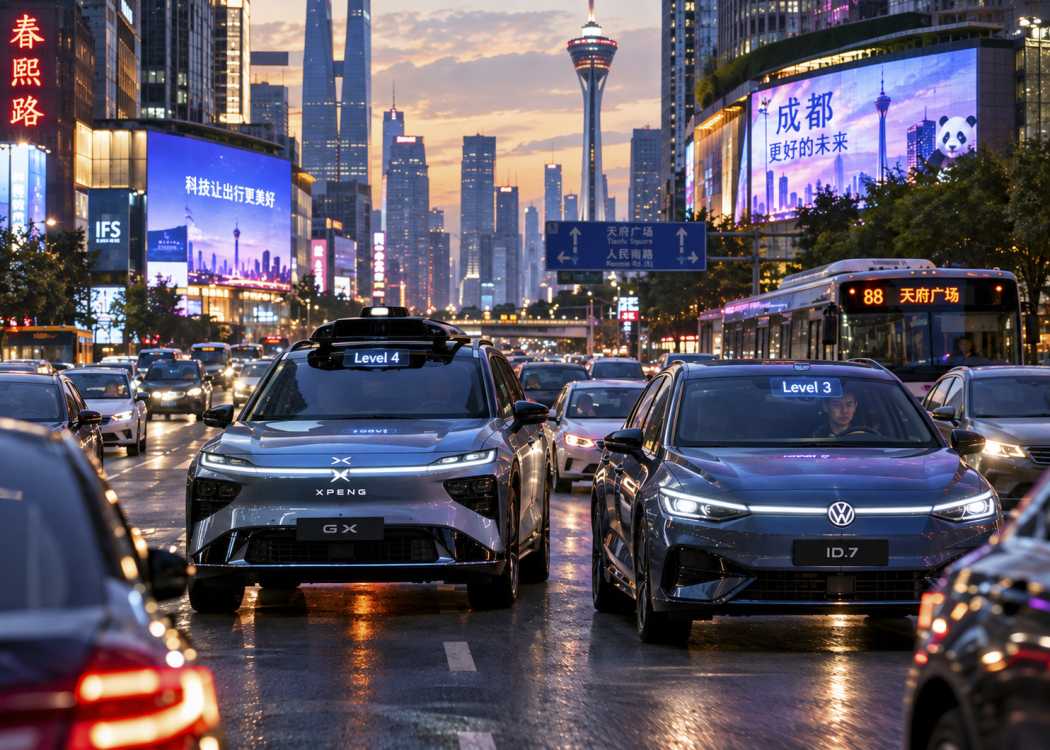
For the taxi business, the difference between assistance systems and driverless operation is increasingly becoming the decisive question for the future. The difference between the two projects is fundamental. Volkswagen is working on Level 3, the so-called conditionally automated driving. Under certain conditions the system takes over the driving task; the driver may temporarily turn away from the traffic, but must be prepared to take back control upon request. The approval applies only within clearly defined deployment boundaries.
Xpeng aims further with Level 4. A correspondingly designed vehicle should be able to drive autonomously within its approved deployment area, without a person at the wheel constantly having to intervene. This is the technical prerequisite for robotaxis without a safety driver. Level 4, however, does not mean that a car can operate autonomously under all weather and traffic conditions.
VW in Hefei on Public Roads
Volkswagen has in Hefei, the capital of the eastern Chinese province of Anhui, received a public-road testing license for Level 3. Testing on public roads and the collection of driving data have already begun. Which models will be used, how large the test fleet is, and on which routes they may operate, the group did not disclose at first. The license is a development step, not a series approval. Volkswagen China aims to achieve technical maturity for Level 3 in 2027. Vehicles with corresponding functions could be delivered to customers at the earliest in the second half of 2027. Development is taking place on site, including through the joint venture Carizon, in which Volkswagen's software subsidiary Cariad and the Chinese technology provider Horizon Robotics are involved.
Xpeng Makes Guangzhou a Robotaxi Lab
While Volkswagen is still working toward the next development stage, Xpeng may expand its robotaxi program in Guangzhou to cover the entire city. The permit dated October 26 allows demonstration rides with vehicles at Level 4. However, that does not mean every passenger can board immediately: in the initial phase Xpeng will continue to issue invitation codes and wants to gradually expand access. The robotaxi is based on the GX SUV. The focus is on a combination of cameras, artificial intelligence, and high computing power. According to its own statements, Xpeng does not use LiDAR sensors and high-resolution maps. Instead, a so-called Pure Vision architecture processes the optical information from traffic. Four self-developed Turing AI chips together deliver a computing power of 3,000 TOPS. The driving decisions are made by the AI model VLA 2.0.
The approach has a practical background: cameras are available in large numbers, and a system that does not rely on highly precise maps could be transferred more easily to new deployment areas. But the architecture alone does not yet prove that a robotaxi will reliably respond in every traffic situation. Construction sites, unclear intersections, emergency vehicles, or unusual behavior of other road users remain challenging tasks. Therefore, what matters is not only computing power, but how safely the overall system operates in everyday use. Xpeng aims to enable regular passenger operation without a safety driver in the vehicle by 2027. In addition, the manufacturer plans partnerships with mobility platforms domestically and abroad. In October the company presented its robotaxi brand XPeng YOYO and opened registration for autonomous driving in China. Talks with European platforms are also said to be underway. A concrete approval for a driverless taxi operation in Germany does not yet follow from this.
China Creates Room for Autonomous Fleets
The two approvals are part of a broader strategy. China has been expanding its test infrastructure for connected and automated vehicles for years. According to the Ministry of Industry and Information Technology, more than 20,000 test licenses have already been issued nationwide. More than 57,000 kilometers of roads are available for tests and demonstrations; the cumulative test mileage exceeds 220 million kilometers. In addition, there are pilot cities and test zones where vehicles, road infrastructure, and cloud systems are tested together. That creates an advantage: manufacturers can test their systems in different traffic situations and collect large amounts of data. At the same time, China is working to standardize technical standards. Because autonomous mobility does not depend solely on individual vehicles. Also the permitting practices, safeguarding against system outages, remote monitoring and the handling of accidents must work.
For the taxi business, what is particularly interesting is that Xpeng does not want to test just a vehicle, but an operating system for a mobility service. A robotaxi must accept orders, pick up passengers at the right location, navigate the route, and respond to disruptions. In addition, cleaning, maintenance, charging, and fleet management come into play. Only when these processes operate reliably and economically will a technical demonstration become a viable ride service.
What does this mean for taxi companies in Europe?
The development in China is not an immediate green light for driverless taxis in Germany. Here there are separate legal requirements. Even a technically capable Level-4 vehicle may not be deployed as a regular robotaxi without the required approvals. The transfer of Chinese test approvals to European roads is not foreseen. Nevertheless, taxi companies should monitor the development. If manufacturers such as Xpeng offer their technology in the future through mobility platforms, new business models could emerge: fleet operators provide vehicles, platforms assume the mediation, and technology providers supply the autonomous driving system. Whether this actually reduces costs depends, among other things, on vehicle price, utilization, insurance, maintenance, and the effort required for remote monitoring.
The tasks in a taxi company could also change. Even if a vehicle operates without a safety driver, dispatch, customer service, vehicle maintenance and fault management do not disappear. They partly shift from the driver's seat to the control center and into fleet operations. How many employees will be required for this cannot yet be inferred from the existing tests. Volkswagen and Xpeng thus represent two different stages of the same development. Volkswagen intends to temporarily relieve the driver under clearly defined conditions. Xpeng is already testing how a vehicle within an approved area can autonomously transport passengers.
Content automatically translated.



Taxi-Fahrzeuge (Pkw) , Taxi-Newsletter, Taxameter, Taxi-Fahrer , BZP – Deutscher Taxi- und Mietwagenverband , Straßenverkehrsordnung (StVO) , Krankenbeförderung , Weiterbildung , Taxi-Konzessionen , Verkehrspolitik , Mietwagenbranche , Taxi-Apps , Berufskraftfahrer-Qualifikations-Gesetz BKrFQG) , Taxizentralen , Personal, Gehälter, Arbeitsschutz , Wirtschaftsnachrichten , Werbung , Taxi-Folierung , Taxi-Umrüster , Straßenverkehr , Elektromobilität, Taxifuhrpark und -flottenmanagement , Taxi-Versicherungen , Hybrid, Diesel, Erdgas , Taxi-Magazin