


2 Ausgaben kostenlos für Sie

Fachmagazin taxi heute: Ihr Zugang zu exklusiven Inhalten rund um die Taxi- und Mietwagenbranche.
Aktueller Termin

Meist gelesen
Between taxi, bus and legislation: VSPV meets Henning Rehbaum
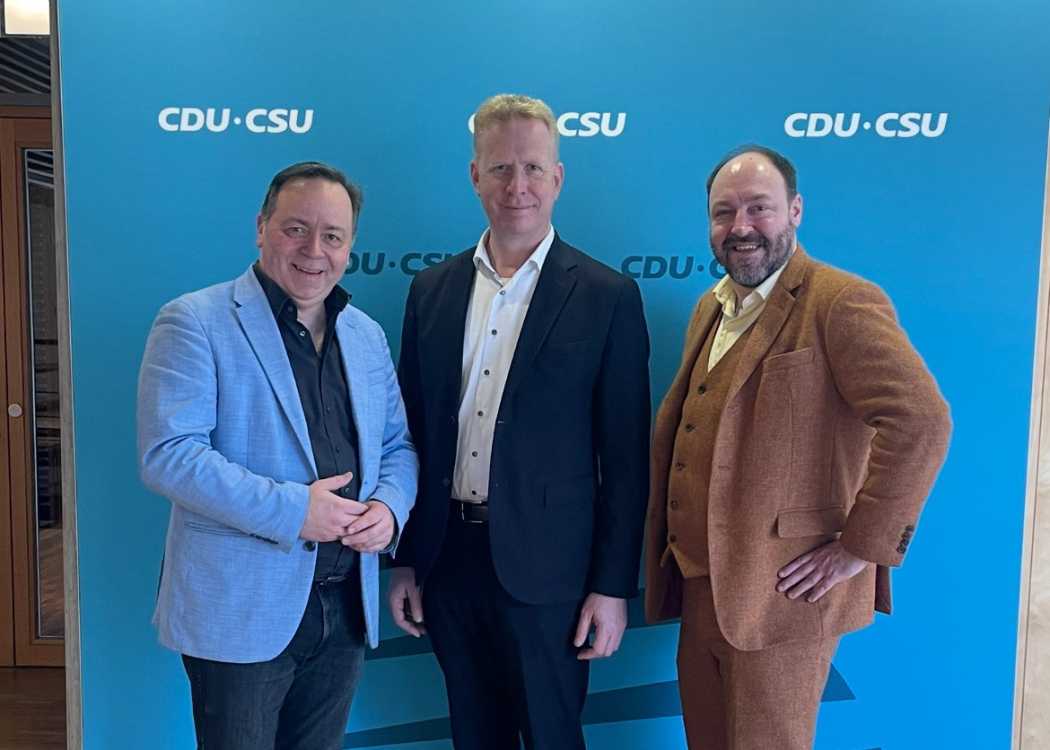
Rehbaum's electoral district of Warendorf lies in the heart of the association's core area. The entry was handled smoothly as a result. The VSPV is well acquainted to him from his time as a transport policy politician in the state parliament, said the Bundestag member. The association brings together diverse interests—from taxi and rental-car trades to bus companies and patient transports. Its significance lies precisely in this.
“Notably, the VSPV's push for the inclusion taxi also shows how important it is to build viable alliances for central issues,” said Rehbaum.
Mobility as a networked system
In an interview with VSPV managing director Sascha Waltemate and head of the capital bureau Patrick Meinhardt, it became clear that the association increasingly understands mobility as an integrated system. The traditional distinction between scheduled services and on-demand transport is, in their view, too narrow—especially in rural areas.
Meinhardt stated this in a personal address:
“Henning, you’re basically our representative—geographically and in terms of content.”
Behind this lies a political objective: Mobility should be considered across sectors.
“Only the close integration of bus and taxi can—and will—close the mobility gap in rural areas.”
The association attaches concrete demands to this. A nationwide local transport pact as well as the further development of the Deutschlandticket are under discussion. The idea: a “Deutschland-Ticket plus Taxi” that integrates taxis more strongly into public transport.
“The taxi is part of public transport, even if too many forget this too often,” Meinhardt continued.
The "ÖPNV-Taxi" as a Concept
The centerpiece of the meeting was a concept that the association has been promoting for some time: the so-called ÖPNV-Taxi. It is intended to address where traditional fixed-route services reach their limits—in sparsely populated regions or during off-peak times.
Waltemate describes the approach as deliberately pragmatic:
"Our concept of the ÖPNV-Taxi targets exactly that, in order to unbureaucratically and finally enable nationwide, comprehensive coverage."
The association has produced a "detailed concept" that could be brought into political consultations. The timing is not random from the VSPV's perspective. In the coming months, central negotiations between the federal government and the states are due to take place – on regionalization funds, the future of the Deutschlandticket and the expansion of local transport. For Waltemate it is clear that structural questions must also be reassessed:
"Especially now […] it would be fatal not to continue to develop conceptually and prospectively."
The ÖPNV-Taxi is not seen by the association as a small addition, but as a structural development.
"The ÖPNV-Taxi for Germany would be a real leap in quality," emphasized Waltemate.
Waltemate linked this to a call for legislation. In upcoming changes to the passenger transport law, policymakers must not cut corners.
Minimum tariffs as an open battleground
In addition to conceptual questions, there was also a topic that has accompanied the industry for years: minimum tariffs in the car rental sector. The association sees this as a central instrument against price pressure from platform providers.
"We finally need nationwide minimum tariffs in Germany to counter unfair competition from Uber & Co," said Meinhardt.
However, implementation has so far failed due to political responsibilities and legal uncertainties. Municipalities and districts hesitated because they feared lawsuits. The accusation is directed indirectly at several levels at once. States pointed to the federal government, the federal government to the Conference of Transport Ministers – a cycle that, from the association's point of view, leads to stagnation.
"It would be a real step forward if the Transport Committee here took the initiative and we did not have to wait until the day after never."
Politics signals willingness to engage in talks
Rehbaum took up the concerns and agreed to continue the exchange—especially with a view to the upcoming debates on the Passenger Transport Act, on local transport planning and on inclusive mobility offerings. The meeting shows how strongly the interests in passenger transport are shifting at present. Associations such as the VSPV are pushing to reorganize existing systems—not through complete upheavals, but through closer integration of existing offerings.
Whether concrete legislative initiatives will arise from this will now also depend on how policymakers bundle the open questions. The thread of conversation between the association and the Bundestag, for its part, should remain intact.
Content automatically translated.


Taxi-Fahrzeuge (Pkw) , Taxi-Newsletter, Taxameter, Taxi-Fahrer , BZP – Deutscher Taxi- und Mietwagenverband , Straßenverkehrsordnung (StVO) , Krankenbeförderung , Weiterbildung , Taxi-Konzessionen , Verkehrspolitik , Mietwagenbranche , Taxi-Apps , Berufskraftfahrer-Qualifikations-Gesetz BKrFQG) , Taxizentralen , Personal, Gehälter, Arbeitsschutz , Wirtschaftsnachrichten , Werbung , Taxi-Folierung , Taxi-Umrüster , Straßenverkehr , Elektromobilität, Taxifuhrpark und -flottenmanagement , Taxi-Versicherungen , Hybrid, Diesel, Erdgas , Taxi-Magazin







