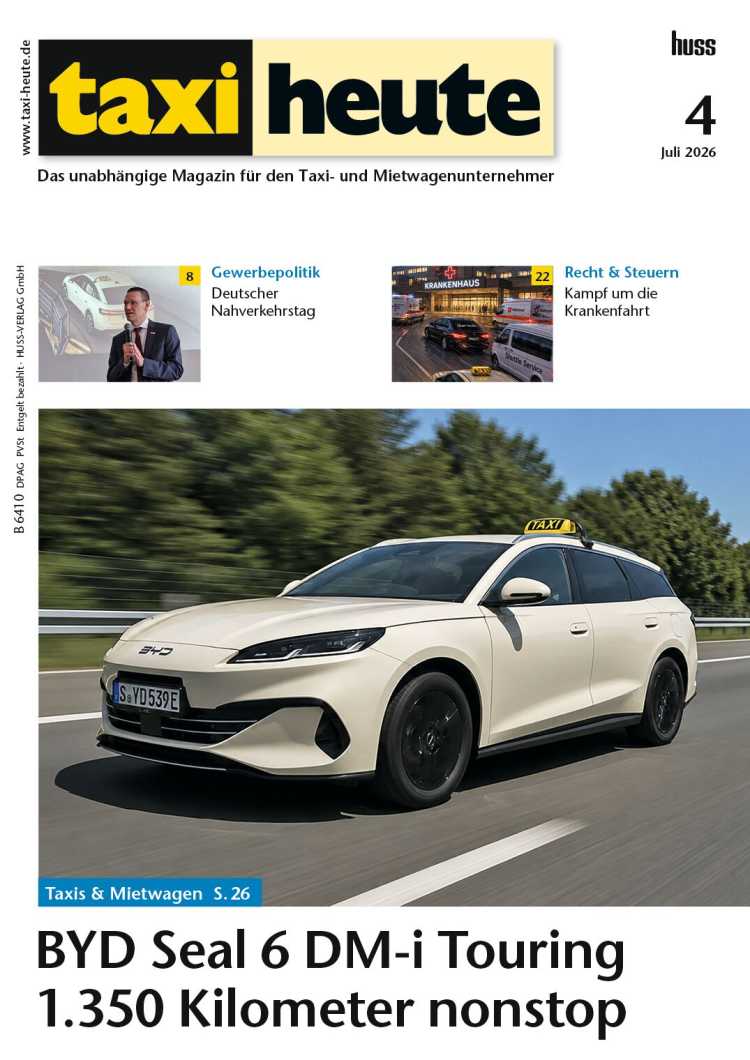
2 Ausgaben kostenlos für Sie

Fachmagazin taxi heute: Ihr Zugang zu exklusiven Inhalten rund um die Taxi- und Mietwagenbranche.
Aktueller Termin

Meist gelesen
Autonomy, Public-Transport Taxi and New Leadership – A Look Back at the German Taxi and Rental Car Day 2025 in Erfurt

The organizers of the Federal Association of Taxi and Rental Cars (BVTM) opted for a packed program: 16 panels, two workshops, a broad industry exhibition, and a debate format in which concerns about the future and new business models found space in equal measure.
Autonomous Driving: Between Experiment and Reality
Even the opening panel showed how strongly the industry is aligning with global trends. Prof. Dr. Andreas Knie (WZB), Dr. Lea Decker (New Mobility Solutions) and Rainer Becker (MOIA) drew the arc from Chinese and US projects to the European testing landscape. For while autonomous vehicles overseas have long been in regular operation, Europe remains a field of experimentation. Becker surprised with the clear statement that MOIA intends in the future not to operate the business themselves, but to offer software and vehicles – the autonomous ID. Buzz – on a licensing basis.
The question of what role taxi companies could play in such a model in the future was picked up by a workshop later in the day. There it was about interfaces, business models and the question of whether autonomous systems would become partners or competitors of taxis.


Parallel Worlds: Fare Corridors, Public-Transit Taxi, and Specialist Knowledge
Parallel to the future topic of autonomy, other participants discussed the tariff corridors. Since the PBefG amendment of 2021, municipalities can permit fixed prices. Representatives from Munich, Berlin, Frankfurt and other cities reported local interpretations that could hardly be more different. The debate repeatedly revolved around congestion times: How can they be reflected in the fixed price, without driving customers away or taking drivers' earnings?
In the ÖPNV taxi, a 90-minute panel demonstrated the political dynamics the topic has taken on. The North Rhine-Westphalia FDP politician Christof Rasche explained why his faction wanted the model anchored in law. A software provider from Luxembourg, a transport association from Lusatia, and René Zach from Weißwasser added perspectives. Afterwards, a workshop deepened the technical and legal questions—with contributions from practice, for example from the Aschaffenburg entrepreneur Benjamin Schmidt, who described his shared-taxi model 'Carl E'.
Another field moved the industry: the 'small professional qualification.' Its planned abolition had Hamburg blocked. The result is a permissive rule that states can use at their own discretion. Hamburg and Berlin want to join. Dirk Ritter of the Hamburg taxi supervisory authority reminded the trade that quality cannot be controlled by authorities alone.


TSE and Digitization: The Struggle for the Deadline
On the topic of TSE (Technical Security Device), things were more matter-of-fact. In a panel, manufacturers such as Hale presented their solutions. The experts agreed: Anyone who has not yet retrofitted will hardly be able to meet the deadline of January 1, 2026. Early retrofitters, for their part, expressed satisfaction. Robert Abel (FMS) and Holger Kampmann (MPC) outlined the technical status, while the discussion repeatedly returned to practical hurdles of day-to-day operation.
Non-emergency medical transport, school transport and the search for order
That non-emergency medical transport is a multi-billion market was underscored by industry expert Gisela Spitzlei with sober figures: €2.1 billion flows annually into this category. Panels on the future of non-emergency medical transport and school transport showed how high the pressure for digitization is. Software providers FMS and Stadt.Land.Netz explained solutions for automated processes and spoke of savings potential in the mid double-digit percentage range.
At the same time, it became clear that competition is increasing—not least due to specialized platforms such as Qrago or Uber Health. Industry magnate Jens Marggraf reported on his idea of a joint platform, with which the trade could present itself in a united front.
Participation, Demography and the Growing Need for Wheelchair Taxis
A socially charged panel focused on public services and participation. Erol Celik (Transform) discussed with Martin Maubach (Social Association) and Gisela Spitzlei about the need for inclusive offerings. The aging population, according to the tenor, will continue to drive up the demand for wheelchair taxis. Funding programs are important, but in many places they are not enough.
Matching this, retrofitters on the outdoor area presented several vehicles: VW models with TriflexAir system floor, Caddy and Touran conversions, and an accessibility-enabled Crafter. The manufacturers VW, Dacia, Renault and Honda also unveiled new models for taxi use – a novelty, as the vehicle presentations of this scope were held for the first time directly in front of the exhibition grounds.
Fleet Electrification: From Practice to Practice
With Jan Grupe from Hamburg and Bodo Siegel from Roxheim, two entrepreneurs who have been driving electric for years shared real operating experiences. They were supported by Dr. Mark-Steffen Walcher (SmartLab), who as backend operator and biller explained the technical side. The interest was high, not least because policymakers are driving the shift to propulsion forward.
Taxi Dispatch Centers Between Tradition and Platform Logic
Things grew more emotional on the second day with the panel “Taxi Dispatch Centers in Competition and the Survival Struggle.” On stage: the dispatch center heads from Frankfurt, Cologne and Stuttgart, as well as Alexander Mönch from Freenow by Lyft. The relationship between platform and traditional dispatch centers remained controversial. For some Freenow remains competition, for others a potent partner. Several examples showed how differently cities handle the networking of analog and digital taxi operations.
Another panel addressed the question of whether dispatch centers can have a future at all. Michael Weiss (FMS) presented software strategies, while the young entrepreneurs Lukas Kleinecke and Rahman Tamiz voiced their clear stance: A modern taxi can endure – if it is taken seriously as a product and organized in a contemporary way.
Minimum Fare: Who Benefits?
The discussion about minimum tariffs for rental cars produced a result that surprised many: The regulation primarily benefits taxi companies, but less so the dispatch centers. Herwig Kollar, the outgoing president of BVTM, discussed with industry representatives from Heidelberg and Hamburg the limits and opportunities of such a charge – and which tariff models could be viable in the future.
Industry Exhibition: Chats in the Aisles
For sponsors, the breaks between panels were the most important stage. Fuel card providers Aral and Shell, insurers like Signal Iduna, TSE specialists, vehicle manufacturers and software companies used the time for conversations. Visitors could assess novelties, test apps, compare insurance models or evaluate retrofits. Volkswagen was also present as a main sponsor.
General Assembly and Presidential Election
The third day was dedicated to association business.As part of the general assembly, Gregor Beiner (39) from Munich was elected the new president of the association. Beiner thus succeeds Herwig Kollar at the head of the national association, who in turn was elected to the post in 2021. At the same time, Bärbel von Teuffel was appointed as the new vice president, thereby taking over the responsibilities from Hermann Waldner going forward. Wolfgang Oertel remains as the third member of the presidency at the association's top. Four members were also newly elected to the federal board. Going forward, the board includes: Daniel Schwuchow (Thuringia), Günsel Yildirim (Berlin), Hans-Peter Kratz (Hesse) and Aleksandar Dragicevic from Taxiruf Köln, who was confirmed in his office. In the public portion, the leadership informed about projects, positions and the state of the industry.
Taxi Days That Inspire Courage
BVTM managing director Michael Oppermann expressed satisfaction: The meeting has developed into a central place for exchange. The industry presents itself confidently, in his assessment. Open, constructive, determined – qualities that many participants felt that day. Whether this will lead to a real renewal will become evident in the coming years. But Erfurt showed: the industry is ready!
Content automatically translated.





Taxi-Fahrzeuge (Pkw) , Taxi-Newsletter, Taxameter, Taxi-Fahrer , BZP – Deutscher Taxi- und Mietwagenverband , Straßenverkehrsordnung (StVO) , Krankenbeförderung , Weiterbildung , Taxi-Konzessionen , Verkehrspolitik , Mietwagenbranche , Taxi-Apps , Berufskraftfahrer-Qualifikations-Gesetz BKrFQG) , Taxizentralen , Personal, Gehälter, Arbeitsschutz , Wirtschaftsnachrichten , Werbung , Taxi-Folierung , Taxi-Umrüster , Straßenverkehr , Elektromobilität, Taxifuhrpark und -flottenmanagement , Taxi-Versicherungen , Hybrid, Diesel, Erdgas , Taxi-Magazin