Ihr kostenloser Branchen-Newsletter

Lassen Sie sich von unseren Fachjournalisten einmal wöchentlich über die wichtigsten aktuellen Entwicklungen der Taxi-Branche informieren, bequem direkt in Ihre Mailbox.
Aktueller Termin

Meist gelesen
VSPV-Standard 101 lays the groundwork for integration into public transport apps.
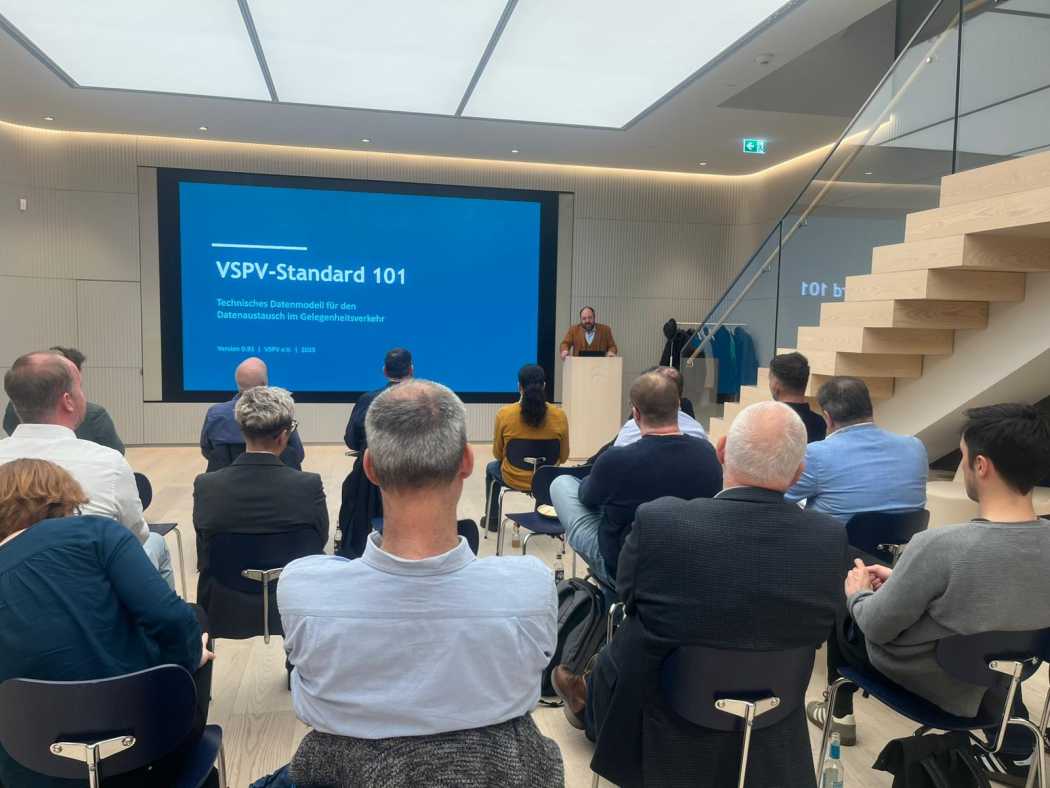
The VSPV Standard 101 is to be adopted this year as Version 1.0. At a stakeholder conference on 19 March 2026 at the NIO House Düsseldorf, the NRW Association of Private Commercial Road Passenger Transport e.V. initiated the final voting phase. At the same time it was announced that the association is now an associated partner in the mFUND-funded federal ODIN-MP project.
The Standard 101 is, according to the association, the first uniform, NeTEx-based technical data model for data exchange across the entire on-demand transport. It covers taxi and rental car services under Paragraphs 47 and 49 of the Passenger Transport Act, demand-responsive services under Paragraphs 42 and 44a of the Passenger Transport Act, and medical transport.
Development from the SDGV project
The basis is the technical data model from the project "Standardization of Data Exchange in On-Demand Transport", which was developed between 2022 and 2024 under the leadership of the Rhine-Ruhr Transport Association (VRR) together with DELFI and the VSPV. The state of North Rhine-Westphalia funded the project with €126,000.
The VSPV transferred this model into a 192-page technical specification. The pre-version 0.91 was publicly presented for the first time on 20 September 2025 at the 2nd Westphalian Taxi and Hire Car Day in Holzwickede before around 200 guests. With the conference in Düsseldorf, concrete coordination with system providers, responsible authorities, cost bearers and consortia begins now.
Three integration levels
The standard defines three levels of connectivity. In the first level static network and timetable data are provided via NeTEx to make ad-hoc transports visible in information systems. Level two adds parameterized booking links with single sign-on redirection. The third level envisages deep integration via the TRIAS interface and REST programming interface, including real-time dispatch as well as end-to-end information, booking and payment processes.
Three application areas
The VSPV standard 101 addresses, according to the association, three central application areas. First, the integration of taxi and rental car offers into applications of the transport associations to map intermodal travel chains. Second, standardized dispatch by emergency control centers, for example for stretcher transport vehicles or wheelchair-accessible transport vehicles. Third, the digital depiction and billing of patient transports via an XML extension that electronically integrates prescriptions.
The background is a hitherto heterogeneous system landscape in the on-demand transport sector. While line service in public transportation uses standardized data models, industry-wide uniform data exchange formats for taxi, rental cars and on-demand transports have so far been lacking. According to the association, around 80 percent of smartphone users have at least one public transport application installed.
ODIN-MP as technical adapter
In the framework of the conference, DELFI presented the project “Overarching Provision of OnDemand Mobility in Mobility Platforms.” The project is supported by the Federal Ministry of Transport within the framework of the mFUND funding measure with around €1.6 million. The total volume is around €3 million, and the duration runs from October 2024 to September 2027.
The goal is the development of a nationwide deployable adapter that integrates non-line-bound (on-demand) traffic into information and booking systems of public transport. The architecture includes the National Access Point for Mobility Data, the DELFI integration platform, the platforms of the transport associations, and the ODIN adapter as an interface to transport companies. Demonstrators are planned in the Berlin-Brandenburg and Rhine-Ruhr joint areas.
With its admission as an associated partner, the VSPV is integrated into the project committees. The association represents, according to its own statements, around 800 member companies with approximately 6,000 vehicles and around 10,000 employees. Since the beginning of 2026 it has maintained its own head office in Berlin.
Broad participation in Düsseldorf
Despite a concurrent strike in public transport in North Rhine-Westphalia, numerous representatives from associations, transport associations, data platforms, consulting firms and system providers attended the conference. Represented were, among others, the Bundesverband Taxi und Mietwagen, the Taxi- und Mietwagenverband Deutschland, the Verkehrsverbund Rhein-Ruhr, DELFI, the Mobilitätsdatenportal Nordrhein-Westfalen, as well as various software and billing providers.
Outlook
Version 1.0 of the VSPV standard 101 is slated to be adopted in 2026. In parallel, demonstrators are being built as part of ODIN-MP to practically test the standard-based integration of on-demand transport. A further technical platform is provided by the 5th DELFI Conference on 28 and 29 April 2026 in Berlin, which is expected to attract around 250 industry professionals. (Source: VSPV)
Content automatically translated.


Taxi-Fahrzeuge (Pkw) , Taxi-Newsletter, Taxameter, Taxi-Fahrer , BZP – Deutscher Taxi- und Mietwagenverband , Straßenverkehrsordnung (StVO) , Krankenbeförderung , Weiterbildung , Taxi-Konzessionen , Verkehrspolitik , Mietwagenbranche , Taxi-Apps , Berufskraftfahrer-Qualifikations-Gesetz BKrFQG) , Taxizentralen , Personal, Gehälter, Arbeitsschutz , Wirtschaftsnachrichten , Werbung , Taxi-Folierung , Taxi-Umrüster , Straßenverkehr , Elektromobilität, Taxifuhrpark und -flottenmanagement , Taxi-Versicherungen , Hybrid, Diesel, Erdgas , Taxi-Magazin