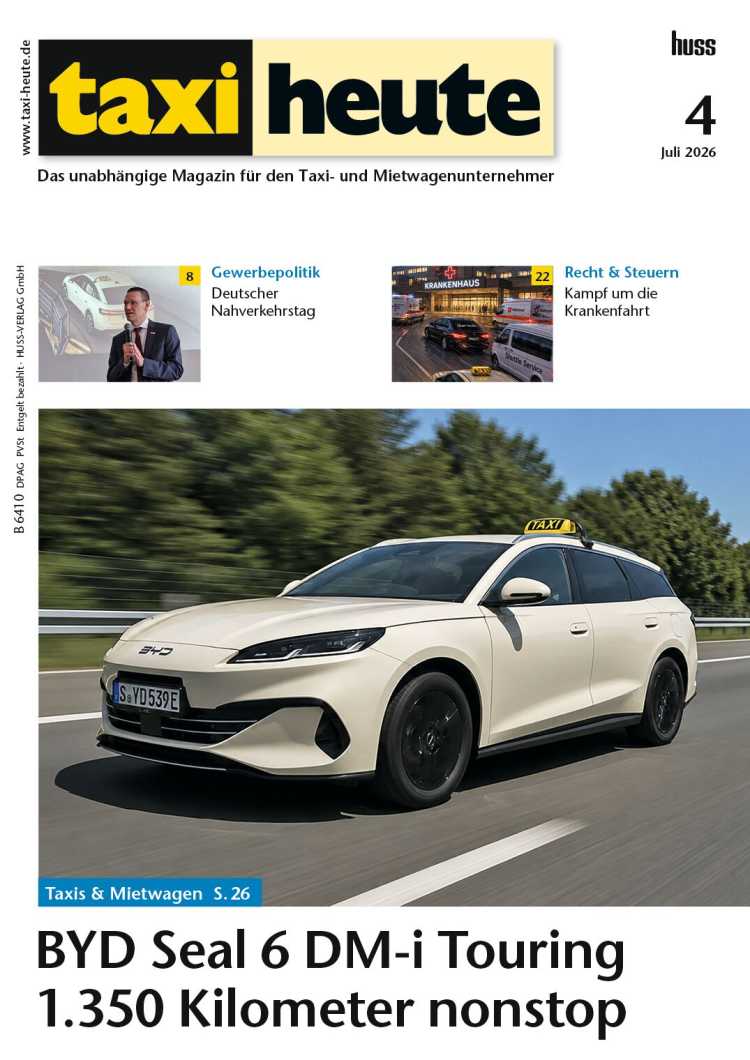
2 Ausgaben kostenlos für Sie

Fachmagazin taxi heute: Ihr Zugang zu exklusiven Inhalten rund um die Taxi- und Mietwagenbranche.
Aktueller Termin

Meist gelesen
Securing the future, not standing still: The Westphalian Taxi and Private Hire Day 2025 in Holzwickede

Around 200 guests came to the second Westphalian Taxi and Private Hire Day, invited by the Association of Private Commercial Road Passenger Transport of North Rhine-Westphalia (VSPV).
Right at the opening by association chairman Jörg Füchtenschnieder, it became clear: this was not only about discussion, but above all about providing guidance and motivation. Managing director Sascha Waltemate put it plainly:
"The taxi is not a dying model. It is the flexible, regulated, quality-assured workhorse of passenger transport—from the village to the city center."
His appeal was unequivocal: those who rest on tradition will lose. Those who, by contrast, seize the opportunities of standards, connectivity and digitalization can stabilize their business—and even open up new areas.
Data as the key—the VSPV Standard 101
A central topic of the day was the newly developed VSPV Standard 101, a standardized data model for for-hire transport. For many taxi operators, "standardization" initially sounds like bureaucracy. But in Holzwickede it became clear: this is not about more obligations, but about greater reach and better visibility.
Up to now, it has often been difficult for health insurers, public transport associations or digital mobility platforms to integrate taxi and private-hire offerings seamlessly. Different interfaces, incompatible formats and a lack of binding specifications have prevented genuine integration. The new standard is intended to solve precisely this problem.


In practical terms, this means:
- More jobs: Medical transport rides can in future be commissioned directly from physicians’ office software or by health insurers via standardized interfaces.
- Better visibility: Passengers who search for connecting mobility in public transport apps see taxi offers where they are needed—without additional intermediaries.
- Simpler billing: fewer queries, less paperwork, because data are consistent and available digitally.
The symbolic handover of version 0.91 to representatives of DELFI, VRR, AOK, and MPC made it clear: the process has been set in motion; now the task is to actively involve the industry.
Politics and lobbying - between defensive struggle and a will to shape
Another focus was the federal political situation. Moderated by Waltemate, TMV President Thomas Kroker, Vice President Jörg Füchtenschnieder, and Head of Office Nico Höttges discussed the umbrella association’s current initiatives in Berlin.
The challenges are well known: international platform providers are pushing into the market with multi-billion budgets, while local entrepreneurs have to operate under strict regulation. The demand for fair competition therefore remains high on the agenda. But topics such as billing for medical transport rides, the future of the Passenger Transport Act, and the role of private hire vehicle operators as competitors were also on the table.
The presentation of a new brochure on billing for medical transport rides, intended as a practical aid, attracted particular interest. Kroker emphasized: “We want every entrepreneur to know their rights and how to assert them.” Smaller companies in particular often find themselves at a disadvantage vis-à-vis the health insurers.


For the operators in the room, this discussion was more than a theoretical sparring match: it showed that the association not only reacts but also drives initiatives—and that persistence in Berlin can pay off.
Automation in the association – a model for operators?
A highlight of the day was the presentation of a project that concerns the VSPV itself—but is also highly relevant for operators. Together with the consulting firm Team GetCloser, the association is developing a system to digitise and largely automate the handling of the entire hearing process under Section 14(2) of the Passenger Transport Act (PBefG).
What sounds dry could be a real breakthrough. Until now, hearings on permits and complaints have consumed enormous amounts of time, both in the authorities and in the associations.
The new system relies on:
- AI-powered text recognition: Documents are automatically captured, structured and assessed.
- Geodata analysis: Locations, routes and operating environments can be examined digitally.
- Algorithmic decision recommendations: Routine cases can be handled automatically, while complex matters remain in the hands of the executive management.
For taxi operators, this means:
- Processes move faster, decisions become more transparent, and the association can focus more on strategic issues. Waltemate announced that he would roll out the system over the next six months—with the option of making it available to other associations later.
- Some participants wondered: Can something like this also be used in their own operations—for example, for documenting medical transport trips or in HR management? The message was clear: What is possible within the association can, in the medium term, also simplify entrepreneurs’ day-to-day work.
Trade fair, exchange and practical relevance
In addition to the stage program, a small but fine exhibition gave participants the opportunity to discover products and services for everyday operations. The spectrum ranged widely—from insurers and software firms to manufacturers of e-taxis and conversion specialists for accessible vehicles.
Particularly in demand were solutions that ease the balancing act between new legal requirements and economic reality. One software provider showcased an application that enables digital documentation and billing of medical transport trips—including an interface to health insurers. A vehicle manufacturer presented an electric taxi with everyday-usable range and charging infrastructure, while a conversion company demonstrated how vehicles can be made accessible while remaining economical.
The exchange with peers was at least as important. Conversations during breaks made it clear that many entrepreneurs are grappling with similar problems: rising costs, driver shortages, ever-new regulations. That’s precisely why Taxi and Rental Car Day was seen as a welcome opportunity to look for solutions together—and to draw courage.
Supporting program and atmosphere
Aside from the specialist topics, there was no shortage of camaraderie. A food truck served currywurst, fries, and vegan alternatives. Drinks were served at the open bar. The event was family-friendly as well: a bouncy castle kept the youngest guests entertained while the adults could focus on the panels.
The relaxed atmosphere did nothing to detract from the seriousness of the topics—quite the opposite. Many entrepreneurs reported that it was precisely this mix of expert input and personal exchange that made Taxi and Rental Car Day especially valuable.
From talk to action
In the end, the organizers drew a positive conclusion. The Westphalian Taxi and Rental Car Day, they said, has established itself as a fixture in the industry calendar. For the entrepreneurs in the room, one insight stood out above all: The industry is in the midst of upheaval—but it is not powerless.
With standards such as VSPV-101, clear lobbying in Berlin, and bold digitalization projects, room for maneuver can be expanded. What will be decisive is whether entrepreneurs seize the opportunities on offer. Because only those who remain visible, are digitally interoperable, and organize political backing will be able to compete with platforms and alternative mobility offerings.
Or, as Waltemate put it at the end:
“We have to get out of a defensive posture. Not just react, but actively shape things ourselves. From talk to action—that is our path.”
Source: Vspv
Content automatically translated.



Taxi-Fahrzeuge (Pkw) , Taxi-Newsletter, Taxameter, Taxi-Fahrer , BZP – Deutscher Taxi- und Mietwagenverband , Straßenverkehrsordnung (StVO) , Krankenbeförderung , Weiterbildung , Taxi-Konzessionen , Verkehrspolitik , Mietwagenbranche , Taxi-Apps , Berufskraftfahrer-Qualifikations-Gesetz BKrFQG) , Taxizentralen , Personal, Gehälter, Arbeitsschutz , Wirtschaftsnachrichten , Werbung , Taxi-Folierung , Taxi-Umrüster , Straßenverkehr , Elektromobilität, Taxifuhrpark und -flottenmanagement , Taxi-Versicherungen , Hybrid, Diesel, Erdgas , Taxi-Magazin