Ihr kostenloser Branchen-Newsletter

Lassen Sie sich von unseren Fachjournalisten einmal wöchentlich über die wichtigsten aktuellen Entwicklungen der Taxi-Branche informieren, bequem direkt in Ihre Mailbox.
Aktueller Termin

Meist gelesen
Which mode of transport is the safest? An overview of all modes of transport and how safe they are.

Table of Contents: Navigate effortlessly through the following informative article on the topic "Which Mode of Transport is the Safest?", click to jump to the corresponding mode of transport and return here to the index at the end of each mode with just a click.
How safe is the mode of transport:
Bus
Statistical Safety of Bus Traffic
- Low accident rate: According to Allianz pro Schiene, an average of 0.13 people per billion passenger kilometers are killed in buses in Germany, while in cars it is 1.57 people.
- Low risk of fatality: According to statistics, the risk of dying in a bus is far lower than that in a car.
Source: Allianz-pro-schiene.de
Why are buses so safe?
- Size and weight: Buses are heavier and more stable than cars, providing better protection for passengers in collisions.
- Professional drivers: Bus drivers undergo specialized training and drive more defensively than many private car drivers.
- Modern safety measures help prevent accidents:
- Electronic stability control (ESP), emergency braking assistants, rollover protection systems, automatic lane-keeping assistants, strict legal safety regulations, blind spot assistant/lane change assistant


- Lower speed: City and intercity buses usually travel at moderate speeds, which reduces accident risk, and the maximum speed is also limited on highways.
Risks and Challenges
Despite the high level of safety, there are also some risks:
- Accidents caused by other road users: Many bus accidents are caused by errors of others, particularly on highways or in cities.
- Lack of seat belts: In many buses (especially city buses), there is no seatbelt requirement. This can be dangerous in severe accidents.
- Bus stations and stops: Pedestrian accidents at stops or bus stations are a risk not to be underestimated.
- Driver fatigue or errors: Even though bus drivers are trained, long driving times and stress can lead to errors.
Comparison: City Bus vs. Coach
- City buses are very safe, but the frequent stopping and heavy traffic present a higher accident risk than on long-distance routes.
- Travel and intercity buses often have more safety measures (seat belts, sturdier bodies) and travel on highways, which is less dangerous than city traffic.
Conclusion: Buses are one of the safest modes of transportation
- The risk of a severe accident is relatively low.
- Bus travel is mostly safer than driving, especially on long distances.
- Modern technology and professional drivers contribute to high safety.
- Important for passengers: use seat belts (if available) and be careful at stops when disembarking, transferring, and boarding.
Source: Destatis.de
Rail
Statistical Safety of Rail Transport
-
Low accident rate: The railway is considered the safest mode of ground transportation in Germany.
-
Comparison with other modes of transport: In the European average, 2.5 car occupants die per billion passenger-kilometers, while for rail passengers it is only 0.07 fatalities. In Germany, this figure is even 0.03 fatalities per billion passenger-kilometers.
Source: allianz-pro-schiene.de
Reasons for the High Safety of Rail
-
Modern control and safety systems: Rail traffic is monitored by comprehensive control systems that minimize human error.
-
No oncoming traffic: There is no oncoming traffic on rails, railroad crossings are secured, which reduces the risk of head-on collisions.
-
Construction and strict safety standards: The railway is subject to very high safety regulations and regular inspections by authorities such as the Federal Railway Authority. Additionally, a train is built extremely robustly.
Source: mobiltree.net, eisenbahn-unfalluntersuchung.de
Detailed Accident Statistics
-
Casualties: In 2022, there were 490 accidents with personal injury in German rail transport, resulting in 927 casualties, including 170 fatalities.
-
Long-term comparison: Between 2009 and 2018, an average of 0.04 travelers per billion passenger-kilometers were killed in rail accidents, compared to 1.86 in car accidents.
Source: destatis.de, besserweiter.de
Challenges and Risk Factors
-
Railroad crossings: Accidents at railroad crossings pose an increased risk. In 2023, the number of fatalities at railroad crossings even reached the highest level since 2010. In over 97% of the cases, however, misconduct by (other) road users was the cause.
-
Safety at stations: Although rail travel itself is a safe mode of transport, there may be safety concerns at stations. In 2023, 25,640 violent offenses were registered on railway facilities, an eleven percent increase over the previous year.
Source: bild.de, tagesschau.de
Conclusion: Rail as a Safe Mode of Transport
-
Low accident risk: Rail travel in Germany and Europe is associated with a very low accident and injury risk, and rail is the safest ground transportation mode.
-
Safety awareness: Despite the high level of safety, passengers should always remain vigilant at railroad crossings and stations and follow safety instructions.
Airplane
Statistical Safety of Air Travel
-
Extremely low accident rate: In 2023, almost 96 million flight movements with 8.7 billion passengers were recorded worldwide. Despite this high volume, the accident rate remains extremely low. A plane crash is an extremely rare event. However, should it occur, the chances of survival are, unfortunately, extremely low in most cases.
-
Comparison with other modes of transportation: Studies show that flying is safer than all other means of transport. For example, the likelihood of dying in a plane crash is only about 1 in 13.7 million.
-
Lightning strike vs. plane crash: The probability of being struck by lightning in a year is 1 in 1.2 million—that is, roughly speaking, you are more likely to be struck by lightning ten times than to be involved in a plane crash as a passenger.
Source: thescottishsun.co.uk
Development of Air Safety
-
Continuous improvement: Over the past decades, the safety of air travel has steadily increased. Between 1968 and 2022, the fatality rate fell by 7.5 percent annually, despite increasing flight numbers.
-
Technological advancements: Modern aircraft are equipped with advanced safety systems that further minimize the risk of accidents. From the ground up, relevant systems in aircraft are highly redundant, so the failure of a critical component does not lead to an acute incident.
Source: thescottishsun.co.uk, magazin.passengersfriend.com
Regional Differences in Air Safety
-
High safety standards in Europe and North America: In regions like the EU, the USA, and Canada, the risk of a fatal air accident is the lowest.
-
Higher accident rates in other regions: In the CIS region (Commonwealth of Independent States), for example, there were 1.18 aircraft losses per one million flights in 2022, the highest worldwide.
Source: thescottishsun.co.uk, de.statista.com
Factors Contributing to Air Safety
-
Strict maintenance protocols: Every component of an aircraft undergoes regular and thorough inspections to ensure safe operation.
-
Redundant systems: Many onboard systems are duplicated, so if one system fails, it can be compensated by another.
-
Extensive personnel training: Pilots, crew members, and ground staff undergo intensive training and regular sessions to work efficiently and error-free and to be prepared for various emergency situations.
Source: magazin.passengersfriend.com
Conclusion: Air Travel as the Safest Mode of Transport
-
Very low accident risk: Statistics show that flying is statistically the safest mode of transport.
-
Continuous advancement: Through continuous improvements in technology and training, air safety is continuously optimized.
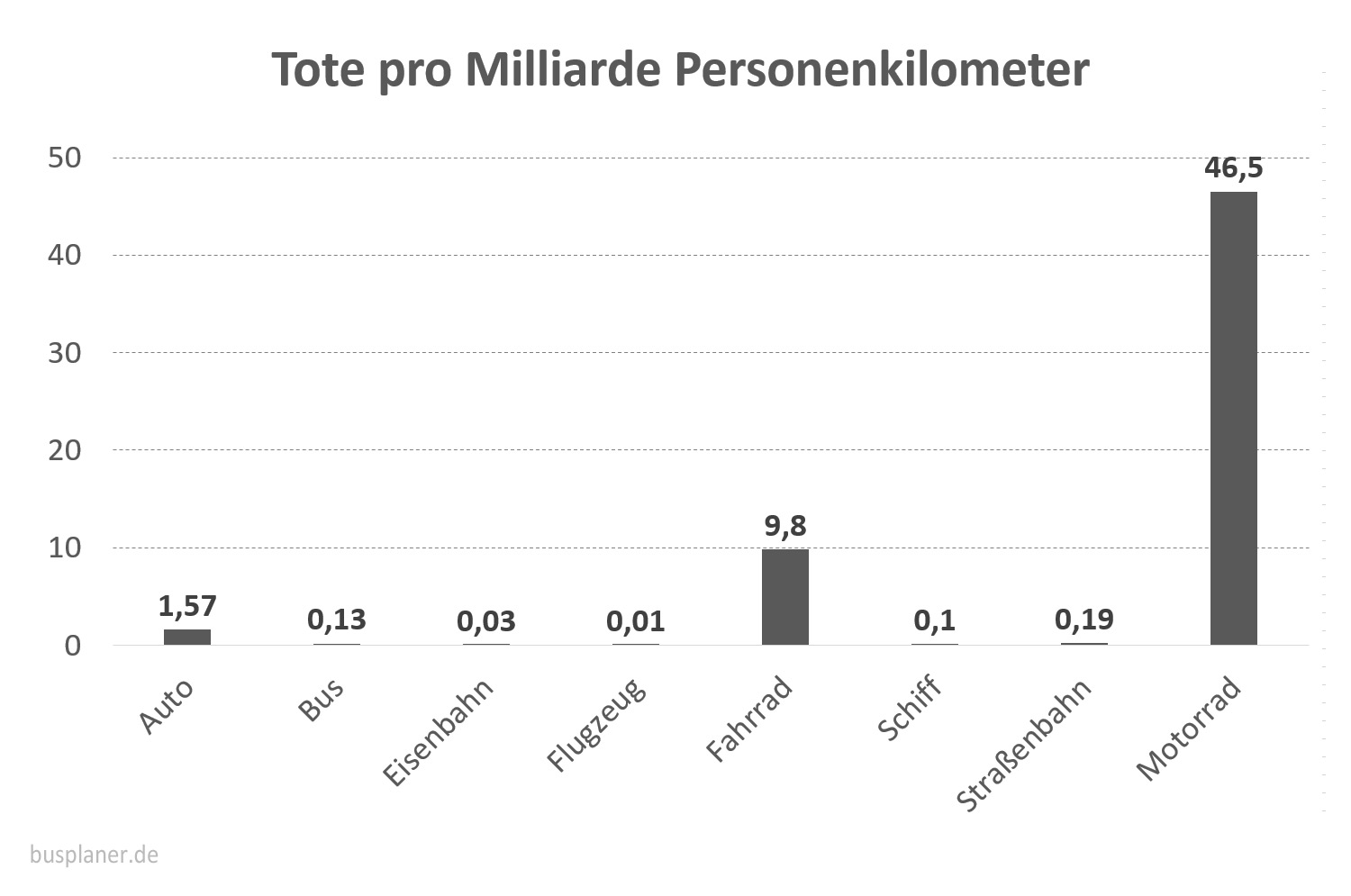
This graphic shows the number of deaths per billion passenger-kilometers for all common transport modes. At a glance, the safe modes of transport (deaths less than 1) and the comparatively less safe ones (deaths greater than 1) are recognizable. | Graphic HUSS-VERLAG, busplaner
Car
Statistical Safety of Car Transport
Highest accident rate among transport modes: The car is considered the least safe compared to other modes of transport. In Germany, about two people die, and 240 are injured per billion passenger-kilometers.
Comparison with other modes of transport: The risk of dying in a car is 56 times higher than on the railway; the risk of injury is even 133 times higher.
Source: t-online.de
Development of Traffic Safety in Road Transport
Long-term decline in road fatalities: Since the 1970s, the number of road fatalities in Germany has significantly decreased. While over 100 road fatalities per 100,000 vehicles were recorded in 1970, this value fell below five from 2020 onwards.
Current figures: In November 2024, there were 199 road fatalities registered in Germany, a decrease of 12 people compared to the same month last year.
Source: de.wikipedia.org, destatis.de
Factors Affecting Safety in Car Traffic
Driver assistance systems: Modern vehicles are equipped with technologies such as fatigue detection and blind-spot monitors, which help to prevent accidents. Since July 2024, many of these systems are mandatory in new vehicles. Serious injuries are also prevented by airbags and other emergency safety measures.
Seat belt law: Wearing seat belts has been mandatory in Germany since the 1970s and has significantly contributed to the reduction of fatalities and serious injuries.
Source: adac.de, bild.de
Human error: A large proportion of accidents are caused by driver errors, such as distraction, excessive speed, violations of rules, or driving under the influence of alcohol.
Regional Differences in Germany
Accident frequency by federal states: In 2023, Schleswig-Holstein recorded the most accidents per capita (3.95 per 1,000 inhabitants), while Thuringia had the fewest accidents at 2.45 per 1,000 inhabitants.
Urban vs. rural areas: The accident rate tends to be higher in urban areas due to higher traffic volumes and population density, while accidents on rural roads are often more severe.
Source: allianzdirect.de
Measures to Improve Safety in Car Traffic
Infrastructure improvements: The expansion of safe roads, roundabouts, and clear signage can reduce the risk of accidents.
Traffic education and enforcement: Information campaigns and intensified controls, for example, to ensure compliance with speed limits and to prevent drunk driving, contribute to increased road safety.
Technological advancements: The introduction of autonomous vehicles could minimize human error in the long term and further reduce the number of accidents.
Source: welt.de
Conclusion:
Although the number of road fatalities has significantly decreased in recent decades, the car remains the mode of transport with the highest risk of accidents and injuries compared to others. Thanks to technological advancements, infrastructural measures, and increased traffic education, road safety can continue to be improved.
Motorcycle or Moped
Accident Statistics and Risk Assessment
Motorcycle and moped riders are among the most vulnerable road users. In 2024, there were 7,024 accidents involving motorized two-wheelers in Bavaria, resulting in 1,525 serious injuries. 99 people died, a slight decline compared to the 103 fatalities the previous year. The motorcycle season in the summer months is particularly dangerous, with most accidents occurring in July.
Source: bild.de
Safety Measures and Prevention
Helmets are legally required for moped and motorcycle riders. Protective clothing, gloves, and armor are strongly recommended to reduce severe injuries in accidents. Modern safety systems like ABS (anti-lock braking system) help to increase stability in dangerous situations.
Source: adac.de
Risks in Road Traffic
In addition to illegal behavior, there is a particular danger in traffic jams: weaving between stationary cars or using the shoulder is prohibited and may result in fines and points. Unauthorized use of the emergency lane poses a high accident risk and is illegal.
Source: bild.de
Education and Road Safety
A good education is essential for safety on the road. The moped license can be obtained at the age of 15 and includes theoretical and practical learning units. Motorcyclists additionally benefit from driver safety training to better master critical situations.
Source: adac.de
Conclusion: Safe Riding on Two Wheels
Motorcycle and moped riding have a higher accident risk than other transport modes, but the risk can be significantly minimized by adopting a defensive, law-abiding driving style, appropriate protective equipment, and driver safety training. It is particularly important to adhere to traffic rules and be aware of dangerous situations to arrive safely at the destination.
Tram
Low accident rate: The tram is one of the safest modes of transportation in urban areas. Although it often shares the road with other users, the accident rate is significantly lower compared to cars or bicycles.
Comparison with other modes of transport: Statistics show that per billion passenger-kilometers, there are significantly fewer fatal accidents involving trams compared to motorized individual transport. While the risk is higher for car occupants, the tram remains a very safe means of transport due to fixed travel routes and technical safety measures.
Source: destatis.de, uestra.de
Reasons for the high safety of trams
Technical safety systems: Modern trams are equipped with emergency brake assistants, automatic signal systems, and surveillance cameras to avoid accidents and enable quick reactions in case of danger. Additionally, trams are built very robustly, and passengers sit elevated compared to other road users.
Dedicated tracks: In many cities, trams travel on separate tracks or lanes, reducing the risk of accidents with motorized traffic. At stops, structural measures ensure higher safety when boarding and alighting.
Strict regulations: Tram operators are subject to high safety requirements, ensured through regular maintenance and inspections. Drivers receive comprehensive training to minimize risks.
Source: vdv.de, stadtverkehr.de
Detailed accident statistics
Personal injuries: In 2022, there were around 1,200 tram accidents in Germany, most of which were caused by other road users. Several hundred people were injured, but the number of fatalities remains low compared to car and bicycle traffic.
Long-term comparison: While the number of tram accidents with personal injury has remained relatively constant over the years, technical improvements, and safety campaigns contribute to a continued risk reduction.
Source: destatis.de, unfallatlas.de
Challenges and risk factors
Intersections with road traffic: Most tram accidents occur at unsecured intersections with individual traffic. Many cases are caused by disregarding the right of way or inattention by car drivers.
Safety at stops: Passengers should always beware of flowing traffic when entering and exiting the tram, particularly when there are no separate platforms. Some cities have already implemented structural measures to improve stop safety.
Source: stvo.de, unfallforschung.de
Conclusion: The Tram as a Safe Mode of Transport
High safety standards: The tram remains an extremely safe means of transport, and in the city, the safest, with low accident risks due to modern technology and strict regulations.
Attention in traffic: Despite the high safety, both passengers and other road users should always observe traffic rules and be cautious, especially at intersections and stops.
Source: vdv.de, stadtplanung.de
Bicycle
Low accident rate: Cycling, whether with an e-bike, pedelec, or e-fahrrad, is a popular and environmentally friendly means of transport. However, the accident rate is higher compared to motorized vehicles. In 2023, 256 cyclists and 190 pedelec riders were fatally injured in Germany.
Source: de.statista.com
Comparison with other modes of transport: Statistics show that cyclists are at higher risk in traffic compared to car occupants or public transport users. While the risk for car occupants is lower, the bicycle, e-bike, pedelec, or e-fahrrad remains a popular mode of transport due to its flexibility and environmental friendliness.
Source: de.wikipedia.org
Reasons for the frequency of bicycle accidents
Technical safety measures: Modern bicycles are equipped with effective braking systems, lighting, and reflectors to increase visibility and safety. However, advanced assistance systems, which are standard in motor vehicles, are often lacking.
Source: bgetem.de
Infrastructure: In many cities, cyclists share the road with motorized traffic, increasing the risk of accidents. Separate bike lanes and dedicated cycling paths could greatly enhance safety.
Source: acv.de
Traffic education and regulations: Although there are clear traffic regulations for cyclists, there is often a lack of knowledge or compliance. More intensive training, increased enforcement, and awareness could help reduce accidents.
Source: adac.de
Detailed accident statistics
Personal injuries: In 2023, approximately 70,900 people in Germany were injured on non-motorized bicycles, including 256 fatalities. Pedelec accidents resulted in 190 fatalities.
Long-term comparison: While the number of conventional bicycle accidents has slightly decreased in recent years, there is an increase in pedelec accidents. Technical improvements and safety campaigns are contributing to an overall risk reduction.
Source: destatits.de
Challenges and risk factors
Intersections with motorized traffic: Collisions between cyclists and motor vehicles frequently occur at unsecured intersections. Causes are often inattention or failure to yield.
Source: de.wikipedia.org
Safety on rural roads: Cyclists are often overlooked on rural roads, leading to serious accidents. On average, there are four fatalities and 58 severely injured cyclists on German rural roads each week.
Source: mdr.de
Conclusion: Cycling and Traffic Safety
Although the bicycle, e-bike, pedelec, or e-fahrrad is an environmentally friendly and health-promoting means of transport, there is an increased risk of accidents compared to other modes of transport, not only in urban areas. Through the expansion of safe infrastructure, enhanced traffic education, and compliance with traffic regulations, cyclist safety can be significantly improved.
Ship
Low Accident Rate
Commercial shipping is considered one of the safest transport modes in international traffic. Particularly large passenger and cargo ships have an extremely low accident rate.
Comparison with Other Modes of Transport
According to data from the International Maritime Organization (IMO) and the European Maritime Safety Agency (EMSA), the death rate in shipping is 0.1 fatalities per billion passenger-kilometers. In comparison, approximately 2.5 car occupants die per billion passenger-kilometers worldwide.
Reasons for the High Safety of Shipping
- Modern navigation and safety systems
- Modern ships are equipped with radar systems, GPS navigation, and automated warning systems to help avoid collisions.
International Safety Standards
The International Convention for the Safety of Life at Sea (SOLAS) sets worldwide safety standards for ships, including:
- Emergency measures
- Evacuation plans
- Fire and leak prevention systems
Slow speeds and controlled routes
Ships move relatively slowly, reducing the risk of accidents. There are also designated shipping routes and traffic monitoring systems in busy areas like the English Channel or the Suez Canal.
Risks and Challenges of Shipping
Despite high safety standards, there are some risks:
- Weather-related hazards
- Storms, high waves, and icebergs are still risks, but modern weather forecasts minimize them.
-
Collisions and accidents
- Even though accidents are rare, collisions with other ships or obstacles can have severe consequences. A well-known example is the Costa Concordia disaster (2012).
-
Personnel errors
- Human error, whether due to poor decisions or fatigue, can lead to accidents. Therefore, there are strict working hours regulations for crew members.
-
Piracy in specific regions
- Particularly in waters off Somalia, the Gulf of Guinea, or the Strait of Malacca, pirate attacks are a risk, countered by international naval patrols.
Comparison: Cruise Ship vs. Cargo Ship
Cruise Ship
Safety measures: Highest standards (SOLAS, lifeboats, emergency drills)
Accident risk: Very low
Risk to passengers: Minimal, due to medical facilities onboard
Cargo Ship:
Safety measures: High standards, but fewer passenger safety systems
Accident risk: Slightly higher due to complex cargo
Risk to passengers: Higher for crew members due to occupational hazards
Conclusion: Shipping remains one of the safest modes of transport
- Low accident numbers despite millions of sea miles per year.
- Strict international safety regulations minimize risks.
- Modern technology and experienced crews contribute to high safety.
- However, there are challenges such as extreme weather, piracy, and human errors.
Sources: de.wikipedia.org, destatis.de
Summary & Conclusion: Which Mode of Transportation is the Safest?
The safety of modes of transportation varies depending on the means of movement, but the statistics show clear trends: The airplane, closely followed by the railway, is the safest mode of transportation. Ships, buses, and trams follow with a considerable distance but are still comparatively above average in terms of safety. The car, on the other hand, has already increased accident and injury risks, while the motorcycle is considered particularly risky and the least safe mode of transportation. Bicycles fall in terms of accident danger between cars and motorcycles and are, therefore, also in a significantly elevated risk category. An infographic of the overall situation with specific numbers (deaths per billion passenger-kilometers) is found further above in the article.
The airplane has by far the lowest accident rate. Despite millions of flights annually, fatal accidents are rare. Very strict safety regulations and surveillance, multiple redundancies of critical systems, modern technology, and professional pilots ensure that flying is extremely safe. However, the chances of survival, should an acute incident occur, are lower than with all other modes of transport.
The train is the safest means of transport on the ground. Thanks to modern signaling technology, extremely robust construction, the absence of oncoming traffic, and high safety standards, train travel is many times safer than car travel.
Shipping is considered one of the safest means of transport on the water. Thanks to modern navigation systems, strict safety regulations, robust ship constructions, and comprehensive emergency plans, ship travel is extremely safe. Thanks to international standards and technical innovations, the risk of serious accidents is low compared to other means of transport.
The bus is also a very safe means of transport, especially coach and long-distance buses. Due to the size, special training for drivers, and modern assistance systems, the risk of accidents is relatively low.
The tram is also among the safe means of transport, especially in urban traffic. Thanks to predetermined routes, robust construction, modern braking and warning systems, and lower speeds, serious accidents are rare. However, collisions can occur due to mixed traffic with other vehicles and pedestrians.
The car remains statistically the most unsafe means of transport. The high accident rate mostly results from human error, such as excessive speed, distraction, and risky driving behavior. Although technical innovations have dramatically improved safety, the individual risk remains highest compared to other means of transport.
The bicycle represents the most environmentally friendly and highly flexible mode of transport, but it also entails certain safety risks. Cyclists are particularly vulnerable in road traffic, as they lack a crumple zone and passive safety systems like airbags or seat belts, and they do not wear specialized protective clothing like motorcyclists do. Especially in urban areas, accidents frequently occur due to collisions with motorized vehicles, unclear traffic situations, or obstacles on bike paths. Safety measures such as wearing a helmet, highly visible clothing, and using bike paths and modern lighting systems can significantly reduce the risk of accidents. Despite these risks, the bicycle, e-bike, pedelec, or e-bicycle remains statistically safer than motorcycles, especially with defensive, anticipatory, and attentive riding and well-developed cycling infrastructure.
Motorcycles and mopeds, on the other hand, are among the most dangerous means of transport. Due to the lack of a crumple zone, the high risk of injury in falls, and the greater susceptibility to weather conditions, the risk of serious or fatal accidents is particularly high. The sometimes reckless riding behavior of motorcyclists may also contribute to the fact that the risk of accidents is significantly higher compared to other means of transport.
We wish you a safe journey and a pleasant trip!
Content automatically translated.



Taxi-Fahrzeuge (Pkw) , Taxi-Newsletter, Taxameter, Taxi-Fahrer , BZP – Deutscher Taxi- und Mietwagenverband , Straßenverkehrsordnung (StVO) , Krankenbeförderung , Weiterbildung , Taxi-Konzessionen , Verkehrspolitik , Mietwagenbranche , Taxi-Apps , Berufskraftfahrer-Qualifikations-Gesetz BKrFQG) , Taxizentralen , Personal, Gehälter, Arbeitsschutz , Wirtschaftsnachrichten , Werbung , Taxi-Folierung , Taxi-Umrüster , Straßenverkehr , Elektromobilität, Taxifuhrpark und -flottenmanagement , Taxi-Versicherungen , Hybrid, Diesel, Erdgas , Taxi-Magazin