VISION mobility kostenlos Probelesen

Die Zeitschrift VISION mobility richtet sich an mobilitätsbegeisterte Menschen bzw. Flottenmanager und begleitet den Technologiewandel in Sachen Automotive und Mobilität.
Aktueller Termin

Meist gelesen
PBefG under scrutiny: VSPV calls for clear rules for fare corridors and minimum fares.
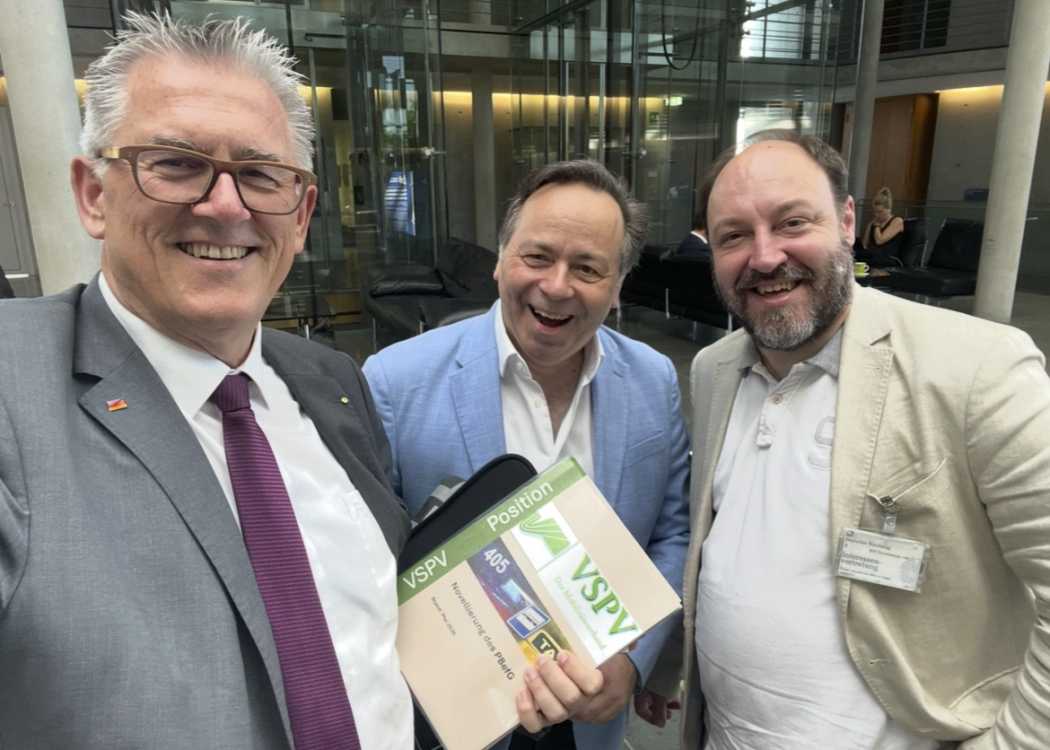
The reform of the Passenger Transport Act is now several years old. What was decided in 2021 in response to new mobility offerings, digital platforms and changed market conditions should now be put to the test. For the Association of Private Commercial Road Passenger Transport in North Rhine-Westphalia (VSPV), this is the right time to take stock. Therefore VSPV managing director Sascha Waltemate and Patrick Meinhardt, General Authorized Signatory and head of the association's Berlin office, handed over to Bundestag member Michael Donth (CDU) an extensive position paper. Donth is regarded within the CDU/CSU parliamentary group in the Bundestag as one of the central contacts for transport policy questions.
Five years of practical experience
The VSPV does not want the upcoming evaluation to be understood as a mere stocktaking. From the association's point of view, it offers the opportunity to openly address weaknesses of the current legal framework and to prepare possible corrections.
“We have deliberately compiled the essential points here in printed form so that all members of the Bundestag's Transport Committee and also the transport ministers of the federal states have in compact form what has not worked from the experiences of the past five years and at which points urgent improvements are needed. Whether a revision must be created now or in the next legislative period will depend on the seriousness of the discussion,” explains Sascha Waltemate.
The message behind it is clear: The industry expects political decision-makers to incorporate the practical experiences of taxi and rental-car companies more into the debate.
Support from the Transport Committee
With Michael Donth, this approach is meeting with an open ear. The CDU politician sees in the association's elaboration an important basis for parliamentary deliberations.
“Having, at the start of the parliamentary debate, a booklet with a detailed presentation of the Passenger Transport Act produced by the trade sector, is a great help. Because we can only conduct the debate in the working group, in the parliamentary group, in the committee and in the plenary in a practically oriented manner if we also have the concrete feedback from the industry and from the associations.”
The statement points to a fundamental problem of many transport policy discussions: Between legislation and operational reality there is often a gap. Associations such as the VSPV therefore try to bring the companies' perspective into political processes at an early stage.
More than a formal evaluation
For Patrick Meinhardt, the upcoming review of the law must not become a mere box-ticking exercise. Especially against the backdrop of political debates about expanding public transport, he sees a substantial need for discussion.
“Even though it is formally only an evaluation, I expect the parliamentary groups to engage in detailed consideration, especially under the banner of a public-transport offensive, about how an innovative, modern and bureaucracy-light Passenger Transport Act should look, which is based on mobility justice and on fair framework conditions. Here we expect proposals, ideally also a hearing at least in the parliamentary groups and, in the end, also necessary changes to the amendment.”
Thus the association formulates a claim that goes beyond the taxi and rental-car trade. It concerns how mobility should be organized in the future—and what role traditional forms of transport, new platform offerings, and municipal mobility concepts will play.
Controversial issue: tariff corridors
VSPV views the regulations on tariff corridors and minimum fares as particularly critical. These instruments were introduced with the reform of the Passenger Transport Act to give municipalities more room for maneuver against platform traffic and rental-car offerings. In practice, however, it becomes evident that many cities and counties see legal uncertainties. Numerous municipalities have so far refrained from introducing corresponding regulations or feared legal disputes. For Waltemate and Meinhardt, this is exactly one of the biggest weaknesses of the previous reform.
“One of the biggest weaknesses of the amendment was and is that it does not establish a nationwide uniform framework to provide legal certainty for municipalities and districts in Germany. There is an urgent need for action here.”
The association therefore calls for clearer legal guidelines at the federal level. The aim is to enable cities and counties to introduce tariff corridors and minimum tariffs in a legally secure manner, without having to fear lengthy legal disputes.
Direction-setting decision for the industry
The evaluation of the Passenger Transport Act will thus be much more than a technical review of existing provisions. For the taxi and rental-car trade, it concerns central questions of competition, municipal steering possibilities, and the future design of the mobility market. The VSPV has articulated its position on this early. Now it remains to be seen whether the political groups take up the practical hints—and whether the evaluation will actually become the starting point for the next reform of the Passenger Transport Act.
Content automatically translated.


Taxi-Fahrzeuge (Pkw) , Taxi-Newsletter, Taxameter, Taxi-Fahrer , BZP – Deutscher Taxi- und Mietwagenverband , Straßenverkehrsordnung (StVO) , Krankenbeförderung , Weiterbildung , Taxi-Konzessionen , Verkehrspolitik , Mietwagenbranche , Taxi-Apps , Berufskraftfahrer-Qualifikations-Gesetz BKrFQG) , Taxizentralen , Personal, Gehälter, Arbeitsschutz , Wirtschaftsnachrichten , Werbung , Taxi-Folierung , Taxi-Umrüster , Straßenverkehr , Elektromobilität, Taxifuhrpark und -flottenmanagement , Taxi-Versicherungen , Hybrid, Diesel, Erdgas , Taxi-Magazin