VISION mobility kostenlos Probelesen

Die Zeitschrift VISION mobility richtet sich an mobilitätsbegeisterte Menschen bzw. Flottenmanager und begleitet den Technologiewandel in Sachen Automotive und Mobilität.
Aktueller Termin

Meist gelesen
Fatal accident during patient transport: Why taxi drivers' responsibility goes far beyond the steering wheel.
When in May 2025 a ten-year-old boy died during a medical transport in the Hohenlohe district, the shock extended far beyond the region. The boy was sitting in a wheelchair-accessible taxi that collided with a regular bus on the Marlacher Steige near Schöntal. A few months later, the Künzelsau District Court sentenced the taxi driver for negligent homicide to ten months' imprisonment on probation. Now the case is moving to the next round: the driver has filed an appeal.
Legally, it will now be re-examined whether the verdict will stand. The road conditions are also being discussed. The defense points to what they see as problematic signage on the Marlacher Steige and the lack of a speed limit. The prosecution has not appealed. But regardless of the open legal questions, the case touches on a topic that is of fundamental importance to the taxi sector: the special responsibility when transporting people with physical or mental impairments.
More than an ordinary ride
Medical and disabled transports have been a fixed part of the taxi trade for decades. Every day, drivers take patients to dialysis centers, rehabilitation facilities, doctor's offices, or schools. Many passengers rely on assistance. Some sit in wheelchairs, others suffer from neurological diseases, visual impairments, or cognitive limitations.
Unlike an ordinary taxi ride, these passengers often cannot respond to dangerous situations themselves. They cannot hold on, cannot dodge, and often cannot free themselves from the vehicle independently. This increases the driver's responsibility. Whoever takes on medical or disability transport does not merely transport people from A to B. For the duration of the journey, they assume a special duty of care.
Safety begins before the start
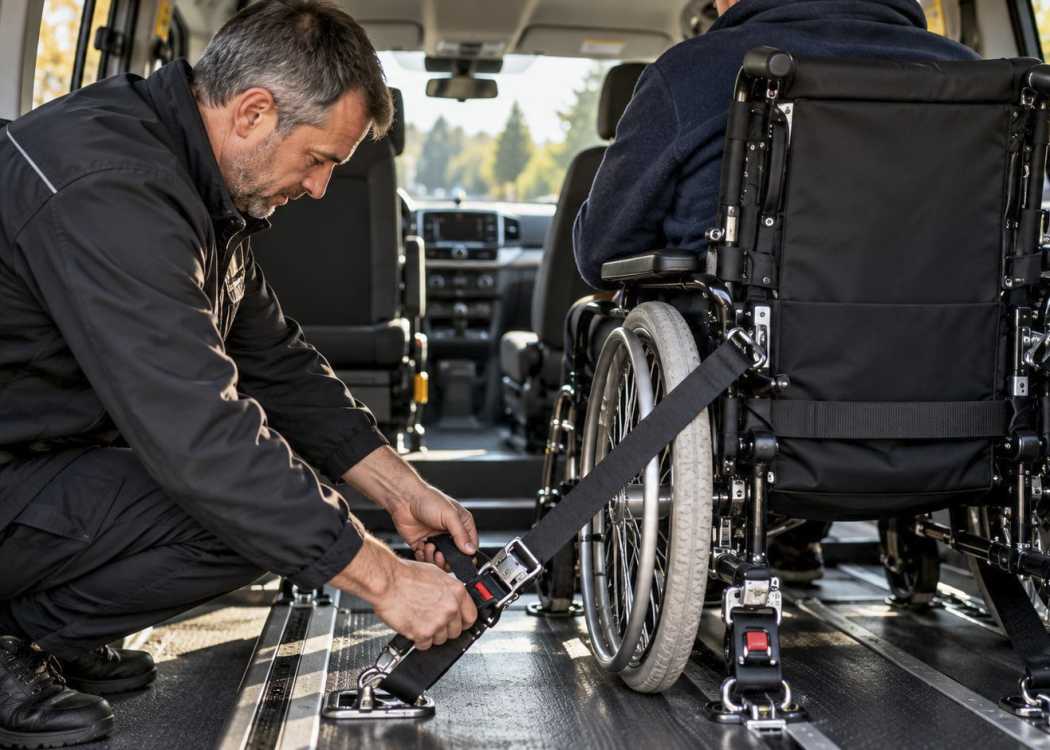
Industry associations and accident researchers have warned for years that many risks arise before starting. What matters are proper securing of wheelchairs, correctly installed restraint systems, and the inspection of all attachment points. Modern wheelchair-accessible vehicles are equipped with special wheelchair restraint systems, belts, and anchorages. But even the best technology only exerts its protective effect when it is used correctly.
Numerous training programs for drivers thus focus not only on vehicle handling. They also teach dealing with people with disabilities, the safe loading of wheelchairs, and behavior in emergency situations.
The road does not forgive mistakes
The accident near Schöntal also reveals another reality of the profession. Taxi drivers move daily in an environment they cannot control. Bad roads, confusing route layouts, changing weather conditions, or the misbehavior of other road users are part of daily life. That is precisely why in passenger transport there is a particularly high standard of vigilance and risk awareness. Professional drivers cover tens of thousands of kilometers each year. They are expected to recognize hazards early and adjust their driving accordingly—regardless of the maximum speed a road formally allows.
The discussion about the signage on Marlacher Steige will therefore probably also play a role in the next court instance. However, this does not change the fact that professional passenger transport is always associated with a special responsibility.
Trust Relationship Over Time
Many passengers have known “their” driver for years. Especially in the field of patient transport, close relationships of trust often develop. Parents entrust their children to the driver. Relatives rely on the fact that a person in need of care reaches their destination safely. Institutions organize their daily routines on the basis of this reliability. This trust is a precious asset. It also explains why accidents in the area of patient and disabled transport regularly attract broad public attention. The consequences extend far beyond the immediate parties involved.
Case Extends Beyond the Courtroom
Whether the verdict against the taxi driver will stand now has to be decided by the higher instances. The legal assessment of the concrete accident remains the task of the courts. For the taxi industry, however, the case already today contains an important reminder. Transport of the sick and disabled are among the most demanding tasks in the industry. They require driving skill, technical understanding, and a high degree of responsibility.
Whoever transports people who rely on help bears more than the responsibility for a vehicle. He bears responsibility for people who place their trust in him—often every single day.
Content automatically translated.




Taxi-Fahrzeuge (Pkw) , Taxi-Newsletter, Taxameter, Taxi-Fahrer , BZP – Deutscher Taxi- und Mietwagenverband , Straßenverkehrsordnung (StVO) , Krankenbeförderung , Weiterbildung , Taxi-Konzessionen , Verkehrspolitik , Mietwagenbranche , Taxi-Apps , Berufskraftfahrer-Qualifikations-Gesetz BKrFQG) , Taxizentralen , Personal, Gehälter, Arbeitsschutz , Wirtschaftsnachrichten , Werbung , Taxi-Folierung , Taxi-Umrüster , Straßenverkehr , Elektromobilität, Taxifuhrpark und -flottenmanagement , Taxi-Versicherungen , Hybrid, Diesel, Erdgas , Taxi-Magazin