Ihr kostenloser Branchen-Newsletter

Lassen Sie sich von unseren Fachjournalisten einmal wöchentlich über die wichtigsten aktuellen Entwicklungen der Taxi-Branche informieren, bequem direkt in Ihre Mailbox.
Aktueller Termin

Meist gelesen
Cash-register law sparks debate: BVTM demands equal rules for taxi and platform transport.
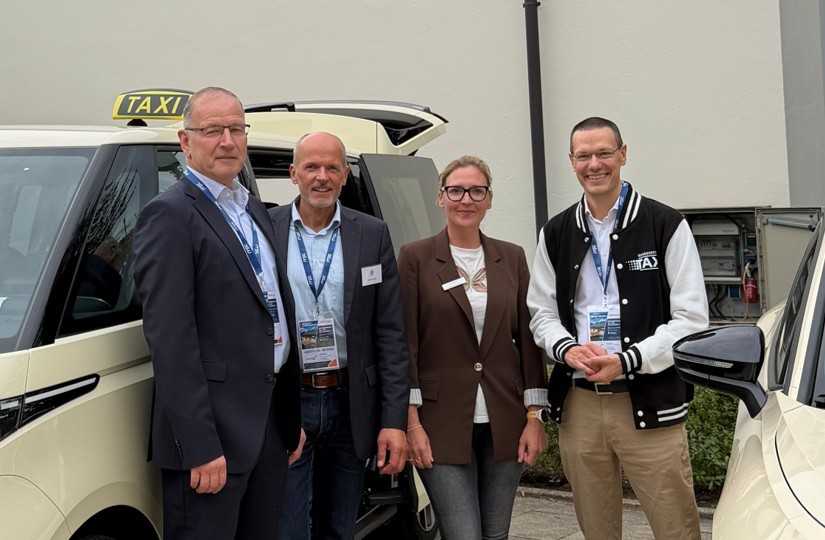
Anyone wanting to know which topics are currently occupying the taxi and rental-car industry did not have to look to Berlin these days. At the Lower Saxony Taxi and Rental Vehicle Day of the umbrella association of the transport trades in Lower Saxony (GVN) in Bad Nenndorf, those questions were on the agenda that affect many entrepreneurs directly—from digitalization to new mobility offerings to tax-related requirements. The Federal Association of Taxi and Rental Cars (BVTM) was represented there by Vice President Wolfgang Oertel and Managing Director Michael Oppermann. Both used the event for discussions with entrepreneurs, associations and industry partners. One topic in particular drew attention: the planned regulations around technical security devices (TSE) and the Cash Register Act.
Dispute over the mileage counter
The technical background was provided by a lecture by Edo Diekmann, who explained the current developments in TSE and the Cash Register Security Regulation. For many taxi and rental-car companies, the topic is of considerable importance. After all, taximeters and mileage counters are already generally regarded as electronic recording systems.
Under current law, certain distance counters are to comply with the requirements of the technical safety devices as of January 1, 2027. The aim is to prevent manipulation and to document tax-relevant data in a tamper-proof manner. From the BVTM's perspective, however, there is a risk of a distortion of competition. The background consists of considerations to exempt parts of the distance-counter obligation from platform traffic.
"We are pressing for improvements. It cannot be that platform traffic is given preferential treatment over reputable taxi and rental-car companies," said BVTM managing director Michael Oppermann.
The association sees this as unequal treatment of different market participants. While taxi and rental-car companies would have to invest in technical systems, digital platform providers could, under certain circumstances, benefit from exemptions.
Battle for equal competitive conditions
The discussion touches on a core conflict of the industry. For years taxi and rental car associations have criticized that traditional companies must meet extensive statutory requirements, while digital ride-hailing platforms in certain areas benefit from different framework conditions. The BVTM therefore announced that it would continue to closely accompany the ongoing legislative process. The aim is to ensure equal competitive conditions for all providers in passenger transport.
But it is not only about tax issues. For many companies, behind that lies the fundamental demand that comparable services should be subject to comparable rules.
Taxi as part of public transport
In addition to the debates about the cash register law, the event also showed how the role of the taxi is changing.
A highly regarded program item was Mareike Harlfinger-Düpow's presentation on the public transport taxi in the Lüneburg district. The model illustrates how taxi companies are increasingly taking on tasks that traditional line services can no longer cover economically on their own.
Especially in rural areas, flexible service forms are gaining importance. Where buses only rarely run or large vehicles would be underutilized, taxis can close mobility gaps. The Lüneburg model is thus seen as an example of cooperation between public transport and commercial passenger transport operators.
For many entrepreneurs, this area is likely to gain importance in the future. Municipalities and responsible authorities are increasingly seeking solutions to ensure mobility even outside urban areas. Taxis are increasingly viewed as part of an integrated transport offering.
A look at technology and the future
Apart from the lectures, the accompanying trade show offered the opportunity to learn about new technical developments and services. Digitalization, vehicle technology and operational solutions were equally in focus as were current developments in the field of electromobility.
The BVTM also valued the exchange with the car manufacturer Volkswagen positively. Especially in light of the upcoming shift toward electrified fleets and new mobility concepts, such discussions are gaining importance for the industry.
Industry between regulation and change
The taxi and rental car day in Bad Nenndorf made clear that the industry is currently challenged on several fronts at the same time. On one hand, companies must implement new legal provisions and adapt to changed tax requirements. On the other hand, new mobility concepts open up opportunities to redefine the role of the taxi in public transport.
The discussion about the Kassengesetz demonstrates, for example, how closely regulation and competition are now intertwined. For the BVTM it is clear that the coming months will be decisive. Because the question of which rules will apply in the future to taxi, rental car and platform transports will not only determine administrative burden—but also how fair competition on the mobility market will be shaped in the future.
Content automatically translated.


Taxi-Fahrzeuge (Pkw) , Taxi-Newsletter, Taxameter, Taxi-Fahrer , BZP – Deutscher Taxi- und Mietwagenverband , Straßenverkehrsordnung (StVO) , Krankenbeförderung , Weiterbildung , Taxi-Konzessionen , Verkehrspolitik , Mietwagenbranche , Taxi-Apps , Berufskraftfahrer-Qualifikations-Gesetz BKrFQG) , Taxizentralen , Personal, Gehälter, Arbeitsschutz , Wirtschaftsnachrichten , Werbung , Taxi-Folierung , Taxi-Umrüster , Straßenverkehr , Elektromobilität, Taxifuhrpark und -flottenmanagement , Taxi-Versicherungen , Hybrid, Diesel, Erdgas , Taxi-Magazin