2 Ausgaben kostenlos für Sie

Fachmagazin taxi heute: Ihr Zugang zu exklusiven Inhalten rund um die Taxi- und Mietwagenbranche.
Aktueller Termin

Meist gelesen
Fleet charging, ensuring mobility: The EV transition in the taxi industry requires more than charging stations.
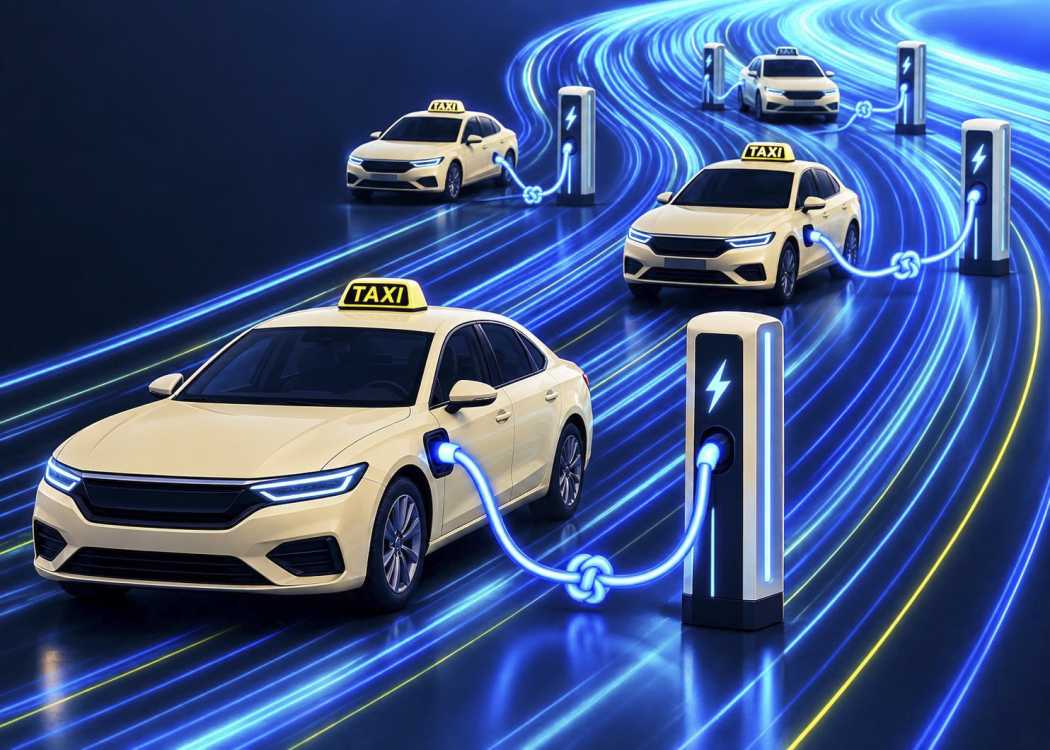
The question of how electric vehicle fleets should be charged in the future has long since occupied not only energy providers and car manufacturers. It also concerns transportation companies, taxi operators, and mobility service providers. At the second Urban Charge Conference of the British Chamber of Commerce in Germany (BCCG) in the Motorworld Cologne, representatives from business, the mobility sector and politics discussed the challenges of fleet electrification. The focus was not only on technical solutions, but also on the question of how the shift to lower-emission mobility can succeed in practice.
Between charging park and inductive road
The technical kickoff was delivered by Michael Krystof, Managing Director of TankE GmbH, Dr. Andreas Wendt of Electreon Germany, and Ingo Goutier of Pierburg. The speakers highlighted current developments in charging infrastructure for commercial fleets. Particular attention was paid to new technologies such as inductive charging. Instead of powering vehicles exclusively at stationary charging points, they could in the future also draw energy during idle periods or, prospectively, even while driving. This is especially promising for commercially used vehicles with high daily mileage.




For taxi companies, the question of charging infrastructure is of central importance. Unlike private vehicles, taxis are often in use twelve to 24 hours a day. Long charging times mean reduced availability and thus lower profitability.
Taxi as part of public transport
In the subsequent panel discussion, Patrick Meinhardt, General Authorized Signatory and Head of the Capital Office of the Association of Private Commercial Road Passenger Transport (VSPV), brought the taxi and rental-car industry's perspective into the debate. Moderator Sebastian Löhr had deliberately invited him as a representative of a sector that is often categorized between traditional public transport (ÖPNV) and individual mobility.
Meinhardt used the opportunity to raise a fundamental critique of the federal government's subsidy policy.
“For a long time it has been incomprehensible to me that taxis are constantly described in Sunday speeches as indispensable for a good connection in the evenings and on weekends, yet in everyday reality they are treated with complete neglect. Taxis are part of public transport. Period. End of story. Amen. They must be funded accordingly. If politics won't understand that, mobility justice will never be achieved in rural and suburban areas.”
Indeed, the role of taxis in public transport has been re-evaluated for years. While in metropolitan areas on-demand offerings are increasingly emerging, taxis already today take on tasks that go beyond traditional individual mobility: patient transport, pupil transport, night-time services, or connecting sparsely populated regions.
Funding policy as a brake on progress
The focus of the discussion was the reliability of government funding programs. Meinhardt pointed to the abrupt end of the environmental bonus at the end of 2023, which had caused significant uncertainty for many companies. Especially medium-sized taxi and rental-car companies rely on long-term planning. Vehicles are often budgeted and financed over several years. If funding programs are changed or discontinued at short notice, this makes investment decisions significantly more difficult.
“The federal policy has unfortunately still learned nothing from this and leaves fleet modernization in the taxi and rental-car sector entirely to state and regional funding programs with very different focal points,” Meinhardt said.
From the perspective of the VSPV, there is therefore a need for a nationwide funding program specifically for the taxi and rental-car industry.
Berlin as a role model
As a positive example, Meinhardt named the Berlin funding program WELMO. There, commercially used electric vehicles and, in particular, inclusion taxis are supported with substantial subsidies. In particular, inclusion taxis play a special role for the mobility transition. They combine climate protection with social participation and enable mobility-impaired people to gain access to public mobility.
Technology openness instead of a one-way street
The debate, however, was not limited to battery-electric vehicles. Meinhardt argued for a technology-open approach and referred to alternative propulsion solutions.
"Those who advocate technology openness must also incorporate it into their concepts."
Among other things, he cited the paraffinic fuel HVO100, which is produced from renewable resources and, according to manufacturers, can enable substantial CO₂ savings compared with fossil diesel. He also referred to hydrogen technology, which, especially for commercially used vehicles with high mileage, is still discussed as a possible future option. Particularly in the taxi and rental-car sector it becomes evident that the requirements vary greatly depending on the region. While in large cities electric vehicles can increasingly be operated economically, companies in rural areas often face other challenges. Long driving distances, low charging-point density and the lack of workshop infrastructure significantly influence investment decisions there.
SMEs in Focus
In the end, the discussion made it clear that the mobility transition for commercial fleets encompasses much more than the purchase of new vehicles.
"For small and medium-sized enterprises, it's a catastrophe to have to hunt for the right information amid this subsidy maze," criticized Meinhardt.
Indeed, medium-sized companies shape the German taxi and rental-car industry. Many businesses have modest fleets and must calculate investments very carefully. The Urban Charge Conference made clear that technical solutions for fleet electrification are increasingly available. The bigger challenge now is to design political, economic, and infrastructural prerequisites so that companies can actually use these solutions.
Or, in other words: The mobility transition is not decided solely at the charging station. It also depends on whether the businesses that organize mobility on a daily basis can economically keep pace with the path to it.
Content automatically translated.





Taxi-Fahrzeuge (Pkw) , Taxi-Newsletter, Taxameter, Taxi-Fahrer , BZP – Deutscher Taxi- und Mietwagenverband , Straßenverkehrsordnung (StVO) , Krankenbeförderung , Weiterbildung , Taxi-Konzessionen , Verkehrspolitik , Mietwagenbranche , Taxi-Apps , Berufskraftfahrer-Qualifikations-Gesetz BKrFQG) , Taxizentralen , Personal, Gehälter, Arbeitsschutz , Wirtschaftsnachrichten , Werbung , Taxi-Folierung , Taxi-Umrüster , Straßenverkehr , Elektromobilität, Taxifuhrpark und -flottenmanagement , Taxi-Versicherungen , Hybrid, Diesel, Erdgas , Taxi-Magazin