Ihr kostenloser Branchen-Newsletter

Lassen Sie sich von unseren Fachjournalisten einmal wöchentlich über die wichtigsten aktuellen Entwicklungen der Taxi-Branche informieren, bequem direkt in Ihre Mailbox.
Aktueller Termin
Meist gelesen
Autonomous shuttle for wheelchair users: Volkswagen is working on an accessible transport service of the future.
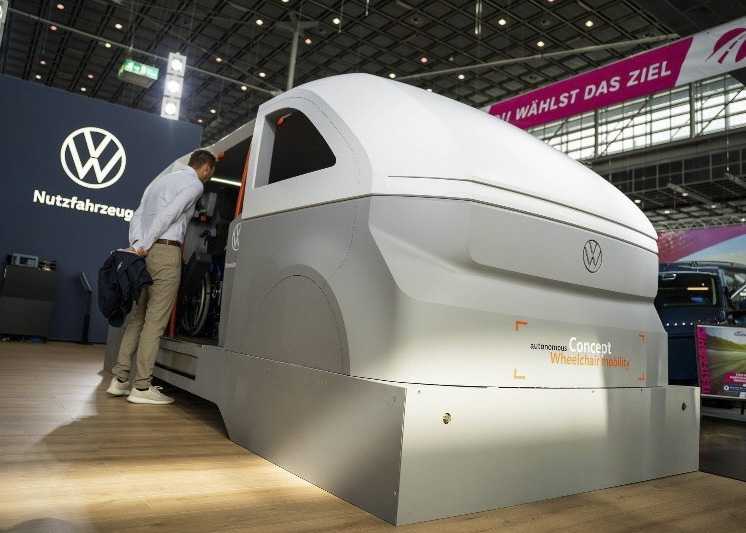
Autonomous driving is often associated with robotaxis, artificial intelligence and futuristic cityscapes. At Rehacare 2026 in Düsseldorf, however, a much more concrete question was at the center: How can wheelchair users in the future independently use an autonomous ride service? Volkswagen Commercial Vehicles presented the concept "Autonomous Wheelchair Mobility". Behind it lies the idea of a fully digitized shuttle service that enables wheelchair users to travel without a companion and without assistance from drivers. The goal is ambitious, but understandable: mobility should not only be automated but at the same time more inclusive.
The approach aligns with the Volkswagen Group's long-term strategy. For years, the company has been working together with its mobility brand MOIA on autonomous ride-pooling services based on the fully electric ID. Buzz. Hamburg is considered the first target city for commercial deployments; additional European and North American markets are to follow. Volkswagen views autonomous fleets as an important component of future Mobility as a Service (MaaS) offerings, where passengers book vehicles via an app and are transported on demand. This is precisely where the new wheelchair concept comes into play.
Vehicle arrives at the push of a button
The service begins with an app. Through it the passenger orders an autonomous shuttle that travels to the desired pickup location. Unlike traditional taxi rides, several passengers are to be pooled on an intelligently calculated route. This corresponds to the ride-pooling principle that Volkswagen and MOIA have been pursuing for years. When the vehicle arrives, it projects the passenger's first name onto the sidewalk. The projection serves as identification and then transforms into an illuminated safety area. Using a smartphone, the user activates a lift that extends from the vehicle floor.
The key idea behind the system is that the passenger retains control at all times. He decides for himself when the lift is extended, when the platform rises and when the doors close. There is no support staff.
Robotic arm secures the wheelchair
For this is precisely where today's wheelchair transports often reach their limits. Upon entering the vehicle, the passenger positions themselves on a specially designed wheelchair space. Subsequently, safety belts are automatically deployed. In addition, a robotic arm secures the wheelchair to the vehicle floor. The system is intended to secure both the wheelchair and the person seated in it, and to prevent forward or backward rolling during the ride.
Volkswagen pursues a universal approach: The securing system should work with different wheelchair types and thus accommodate as many user groups as possible.
Inclusion as a development task
The presentation at Rehacare was deliberately not a finished product presentation. More precisely, Volkswagen used the trade fair as a field test. Wheelchair users could experience a full-scale functional model and relay their experiences directly to the developers.
This step seems sensible, because technical feasibility alone does not determine the success of such an offer. For people with mobility impairments, details play a central role: Is the app understandable? Does the entry feel safe? Are the processes intuitive? How much trust is placed in a driverless vehicle? The answers to these questions are not provided by engineers at a computer, but by the eventual users themselves.
Opportunities also for taxi traffic
For the taxi and rental car industry, the concept raises interesting questions. So far, many wheelchair trips require specially retrofitted vehicles and trained personnel. Accordingly, the offering is limited in many cities. Autonomous shuttles could in the future create additional mobility options, especially for trips within urban spaces. Theater visits, medical appointments, shopping, or leisure activities could be organized independently of accompanying persons.
This step is still future music. Autonomous ride services are still being developed worldwide. Volkswagen, however, is pushing the development forward with determination and has already presented a production platform for future fleets with the autonomous ID. Buzz. The group plans to bring autonomous mobility services to the road on a larger scale. The real innovation of the Düsseldorf trade fair appearance lies therefore less in sensors or software. What is especially interesting is the shift in perspective: Autonomous driving is not presented here as a technological toy, but as a tool for greater participation.
Content automatically translated.


Taxi-Fahrzeuge (Pkw) , Taxi-Newsletter, Taxameter, Taxi-Fahrer , BZP – Deutscher Taxi- und Mietwagenverband , Straßenverkehrsordnung (StVO) , Krankenbeförderung , Weiterbildung , Taxi-Konzessionen , Verkehrspolitik , Mietwagenbranche , Taxi-Apps , Berufskraftfahrer-Qualifikations-Gesetz BKrFQG) , Taxizentralen , Personal, Gehälter, Arbeitsschutz , Wirtschaftsnachrichten , Werbung , Taxi-Folierung , Taxi-Umrüster , Straßenverkehr , Elektromobilität, Taxifuhrpark und -flottenmanagement , Taxi-Versicherungen , Hybrid, Diesel, Erdgas , Taxi-Magazin