VISION mobility kostenlos Probelesen

Die Zeitschrift VISION mobility richtet sich an mobilitätsbegeisterte Menschen bzw. Flottenmanager und begleitet den Technologiewandel in Sachen Automotive und Mobilität.
Aktueller Termin

Meist gelesen
Regenerative gasoline on the road: A practical test for the internal combustion engine of the future?
A new pilot project in Spain aims to provide an answer to that. Bosch, Toyota Motor Europe, the BMW Group and the energy company Repsol have been testing since July the use of fully renewable gasoline in everyday operation. About 20 vehicles from Toyota, Lexus and BMW will be fueled for a period of six months exclusively with the Nexa 95 fuel from Repsol. The aim is to investigate under real traffic conditions how renewable fuels can be integrated into existing vehicle fleets—without technical modifications to vehicles or fueling stations.
The initiative comes at a time when the discussion about the path to climate-neutral mobility in Europe is sharpening. While electrification remains the central pillar of European regulation, it is becoming clear that transforming the vehicle fleet will take considerably longer than the market introduction of new technologies. Millions of combustion-engine vehicles will continue to be on Europe's roads in the coming years. Renewable fuels are precisely where this concept comes into play. They are intended to improve the CO₂ balance of existing vehicles, without their owners having to purchase new vehicles. The Spanish pilot project will now show whether this concept works not only in the laboratory but also in everyday life.
Digital control instead of a trust-based principle
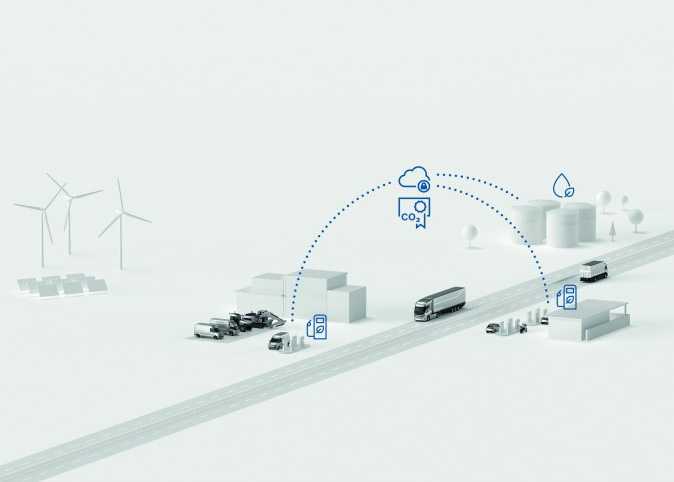
Bosch plays a special role here. The technology group Bosch provides a system, the so-called Digital Fuel Twin, that documents the use of regenerative fuel and makes it traceable.
The challenge lies less in refueling itself than in the documentation. If a fuel is to be recognized for regulatory purposes, its origin and the vehicle in which it was actually used must be transparently documented. The Digital Fuel Twin links information from various sources: vehicle data, fueling-station systems, and transactions from fuel cards are digitally integrated and reconciled.
Thus, a kind of digital twin of fuel consumption arises. Each refueling can be attributed to a specific vehicle. For fleet operators, authorities, and subsidy programs, such documentation could, in the future, be an important prerequisite for reliably capturing emissions reductions. Bosch sees this as a crucial building block for market development. Because while alternative fuels are technically often available, there has so far often been a lack of standardized and verifiable evidence of their actual use.
Existing vehicles as a test bed
Unlike many demonstration projects, the initiative deliberately relies on serial vehicles from existing fleets. Vehicles from the stock of Toyota España as well as vehicles of the BMW Group will be used. New engine generations or specially adapted prototypes play no role. This approach, in particular, makes the project interesting. Because the question is not whether future vehicles can be powered by regenerative fuels. Rather, it should be studied whether the infrastructure available today is already sufficient to make a relevant contribution to emission reductions. According to the project partners, the gasoline used is fully compatible with today’s Otto engines. Nor are any technical adjustments required at fueling stations either. From the perspective of the involved companies, this opens up the possibility of relatively rapid scaling.
For taxi operations, rental car fleets, or other commercially used vehicles, this perspective is particularly relevant. In many businesses, vehicles are used for several years. The replacement of entire fleets with battery-electric vehicles often represents a substantial investment and also depends on charging infrastructure and usage profiles. Fuels that can be used in existing vehicles therefore offer an alternative approach to reducing emissions.
Spain as a real-world laboratory
The fact that the project is taking place in Spain has practical reasons. Repsol currently operates there as the sole provider of a network of public gas stations at which 100 percent renewable gasoline is available. The existing infrastructure makes it possible to use the fuel not only under controlled conditions but also in regular road traffic.
The product Nexa 95 is produced from raw materials that meet the sustainability requirements of the European Renewable Energy Directive. According to the company, over the entire life cycle greenhouse gas emissions are significantly lower than with fossil gasoline. For the participating manufacturers, however, it's not solely about technical feasibility. The six-month test phase should also provide data on how fueling processes can be documented, what certification requirements arise, and how larger vehicle fleets can be managed.
Contribution to the political debate
The results are likely to attract attention far beyond the project itself. Because the partners explicitly aim to contribute their findings to the European discussion on the future regulation of the transport sector. The focus is on the concept of technology openness. Industry associations as well as parts of the automotive and energy sectors have argued for years that, alongside electric mobility, renewable fuels could contribute to decarbonization. Critics, in turn, point to limited availability and efficiency losses compared with battery-electric drivetrains. The Spanish pilot project could provide a foundation for political decisions to be more strongly based on real operating data.
For Bosch, Toyota, BMW and Repsol, that is precisely the real value of the project. After six months, not only consumption and emission data should be available, but also insights into how renewable fuels can be organized, controlled, and documented in everyday life. Whether renewable gasoline works technically is not the question; rather, it is about whether the model can be implemented economically and regulatorily at a scale relevant to Europe’s vehicle fleet.
Content automatically translated.





Taxi-Fahrzeuge (Pkw) , Taxi-Newsletter, Taxameter, Taxi-Fahrer , BZP – Deutscher Taxi- und Mietwagenverband , Straßenverkehrsordnung (StVO) , Krankenbeförderung , Weiterbildung , Taxi-Konzessionen , Verkehrspolitik , Mietwagenbranche , Taxi-Apps , Berufskraftfahrer-Qualifikations-Gesetz BKrFQG) , Taxizentralen , Personal, Gehälter, Arbeitsschutz , Wirtschaftsnachrichten , Werbung , Taxi-Folierung , Taxi-Umrüster , Straßenverkehr , Elektromobilität, Taxifuhrpark und -flottenmanagement , Taxi-Versicherungen , Hybrid, Diesel, Erdgas , Taxi-Magazin