Ihr kostenloser Branchen-Newsletter

Lassen Sie sich von unseren Fachjournalisten einmal wöchentlich über die wichtigsten aktuellen Entwicklungen der Taxi-Branche informieren, bequem direkt in Ihre Mailbox.
Aktueller Termin

Meist gelesen
Uber launches petition against minimum prices in Munich
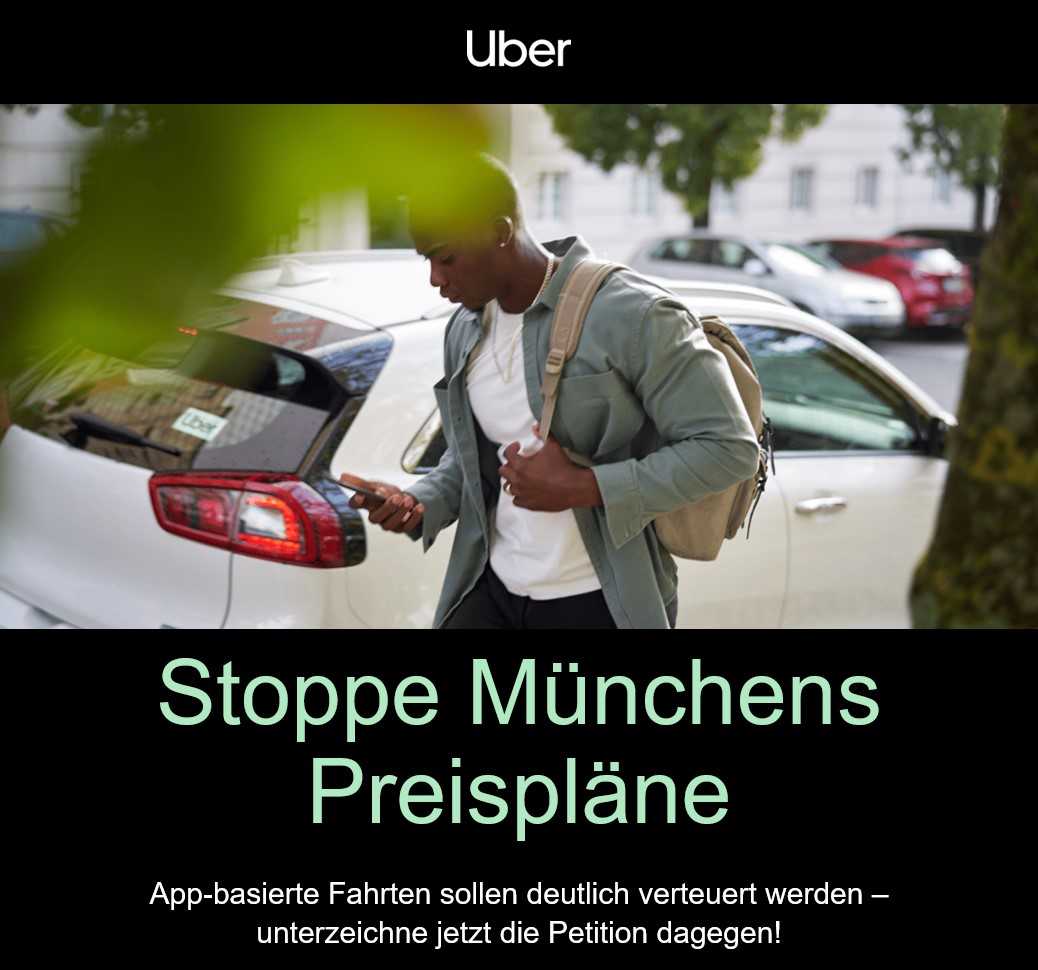
The petition urgently warns against a pricing dictate and the arbitrary increase in the cost of mobility. This sounds dramatic. But upon closer inspection, much of it turns out to be mere polemics—and some as red herrings.
"Socially Unjust"?
"Minimum prices affect people with low incomes," it says. The truth is: dumping prices on platform rides may seem affordable in the short term. However, in the long run, they undermine any reliability in the system. If a driver is paid off with ten euros gross per hour, they can't pay rent with that—let alone taxes or social contributions. A social mobility on the backs of precariously employed people is not a solution, but part of the problem.
The taxi trade is familiar with mandatory tariffs. There are clear prices, reliable standards, drivers with health insurance and pension plans. Mobility should not be based on the principle that one person can only travel cheaply because another is poorly paid.
"Threat to Jobs"?
The platforms argue that minimum prices would destroy livelihoods—particularly for drivers with a migration background. This initially seems compassionate, but one should ask: who exactly benefits here? The drivers? Or rather the intermediary platforms that do not want to take on any employer obligations but still profit from every ride?
Drivers working for Uber, Bolt, or FreeNow are mostly self-employed individuals—without rights, without security. Minimum prices could help organize this uncontrolled growth and counter the precarious reality with some reliability. The taxi is not an outdated model—it is a socially regulated counterproposal.
"A Step Back for the Mobility Transition"?
The climate argument is also being used: rental cars are "consistently low in emissions," and those who make them more expensive harm the environment. Really? Many taxis have long been hybrid, electric, or even hydrogen-powered. In many cities, there is even a requirement for emission reduction in the taxi fleet. The supposed ecological argument is a fallacy that misses the real point: the mobility transition needs fair, integrated systems – not discount wars at the expense of public order.
"Innovation instead of Regulation"?
It becomes particularly bizarre when there is talk of the "unwillingness of the taxi industry to reform." This paints a distorted picture that borders on being populist in its derogation. The reality is different: many taxi companies have long been using digital booking systems, apps, and digital payments. However, and this is the difference, they do so in compliance with legal requirements. Platforms like Uber, on the other hand, repeatedly demonstrate that regulation is a thorn in their side – if they adhere to it at all.
"Rules" must apply to everyone!
Those who, like Uber and Bolt, seek competition should also adhere to the rules. Minimum prices are not an attack on the mobility of the future – they are a protective shield for fair conditions in a market that too often operates at the expense of the weakest. The taxi is not perfect. But it operates reliably, controlled, and in accordance with the law – also at night, in the rain, without an app. Because a system that is based on social responsibility is not an outdated model. It is the foundation for a mobility that aims to be more than just a quick click to the lowest price.
Minimum prices are not madness – but long overdue!
Content automatically translated.


Taxi-Fahrzeuge (Pkw) , Taxi-Newsletter, Taxameter, Taxi-Fahrer , BZP – Deutscher Taxi- und Mietwagenverband , Straßenverkehrsordnung (StVO) , Krankenbeförderung , Weiterbildung , Taxi-Konzessionen , Verkehrspolitik , Mietwagenbranche , Taxi-Apps , Berufskraftfahrer-Qualifikations-Gesetz BKrFQG) , Taxizentralen , Personal, Gehälter, Arbeitsschutz , Wirtschaftsnachrichten , Werbung , Taxi-Folierung , Taxi-Umrüster , Straßenverkehr , Elektromobilität, Taxifuhrpark und -flottenmanagement , Taxi-Versicherungen , Hybrid, Diesel, Erdgas , Taxi-Magazin