2 Ausgaben kostenlos für Sie

Fachmagazin taxi heute: Ihr Zugang zu exklusiven Inhalten rund um die Taxi- und Mietwagenbranche.
Aktueller Termin

Meist gelesen
"Thinking from Practice" – VSPV and FPN in dialogue with permitting authorities and the administration

North Rhine-Westphalia is leading the way. With events in Hagen and Dortmund, the VSPV e. V. (Association of Private Commercial Road Passenger Transport NRW) and the FPN e. V. (Professional Association for Passenger Transport North Rhine, taxi rental cars) seek dialogue with the authorities. Thus the Audimax of the University of Police and Public Administration (HSPV) in Hagen at the end of August was a meeting point for an event with a program that provided deep impulses for a modern licensing practice in the taxi and rental-car sector.
Many authorities are facing practical uncertainties
The day began with an opening by Jörg Füchtenschnieder (the VSPV's first Chairman), followed by moderation by Sascha Waltemate (VSPV Managing Director). The first lecture was given by Thomas Grätz, co-author of the Fielitz/Grätz commentary on the law governing passenger transport and commentator on BOKraft. He explained the legal bases and limits of denial or withdrawal of permits in on-demand transport with taxis and rental cars. The subsequent Q&A showed: Many authorities face practical uncertainties, especially when it comes to legally sound assessments in individual cases.



In the second presentation of the morning, Isabell Frisch and Marco Gampe from the Mobidrom.NRW project presented the importance of mobility data for permitting authorities and the transport transition. Topics such as data foundations, intermodalität and networking were central. It became clear: authorities could increasingly rely on data-based analyses – for example to identify transportation needs, to review permits or to forecast traffic burdens.
The conclusion of the first half of the program was Waltemate with the topic area “Public transport taxi as a mobility building block.” He outlined prerequisites, framework conditions and, using case examples, points of contact for practical implementation. Particularly in rural areas he saw potential: The public transport taxi could close gaps in public transport there and at the same time open up new perspectives for the taxi trade.
Praxiswissen, Austausch und aktuelle Entwicklungen
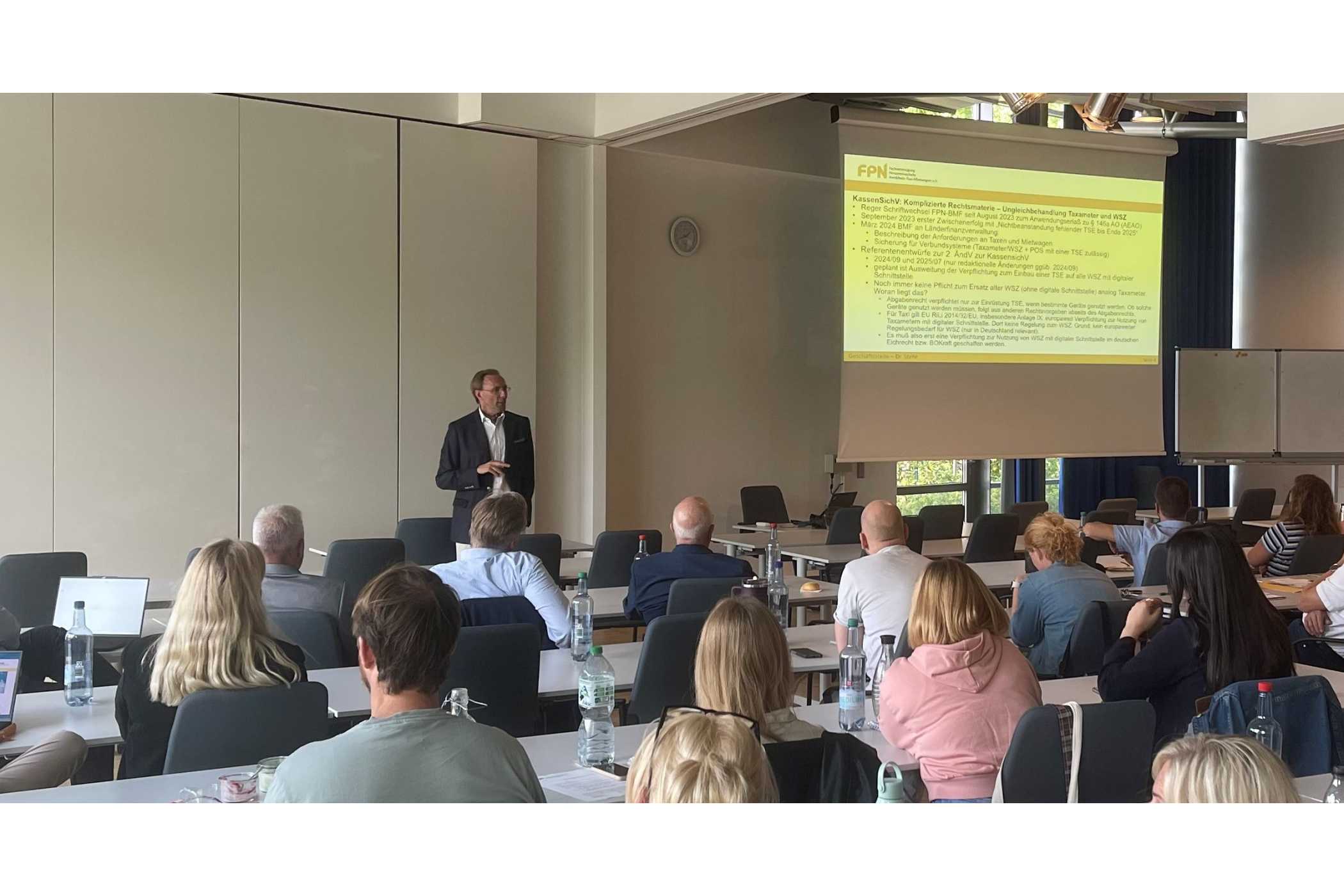
After the lunch break, Dr. Michael Stehr (FPN) took the stage with the talk “Current Developments in the Practice of Passenger Transport Law.” His approach was pragmatic: He conveyed changes and trends from administrative and legal practice and enabled, through a second Q&A round, direct exchange between authorities and association representatives.
The closing consisted of a summarizing statement by Waltemate, in which he reflected on the day’s central findings. Participant feedback was uniformly positive – both from the authorities and from the organizing associations, the event was regarded as a gain for the exchange.
Meaning and impact for permitting authorities
The event offered not a theoretical seminar, but a bridge to practice: Many authorities’ representatives stated that they felt overwhelmed in their daily decisions by new legal frameworks, increasing digitization and complex permit procedures. The dialogue with associations and experts helped reduce uncertainties and make procedures more plausible.
A point of central importance was the implementation of § 51a PBefG, which, under certain conditions, enables minimum fares for hire cars – as an instrument to protect public transport interests. In a letter published by the association partners (January 2025), this paragraph is explicitly cited as a legitimate steering instrument when a threatened impairment of local taxi traffic is to be feared. The event helped sharpen a uniform understanding of this regulation.
Furthermore, the importance of standardized mobility data was emphasized. Authorities that are hesitant today could soon reach their limits tomorrow when traffic forecasts, permit procedures and the management of supply and demand become increasingly data-driven.
Finally, the concept of the ÖPNV taxi in Waltemate’s talk shed light on a possible future: As a flexible feeder service, on-demand transport or a supplementary offering in rural areas, it can help permitting authorities and transport providers close mobility gaps – and this while respecting economic viability and public service provision.
Informationsveranstaltung war mehr als eine Schulung
The information event was a pilot project for cooperative administrative work, where legislation (PBefG), technological progress and practical application are negotiated on an equal footing. In North Rhine-Westphalia, this is taking shape as a model in which permitting authorities not only supervise but also actively shape policy.
For the taxi and rental car sector, this means: Those who stay in conversation with authorities today can secure room for maneuver. For the authorities, it means: The path to legally and data-based practice is not a quick course, but an ongoing process.


VSPV-Workshop in Dortmund: Ways for the public-transport taxi in NRW
“Bus-Taxi rental cars: shaping the mobility of the future together!?” was the topic in early September for professionals from administration, transport companies and permitting authorities in Dortmund. The aim was to translate the latest resolution of the state parliament promoting the public-transport taxi into concrete implementation steps.
Focusing on the central question of what tasks and opportunities arise for territorial authorities, mandate holders and municipal transport companies, the workshop offered a mix of presentations and practical discussions. After the welcome by VSPV managing director Sascha Waltemate, Dennis Steinke of BBG und Partner spoke about the legal framework. Dr. Christian Mehlert of KCW GmbH explained the economic potentials of on-demand transport, while Thomas Krause of Linne + Krause highlighted the capabilities of the taxi sector in the public-transport context. Finally, Waltemate presented funding and support programs for the public-transport taxi in NRW.
Taxi as a flexible and economically viable solution in public transport
After the joint lunch, the participants split into working groups to address concrete questions raised by the participants. In the final round, it became apparent that the workshop had intensified the dialogue between public authorities and the business community. The event made clear that the ÖPNV-Taxi in North Rhine-Westphalia is not only intended as a supplementary transport option, but as an approach to make existing offerings more flexible and economically viable.
The workshop demonstrated that exchange among all stakeholders is essential to make new mobility offerings beyond traditional bus lines practical. For municipalities, the challenge remains to design legal and economic framework conditions so that the ÖPNV-Taxi can be integrated into public transport in the long term.
Content automatically translated.


Taxi-Fahrzeuge (Pkw) , Taxi-Newsletter, Taxameter, Taxi-Fahrer , BZP – Deutscher Taxi- und Mietwagenverband , Straßenverkehrsordnung (StVO) , Krankenbeförderung , Weiterbildung , Taxi-Konzessionen , Verkehrspolitik , Mietwagenbranche , Taxi-Apps , Berufskraftfahrer-Qualifikations-Gesetz BKrFQG) , Taxizentralen , Personal, Gehälter, Arbeitsschutz , Wirtschaftsnachrichten , Werbung , Taxi-Folierung , Taxi-Umrüster , Straßenverkehr , Elektromobilität, Taxifuhrpark und -flottenmanagement , Taxi-Versicherungen , Hybrid, Diesel, Erdgas , Taxi-Magazin