VISION mobility kostenlos Probelesen

Die Zeitschrift VISION mobility richtet sich an mobilitätsbegeisterte Menschen bzw. Flottenmanager und begleitet den Technologiewandel in Sachen Automotive und Mobilität.
Aktueller Termin

Meist gelesen
The race to the robot car, or: Hands off the wheel!

A few days ago, VW finally emerged from hiding regarding autonomous driving. At the mobility trade show "UITP Summit 2025," the Lower Saxony car manufacturer showcased the ID.Buzz AD in the spotlight through its subsidiary brand Moia. The abbreviation "AD" is crucial because it stands for "Autonomous Driving" in this case. As early as next year, the electric vans are set to launch as robo-taxis in Hamburg and Los Angeles, with additional cities to follow. A partnership already exists with the Berlin transport company (BVG), and the US ride-hailing company Uber is on board. Thus, it will not remain limited to the West Coast metropolis in the USA. Over the next ten years, several thousand of the robo-ID.Buzz vehicles are expected to operate.
Waymo is in the Pole Position
This all sounds promising, but in the USA, Tesla and Google's sister company Waymo have already moved a step ahead. The Alphabet subsidiary is already operating autonomous taxis under the brand name Waymo One in several US cities, including San Francisco, Los Angeles, Phoenix, and Austin. The fleet of self-driving vehicles, which are capable of Level 4 autonomous driving, currently includes about 1,500 vehicles. Approximately 250,000 rides are booked per week. By the end of the year, Waymo plans to offer its services in Atlanta, Miami, and Washington D.C., adding around 2,000 more vehicles to the road. This will likely lead to an explosion in the number of routes and, most importantly, the collected data, which is essential for autonomous driving. Klaus Schmitz, a partner at the strategic consultancy Arthur D. Little, estimates Waymo's lead over VW to be about five years.


Waymo's Major Competitor: Tesla
"Tesla is clearly ahead here, despite all the criticism. No other manufacturer is testing a comparably powerful AI system on this scale. In fact, Tesla is the only provider with a nationwide AI field test in real operation," says Martin Geißler, partner at the management consultancy Advyce & Company.
And this, although Tesla’s Full Self-Driving (FSD) relies on a camera-based solution and forgoes LiDAR sensors. Elon Musk utilizes artificial intelligence in conjunction with neural network training. The amount of data already collected by the autopilots is immense. Nevertheless, there are still doubts whether capturing the environment with cameras is sufficient in poor visibility conditions.
"Even in China, they are further along: providers like Baidu or Apollo Go, AutoX, or WeRide are testing their robotaxis in megacities like Shenzhen, Wuhan, or Guangzhou, sometimes also without safety drivers and with real passengers. Research is no longer being conducted here; it’s already being scaled," Martin Geißler points out.
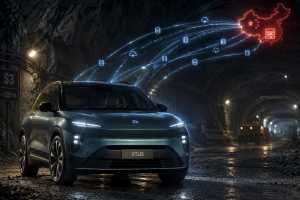
The dynamics with robo-cars in the Middle Kingdom are high. Manufacturers like BYD and Nio are developing the technology including the processors themselves. Nio has taken Tesla as a model and wants to succeed with a similar strategy. For now, the Americans are clearly ahead. Nevertheless, the Chinese are making massive progress in city traffic.


Xiaomi Accelerates
A player that many haven't even considered yet is Xiaomi. The fact that the technology giant can build cars was demonstrated by the Chinese with the SU7 Ultra, which broke the record for electric vehicles on the Nürburgring's Nordschleife. Xiaomi is also accelerating in autonomous driving. Cars like the Luxeed R7 (belonging to Chery) or the Voyah Free are already equipped with the latest autonomous driving system Huawei ADS 4.0 (Advanced Driver-Assistance System). Although Huawei's Cruise Assist does not completely relieve the driver of responsibility, the system already operates quite confidently even in the hustle and bustle of Chinese megacities. What plays into the hands of the Middle Kingdom's players in the development of robo-cars are the more generous regulations.
And the Germans?
They operate more cautiously in urban areas. BMW demonstrates with the Neue Klasse that self-driving vehicles are being developed diligently in Munich as well. Despite all the progress, BMW insists that the technology does not yet constitute autonomous driving, rather more like Level 2++. Mercedes is on a similar path, at least within city limits. Even though Mercedes engineers make it clear behind closed doors that the CLA can operate as confidently as the Chinese models, it is simply not allowed in Germany. The situation is quite different on highways. So far, Mercedes is the only manufacturer to have realized Level 3 autonomous driving with the Drive Pilot 95, which is eligible for approval. This means that you can take your hands off the steering wheel and focus on other tasks. Before this decade ends, the speed is planned to increase to 130 km/h.
LiDAR sensors are expensive
One topic that will still play a major role in the race for autonomous driving is the economic factors. On the one hand, LiDAR sensors are still very expensive, and on the other, an enormous amount of development effort is needed to make cars ready for Level 4 autonomous driving. Not to mention Level 5. Not every car manufacturer can afford this in the long term. Whether the whole thing is worthwhile remains to be seen.
“The robotaxi market is being talked up more than it is. Predictions of 40 billion dollars by 2030 are simply utopian: the entire global market for taxi rides is currently just over 100 billion – with negative growth,” says Martin Geißler.
“With the current hardware costs for example for Waymo or Moia, an economical solution is neither possible for robo-taxis nor for privately used self-driving,” adds Klaus Schmitz.
The geopolitical situation also plays a role.
“Due to the rigid technology and trade restrictions, the availability of chips with structures smaller than seven nanometers will become a challenge for the Chinese,” says Klaus Schmitz.
Powerful processors are indispensable if the car is to operate autonomously. The race for robo-cars is thus influenced by many factors.
On site for us: Wolfgang Gomoll; press-inform
Content automatically translated.


Taxi-Fahrzeuge (Pkw) , Taxi-Newsletter, Taxameter, Taxi-Fahrer , BZP – Deutscher Taxi- und Mietwagenverband , Straßenverkehrsordnung (StVO) , Krankenbeförderung , Weiterbildung , Taxi-Konzessionen , Verkehrspolitik , Mietwagenbranche , Taxi-Apps , Berufskraftfahrer-Qualifikations-Gesetz BKrFQG) , Taxizentralen , Personal, Gehälter, Arbeitsschutz , Wirtschaftsnachrichten , Werbung , Taxi-Folierung , Taxi-Umrüster , Straßenverkehr , Elektromobilität, Taxifuhrpark und -flottenmanagement , Taxi-Versicherungen , Hybrid, Diesel, Erdgas , Taxi-Magazin