


2 Ausgaben kostenlos für Sie

Fachmagazin taxi heute: Ihr Zugang zu exklusiven Inhalten rund um die Taxi- und Mietwagenbranche.
Aktueller Termin

Meist gelesen
The forgotten station wagon from Liège – or how the Mercedes-Benz "Universal" paved the way for the Model T.
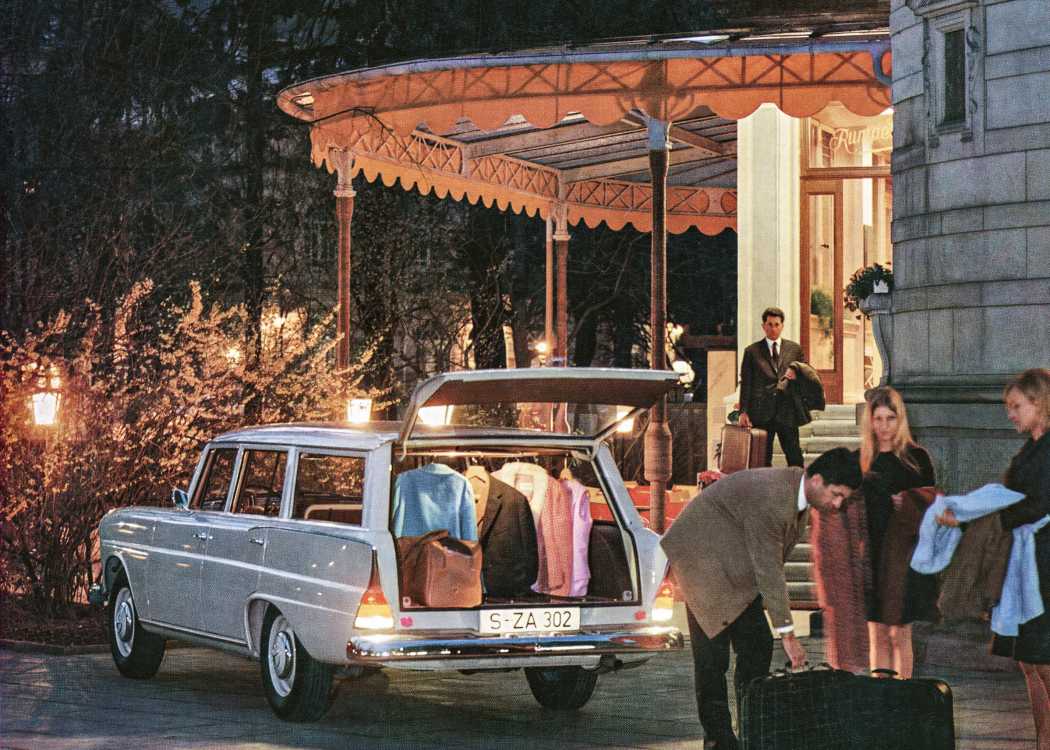
In August 1966 Mercedes-Benz included the 230 S "Universal" in its model range. The vehicle was based on the then-current luxury sedan of the W 111 series, better known as the "tailfin." It was a remarkable step for a manufacturer that had long focused on sedans. For the "Universal" combined the comfort and solidity of a Mercedes-Benz sedan with the practical characteristics of a station wagon. However, the vehicle was not produced by Mercedes-Benz itself. The conversion was undertaken by the Belgian company IMA (Industrie Meccaniche Automobili) in Liège. There, since the early 1960s, various wagon versions of Mercedes models had already been produced. What was new now was that Mercedes-Benz officially integrated these vehicles into its distribution program.
Kombis waren „Handwerkerfahrzeuge“
For the time, that was quite unusual. Station wagons in the 1960s were mainly regarded as commercial vehicles for tradespeople, authorities, or larger families. They were utilitarian, but hardly prestigious. Mercedes recognized early that behind the concept there was more than just extra storage space. The 230 S "Universal" offered exactly what many customers were looking for: a representative vehicle with high everyday practicality. Behind the generous tailgate, a loading compartment was created that offered significantly more space than the classic sedan. At the same time, the driving comfort for which the brand was known remained intact.


From today's perspective, the concept seems self-evident. In the mid-1960s, however, it was an experiment. Accordingly, the production period remained relatively short. The 230 S "Universal" was produced only until 1968. The wagon versions of the smaller W-110 series enjoyed greater success. The models 200 D, 200 and 230 were also offered as "Universal" and found interest especially among commercial customers.
Not yet as a taxi
Here, in particular, an interesting connection to the taxi trade emerges. In the 1960s, sedans dominated the street scene at German taxi stands. The classic Mercedes diesel was regarded as the epitome of a taxi vehicle. But even then there were areas of operation where a station wagon would have offered advantages: airport transfers, courier trips, hotel shuttles, or the transportation of larger luggage quantities. In fact, wagons were later to play an important role precisely in these areas. When Mercedes-Benz presented the first in-house T-model in 1977, the body style quickly became a popular alternative for taxi operators. Especially in rural areas, for hospital runs or in hotel transport, operators valued the combination of passenger-car comfort and increased loading volume.
The 'Universal' can therefore be regarded as a missing link in the history of commercial passenger transport. It was ahead of its time in many respects. While limousines continued to set the standard, the vehicle already demonstrated how flexible a Mercedes could be used in everyday commercial operation.
Comfort and practicality – Advantage for the station wagon
Technically as well, the modification set its own accents. The vehicles manufactured by IMA received, among other things, 15-inch wheels instead of the 13-inch wheels usual on the limousines. This increased ground clearance. For use on poor roads or under heavy load, that was a practical advantage. In addition, the larger wheels gave the vehicle a distinctive appearance.
In retrospect, the 'Universal' is less a mere aside than a significant step in development. It showed Mercedes-Benz that customers were ready to combine comfort and practicality. The insights from this project later flowed into the development of the T-Models, which for decades became fixtures in the fleets of many taxi and rental-car companies. Viewed in this light, the Mercedes-Benz 230 S 'Universal' not only tells the story of a rare station wagon from Belgium. It also tells of a shift in automobile construction: away from the strict separation between passenger cars and commercial vehicles, toward vehicles that could be both. For the taxi industry, which has long balanced the demand for comfort with practicality, this idea was of particular importance.
Content automatically translated.


Taxi-Fahrzeuge (Pkw) , Taxi-Newsletter, Taxameter, Taxi-Fahrer , BZP – Deutscher Taxi- und Mietwagenverband , Straßenverkehrsordnung (StVO) , Krankenbeförderung , Weiterbildung , Taxi-Konzessionen , Verkehrspolitik , Mietwagenbranche , Taxi-Apps , Berufskraftfahrer-Qualifikations-Gesetz BKrFQG) , Taxizentralen , Personal, Gehälter, Arbeitsschutz , Wirtschaftsnachrichten , Werbung , Taxi-Folierung , Taxi-Umrüster , Straßenverkehr , Elektromobilität, Taxifuhrpark und -flottenmanagement , Taxi-Versicherungen , Hybrid, Diesel, Erdgas , Taxi-Magazin







