


2 Ausgaben kostenlos für Sie

Fachmagazin taxi heute: Ihr Zugang zu exklusiven Inhalten rund um die Taxi- und Mietwagenbranche.
Aktueller Termin

Meist gelesen
ADAC: How to use fog lights correctly - what drivers must pay attention to in poor visibility

Fog, rain and snowfall can significantly impair visibility in road traffic. Drivers must then reduce their speed, maintain a sufficient distance and adjust the vehicle lighting to the visibility conditions. Especially for the use of fog lights and rear fog lights there are different legal requirements. What matters is the cause of the visibility obstruction and the remaining visibility distance.
Fog lights permitted with substantial impairment of visibility
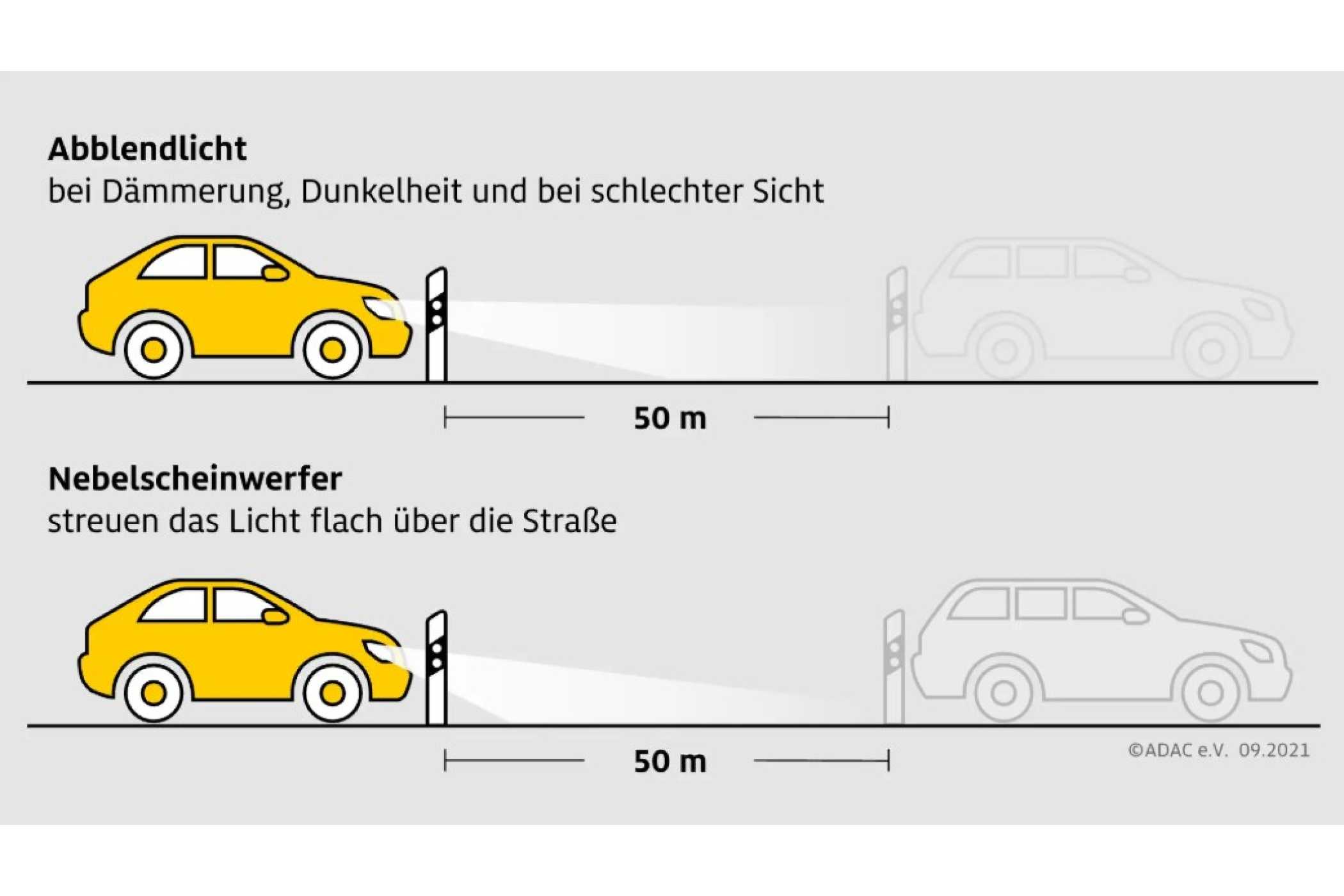
Fog lights improve the illumination of the roadway in poor visibility. They spread the light low across the road and can thereby facilitate orientation in fog, heavy rain or snowfall.
According to the applicable traffic rules fog lights may be switched on when fog, snowfall or rain significantly reduces visibility. They may be used in addition to the dipped headlights or in place of them. If visibility improves, drivers must switch off the fog lights again. Prolonged use under normal visibility conditions is not permitted.
Rear fog light only when visibility is less than 50 meters
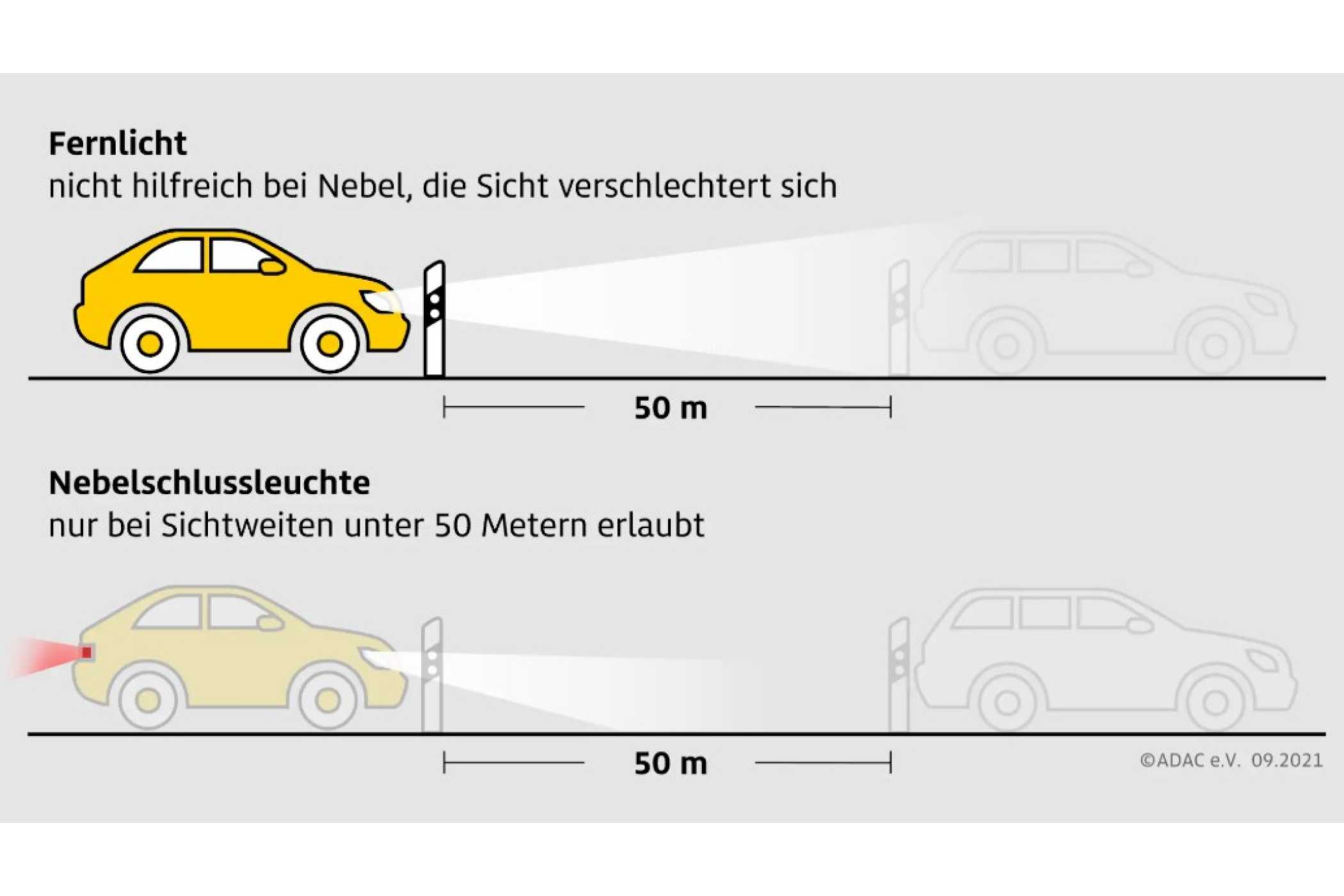
Stricter regulations apply to the rear fog light. It may only be switched on if fog reduces visibility to less than 50 meters. In cases of visibility impairment caused by rain or snowfall, its use is not allowed.
The rear fog light serves to make the vehicle more easily recognizable for following road users. Because of its high light intensity it can dazzle other drivers when visibility is sufficient.
Its use is also permitted within built-up areas, provided that visibility due to fog is less than 50 meters. There is no legal obligation to switch on the rear fog light.
Anyone who uses the rear fog light unlawfully may expect a warning penalty of 20 euros. If other road users are endangered as a result, the amount increases to 25 euros. If an accident results from the violation, 35 euros are due.




With visibility under 50 meters, a maximum of 50 km/h
The visibility distance determines not only the permissible use of the rear fog light, but also the speed. If the visibility due to fog, snow, or rain is less than 50 meters, vehicles may drive at most 50 km/h. This speed limit applies regardless of whether the rear fog light is switched on. If road and visibility conditions require a lower speed, drivers must drive correspondingly slower.
To gauge visibility, the guide posts along the roadside can serve. On country roads and motorways they are usually spaced 50 meters apart. If the next guide post is barely recognizable, this indicates correspondingly low visibility.
Turn on low beam headlights in poor visibility
Also outside of the 50-meter limit, drivers must use the prescribed lighting when visibility is significantly reduced.
According to the ruling cited in the original text, significant visibility impairment on motorways occurs with visibility under 150 meters. On other roads outside built-up areas this is around 100 meters, in urban areas around 60 meters.
Under such conditions, low beam headlights must be turned on. This also applies during daylight.
Daytime running lights do not provide an adequate substitute in poor visibility. In many vehicles, only the front lights are on, while the rear lighting remains deactivated.
The automatic headlight system doesn't always detect fog
Modern vehicles often have automatic headlight control. It switches between daytime running lights and low beam depending on the detected lighting conditions.
Fog or hazy weather, however, are not always reliably detected by such systems. Despite significantly reduced visibility, only the daytime running lights may remain on. Drivers should therefore not rely solely on the automatic lighting in fog. If the visibility conditions require it, the low beam must be activated manually.
High beams should be avoided in fog. The light is reflected by water droplets and can further impair visibility. Low beam and, if applicable, fog lights are better suited under these conditions.
Indicator lights show activated fog lighting
Whether fog lights or the rear fog light are switched on can be seen from the cockpit's indicator displays.
The rear fog light is indicated by a yellow symbol. A green indicator light is provided for the fog lights.
Both symbols are distinguished from the low-beam display by a wavy line crossing the depicted light beam.
Adjust distance and speed in sudden fog
Special caution is required when vehicles suddenly enter a dense fog bank. Drivers should then carefully observe their own lane, the vehicles ahead, and possible obstacles.
The speed must be adjusted so that the vehicle can come to a stop within the visible distance. Abrupt braking should be avoided if possible, as following vehicles may not react quickly enough.
Equally important is an adequate safety distance. The rule of thumb in fog is that the distance in meters should be at least equal to the speed in km/h. At a speed of 50 km/h, this results in a distance of at least 50 meters.
The guideposts along the roadside can also help in estimating this distance. However, the key remains that drivers continually adjust their speed and distance to the actual visibility and road conditions. (Source: ADAC)
Content automatically translated.


Taxi-Fahrzeuge (Pkw) , Taxi-Newsletter, Taxameter, Taxi-Fahrer , BZP – Deutscher Taxi- und Mietwagenverband , Straßenverkehrsordnung (StVO) , Krankenbeförderung , Weiterbildung , Taxi-Konzessionen , Verkehrspolitik , Mietwagenbranche , Taxi-Apps , Berufskraftfahrer-Qualifikations-Gesetz BKrFQG) , Taxizentralen , Personal, Gehälter, Arbeitsschutz , Wirtschaftsnachrichten , Werbung , Taxi-Folierung , Taxi-Umrüster , Straßenverkehr , Elektromobilität, Taxifuhrpark und -flottenmanagement , Taxi-Versicherungen , Hybrid, Diesel, Erdgas , Taxi-Magazin





