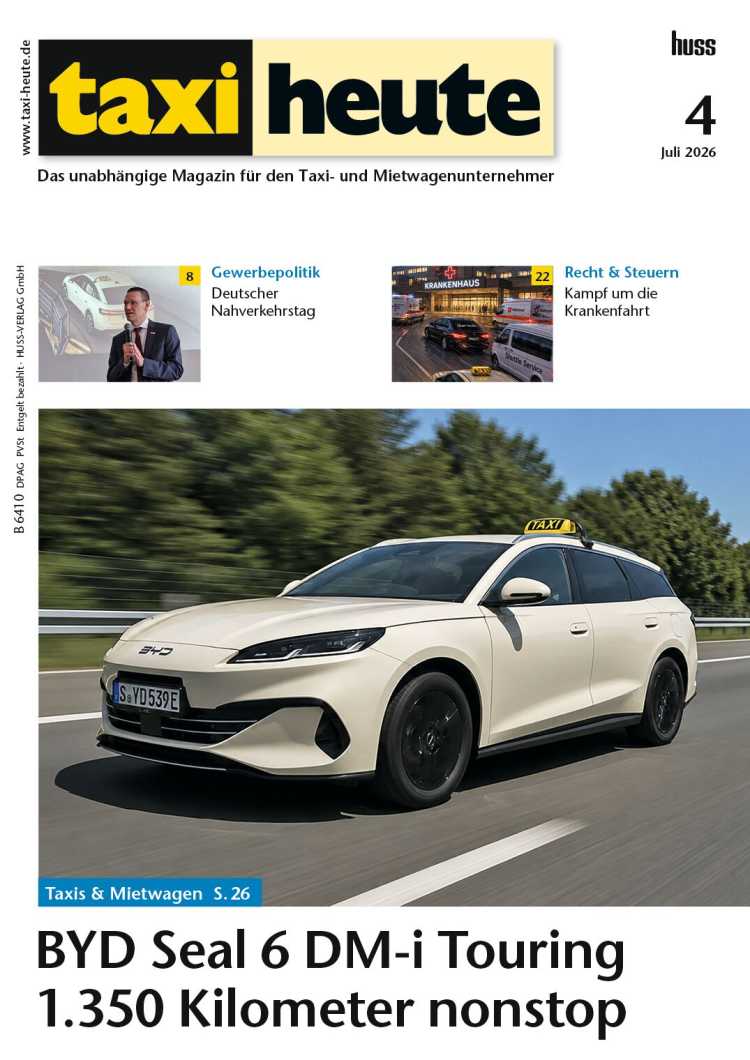
2 Ausgaben kostenlos für Sie

Fachmagazin taxi heute: Ihr Zugang zu exklusiven Inhalten rund um die Taxi- und Mietwagenbranche.
Aktueller Termin

Meist gelesen
TMV calls for uniform rules for everyone: debate over possible exemptions to the cash-register requirement.

The Taxi and Rental Car Association Germany (TMV) warns of possible exemptions for platform-mediated rental cars and sees the danger of new distortions of competition. At the center of the debate is a draft proposal from the Federal Ministry of Finance, which provides for the introduction of a cash-register obligation for further areas of passenger transport. In the future, accordingly, rental cars as well as vehicles of bundled on-demand transport are to be equipped with digital distance meters and certified technical security devices (TSE). The aim is a tamper-proof recording of revenues and better oversight by the tax authorities.
Agreement in principle
The TMV welcomes this approach. The association sees in the planned regulations a step toward greater transparency and tax fairness. In particular, the expansion of the technical recording obligations to additional forms of transport is viewed by the industry as an overdue measure. For years, the taxi industry has discussed how to prevent manipulations of records and how to document tax-relevant data in a verifiable manner. The introduction of certified technical safety devices has always been associated with the aim of creating equal conditions for all market participants.
This is precisely where the association's criticism begins.
Concern about a new loophole
In the TMV's view, there is a danger that certain rental-car operations could be exempted from the new obligations. Specifically, this concerns vehicles whose trips are mediated exclusively via digital platforms. If a special regulation were created for these operations, this would, in the association's view, undermine the fundamental idea of the law. While traditional taxi and rental-car companies would have to meet extensive recording and documentation obligations, platform-based providers could benefit from relaxed rules.
"A fair competition can only work if the same rules apply to all market participants," explains TMV President Thomas Kroker.
Whoever commercially transports people must record his revenues in full and in a tamper-proof manner – regardless of whether the orders are placed by telephone, via an app, or through other mediation channels.
Old debate, new impetus
The debate fits into a discussion that has accompanied the industry for years. Taxi and rental-car associations repeatedly criticize that digital platforms benefit from regulatory peculiarities that traditional companies cannot take advantage of. This is no longer only about questions of fare regulation or the return obligation in rental-car transport. Tax and documentation-related issues are increasingly in focus. The associations argue that different regulatory standards inevitably lead to different competitive conditions.
From their point of view, it would therefore be contradictory to introduce stricter rules to combat tax evasion on the one hand and on the other hand to exempt certain market participants from central obligations.
Blick auf das weitere Verfahren
Outlook for the next steps
This is still a ministerial draft. Until final adoption by the Bundestag and Bundesrat, individual regulations may change. TMV is counting on that now. The association calls on the federal government and Parliament to critically review possible exemption regulations and, if necessary, to strike them. The cash-register obligation must apply to all commercial passenger transport operators equally. Only in this way can the stated goal be achieved: to curb tax evasion effectively and create a level playing field.
For the industry, it's about more than a technical issue of revenue recording. Behind the discussion is a fundamental conflict that has occupied the trade for years: whether digital mediation platforms should be subject to the same rules as traditional transport companies—or whether with each new regulation differences again arise. With the Cash-Register Obligation Act, this debate could now move into the next round. For the TMV, one thing is clear: tax justice begins where exemptions end.
Content automatically translated.


Taxi-Fahrzeuge (Pkw) , Taxi-Newsletter, Taxameter, Taxi-Fahrer , BZP – Deutscher Taxi- und Mietwagenverband , Straßenverkehrsordnung (StVO) , Krankenbeförderung , Weiterbildung , Taxi-Konzessionen , Verkehrspolitik , Mietwagenbranche , Taxi-Apps , Berufskraftfahrer-Qualifikations-Gesetz BKrFQG) , Taxizentralen , Personal, Gehälter, Arbeitsschutz , Wirtschaftsnachrichten , Werbung , Taxi-Folierung , Taxi-Umrüster , Straßenverkehr , Elektromobilität, Taxifuhrpark und -flottenmanagement , Taxi-Versicherungen , Hybrid, Diesel, Erdgas , Taxi-Magazin