Ihr kostenloser Branchen-Newsletter

Lassen Sie sich von unseren Fachjournalisten einmal wöchentlich über die wichtigsten aktuellen Entwicklungen der Taxi-Branche informieren, bequem direkt in Ihre Mailbox.
Aktueller Termin

Meist gelesen
Christian Hirte remains Parliamentary State Secretary: VSPV presses for an open debate on the PBefG

Following the change at the top of the Federal Ministry of Transport, the personnel shifts on the second management level are also being realigned. While Steffen Bilger has taken over the office of Federal Minister of Transport, Christian Hirte has been confirmed as Secretary of State in the ministry. This decision is being positively received by the Association of Private Commercial Road Passenger Transport in North Rhine-Westphalia (VSPV).
Hirte - responsible for the PBefG
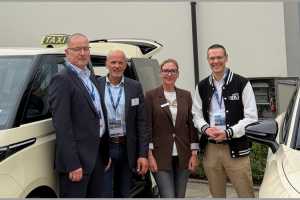
VSPV managing director Sascha Waltemate and Patrick Meinhardt, General Authorized Signatory and head of the association's capital office, personally congratulated Hirte on his reappointment. Both point to their prior contacts with the state secretary, who in the ministry is responsible among other things for passenger transport.
“We have already had several meetings with Christian Hirte in his relatively short time in office; after all, passenger transport and thus the topics of taxi and rental cars as well as public transport fall within his remit. We at VSPV wish him continued all the best and, in particular, an open ear for all improvement proposals during the upcoming, centrally important evaluation of the Passenger Transport Act.”
The central focus of the association's expectations is the upcoming review of the Passenger Transport Act (PBefG). Five years after the last reform, the VSPV sees a substantial need for discussion. In the association's view, it is not enough to merely consider individual aspects of the amendment to the law.
"For the VSPV, when it comes to experiences five years after the last amendment of the PBefG, a comprehensive debate and an honest stocktaking—and not just a narrowly limited minimal analysis—are in order," explains Waltemate.
More than a 'minimal analysis' demanded
The association indeed expects differing positions among politics, administration, and industry. That's precisely why a structured exchange is necessary.
"We will certainly not be of one mind with the Ministry. All the more important is that there must be a broad-ranging exchange of views. As VSPV, we also count on the Ministry inviting the responsible associations to a round table," Waltemate continues.
Patrick Meinhardt also expects that the discussion about the future of the law on passenger transport will pick up pace noticeably in the coming months. In his view, alongside the Federal Ministry of Transport, the Conference of Transport Ministers, the Transport Committee of the Bundestag, and the parliamentary factions could also join the debate with their own proposals.
„We assume that there will be a paper from the Conference of Transport Ministers, and that the Transport Committee, the entire Bundestag, and the individual factions will also take up the topic with their own motions this autumn. In our view, there should also be a hearing of the Transport Committee, because there is substantial need for reform. And even if it is only an evaluation, the legitimate demand for an amendment and for solid preparation of such will ultimately be on the table.“
With its statement, the VSPV makes clear that it does not view the evaluation of the Passenger Transport Act as a purely formal procedure. The association sees this rather as the starting point for a fundamental discussion about the framework conditions for taxi and hire-car traffic in Germany. Whether this will actually lead to another amendment to the law will likely depend largely on how policymakers, authorities, and industry representatives assess the experiences of the past years.
Content automatically translated.



Taxi-Fahrzeuge (Pkw) , Taxi-Newsletter, Taxameter, Taxi-Fahrer , BZP – Deutscher Taxi- und Mietwagenverband , Straßenverkehrsordnung (StVO) , Krankenbeförderung , Weiterbildung , Taxi-Konzessionen , Verkehrspolitik , Mietwagenbranche , Taxi-Apps , Berufskraftfahrer-Qualifikations-Gesetz BKrFQG) , Taxizentralen , Personal, Gehälter, Arbeitsschutz , Wirtschaftsnachrichten , Werbung , Taxi-Folierung , Taxi-Umrüster , Straßenverkehr , Elektromobilität, Taxifuhrpark und -flottenmanagement , Taxi-Versicherungen , Hybrid, Diesel, Erdgas , Taxi-Magazin