


2 Ausgaben kostenlos für Sie

Fachmagazin taxi heute: Ihr Zugang zu exklusiven Inhalten rund um die Taxi- und Mietwagenbranche.
Aktueller Termin

Meist gelesen
Chinese EVs for everyday taxi service: Adler expands Xpeng program to include the P7+ and G9

While many companies have to date oriented themselves primarily between the well-known European and Korean manufacturers, Chinese brands are increasingly pushing into commercial passenger transport. An example of this is Xpeng. After the Xpeng G6, which has already been on offer for some time, taxi companies can in the future also obtain the Xpeng P7+ and the Xpeng G9 as fully converted taxis. The two all-electric vehicles were equipped by the Bavarian specialist Adler Taxameter & Funktechnik GmbH with the technology required for taxi operation.
From the electric car to the taxi
For commercial use, a standard-production vehicle alone is not enough. A taximeter, a roof sign and an emergency alarm system continue to be part of the basic equipment of a taxi. Exactly these components have Adler integrated into the two new Xpeng models. The display vehicles were wrapped in ivory and are delivered turnkey on request.


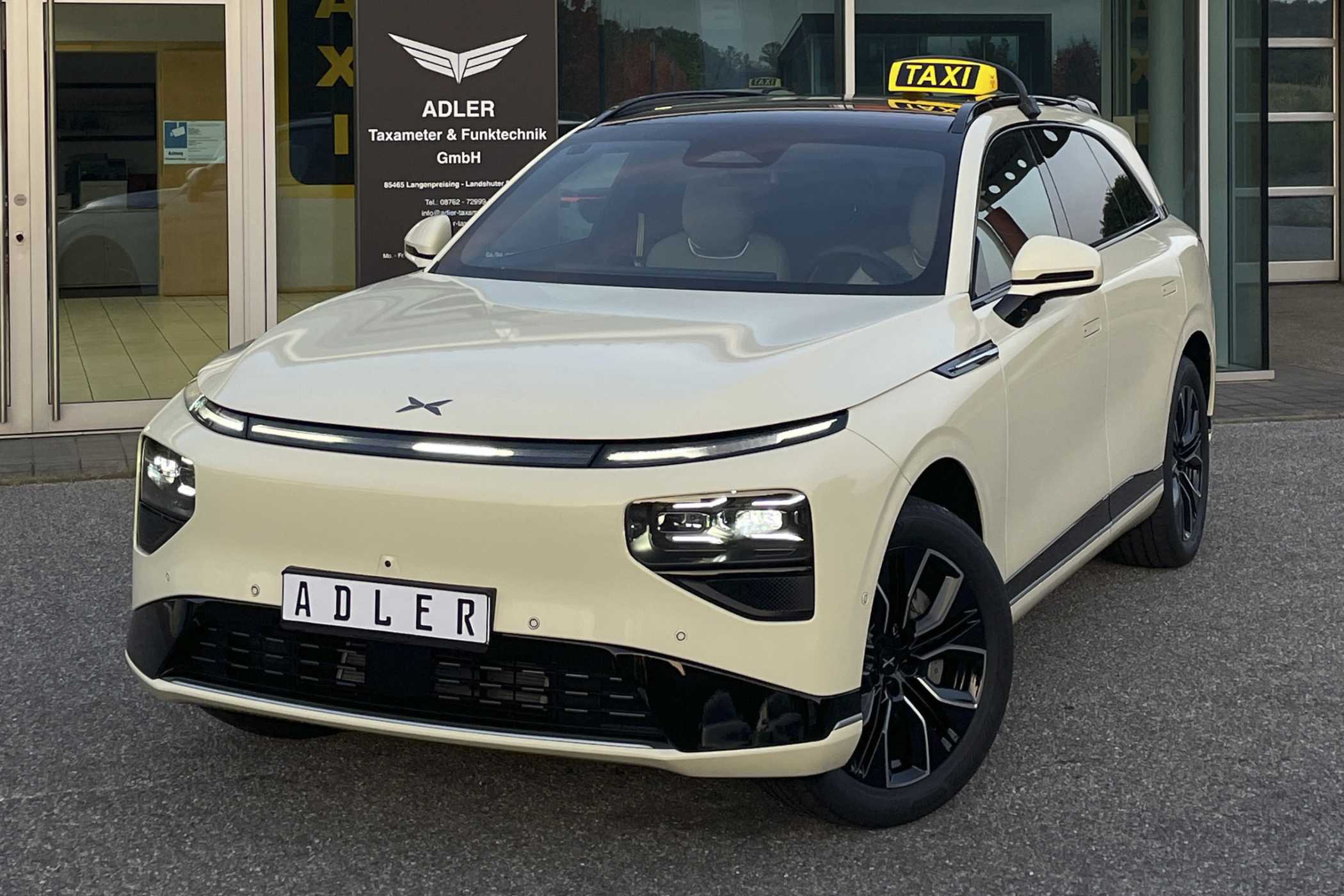

Xpeng becomes more interesting for the commercial sector
The collaboration between Adler and Xpeng is not new at all. For some time now, the company has been offering retrofits for the Xpeng G6. Vehicles of this model have been built as taxis, including for the Much dealership in Bad Tölz.
With the expansion to the P7+ and the G9, the range is now expanding significantly. While the P7+ serves as a large sedan, the G9 positions itself as a spacious SUV. Thus, Xpeng will in the future meet different requirements within the commercial sector—from the classic city and airport transfer to trips with larger luggage needs. For the industry, this is further evidence that Chinese manufacturers are taking the taxi market more seriously. Only a few years ago such offerings were rare. These days, more and more models are appearing that are tailored specifically to the needs of commercial fleet drivers.
Division of labor between dealers and conversion specialists
The current vehicles were developed in collaboration with Auto Grill. The car dealership handles consulting, sales and vehicle procurement, while Adler is responsible for the industry-specific conversion.
This model has been established in the taxi industry for years. Many manufacturers no longer offer factory taxi variants. Instead, specialized companies take on the adaptation of the vehicles to the requirements of the passenger transport market. Especially with new electric models, this role is gaining importance. The integration of taximeter technology, alarm systems and other equipment increasingly requires specific know-how, particularly when the vehicles are based on modern electronic platforms.
More choice for operators
For taxi operators, the number of available electric vehicles is thus expanding once again. While the industry is actively dealing with questions of range, charging infrastructure and operating costs, the variety of models is growing in parallel.
Whether Xpeng can establish itself permanently in the German taxi market will only become evident in the coming years. Adler's decision to include three models of the brand in the conversion program, however, suggests that there is interest in the vehicles. And for taxi operators, with each new model the probability increases that a vehicle can be found that fits the respective operating profile.
Content automatically translated.


Taxi-Fahrzeuge (Pkw) , Taxi-Newsletter, Taxameter, Taxi-Fahrer , BZP – Deutscher Taxi- und Mietwagenverband , Straßenverkehrsordnung (StVO) , Krankenbeförderung , Weiterbildung , Taxi-Konzessionen , Verkehrspolitik , Mietwagenbranche , Taxi-Apps , Berufskraftfahrer-Qualifikations-Gesetz BKrFQG) , Taxizentralen , Personal, Gehälter, Arbeitsschutz , Wirtschaftsnachrichten , Werbung , Taxi-Folierung , Taxi-Umrüster , Straßenverkehr , Elektromobilität, Taxifuhrpark und -flottenmanagement , Taxi-Versicherungen , Hybrid, Diesel, Erdgas , Taxi-Magazin







