Ihr kostenloser Branchen-Newsletter

Lassen Sie sich von unseren Fachjournalisten einmal wöchentlich über die wichtigsten aktuellen Entwicklungen der Taxi-Branche informieren, bequem direkt in Ihre Mailbox.
Aktueller Termin

Meist gelesen
Taxi World Japan - the silent ants of Tokyo

Japan is known for an excellent rail network, lightning-fast Shinkansen trains, impressive cleanliness and crowded metropolises. Without subways and high-speed trains, there is almost nothing possible between Tokyo, Kyoto or Sapporo. But just as important as the delay-free train connections are the so-called Japan-Taxis, which enable daily life for the island nation in the Pacific. There are 50,000 taxis operating in Tokyo alone – nationwide there are just under 240,000. Most of them wear the Toyota brand emblem on the hood and the trunk lid. Although, especially in smaller cities, older Toyota Crown models are still on the road in the typical white-and-red livery, but not only since the postponed Summer Olympics in 2021 has the new model increasingly been making its way, which bears the purist, typically Japanese name Japan-Taxi.
From the first Ford taxis to the Toyota legend
The history of taxis on the streets of Japan began on August 5, 1912—and entirely without Toyota, for at that time the first taxi company began operations in Tokyo. The mere six Ford Model T vehicles were on the road with little more equipment than a taximeter. Only ten years later did the first taxis go on city tours without a fixed stand, while after the Great Kanto Earthquake of 1923 cars and taxis grew into an increasingly important part of public life. Unified tariffs did not take long to arrive with the Entaku- or Yen-Taxis. Only shortly before World War II did Toyota enter the taxi business in 1936 with its first model, the Toyoda AA. In doing so, the Japanese automotive giant was not primarily concerned with the taxi business alone, but rather used the taxi trade with its intensive daily usage and high mileage in everyday traffic for long-term durability testing. The harsh operating conditions were intended to make the models more reliable and, in particular, more durable. Thus, from the 1950s onward, models such as the Toyopet Super, Toyopet Master, or especially the Toyota Crown became indestructible taxi legends.






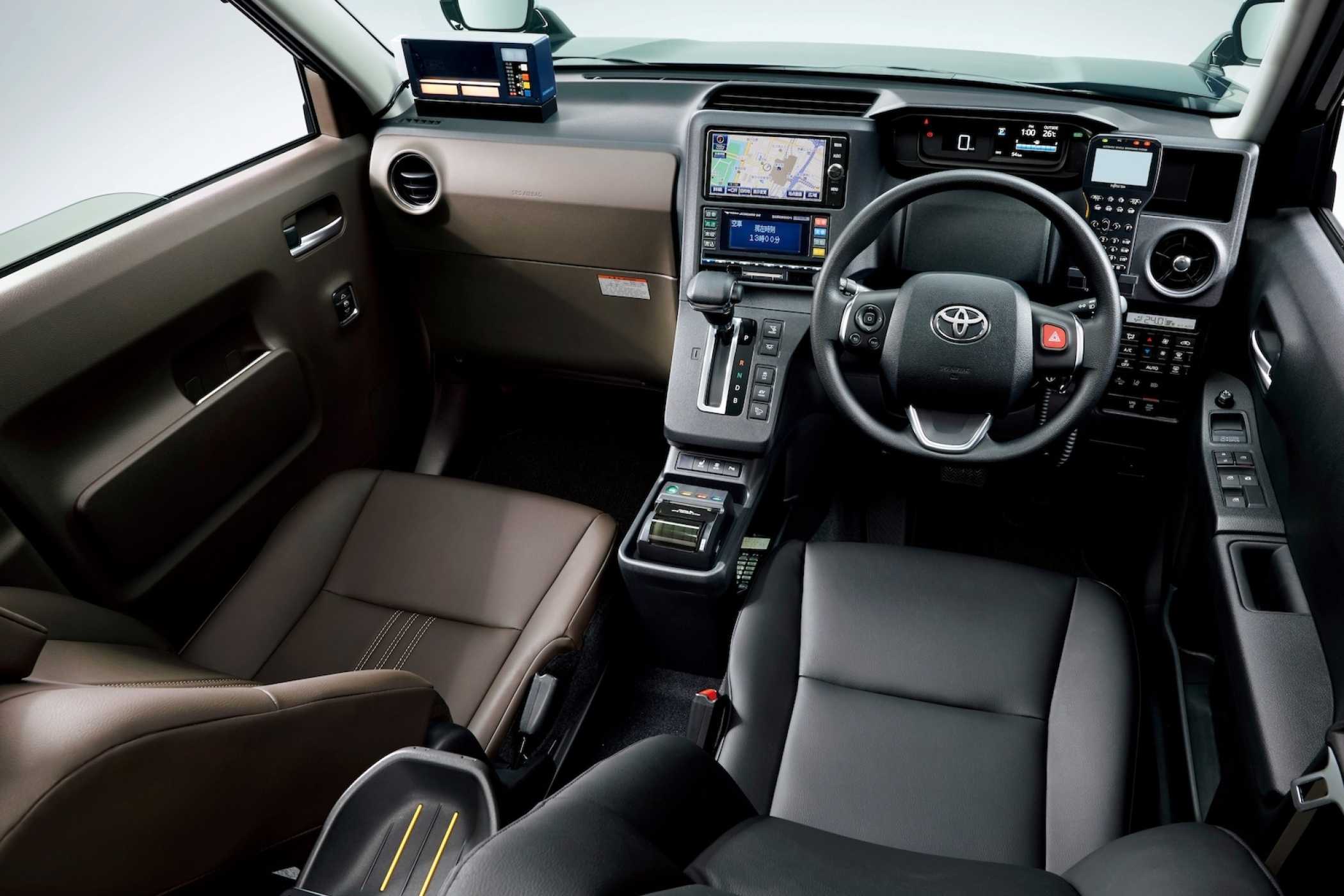






Japan Taxi: A specialist with British leanings
The pursuit of durability has hardly changed over the decades and so there are today as many Toyota taxis on Japan's streets as there were in the 1970s in Germany, when predominantly Mercedes models populated city centers and taxi stands. The latest generation of the Japan Taxi was introduced in 2017 and it does show clear similarities to the world-famous London Taxi, which has long since been electrified and glides through the British metropolis. However, the Japan Taxi is not a converted production model like the vehicles from Mercedes, Citroen, Hyundai or Kia, but has its own platform along with an independent body with a low entry, large doors and a tall body.
Sliding doors, plenty of space and comfort for passengers
While taxi drivers, seated on the right front, could conveniently open and close the rear left door on older models by Bowden cable, this is how it works on the current Japan Taxi – usually painted in a deep dark blue (Koiai), with an electric sliding door. The right rear door is designed completely differently, can be swung outward by a handle and has no window regulator. Inside the taxi there is plenty of space for passengers and luggage, which only for larger suitcases ends up in the not-too-large cargo space. Most taxi passengers take their bags inside. On the rugged artificial leather seats there is comfortable space for two to a maximum of three people, with separate climate control along with a roof-mounted seat heater. USB ports secure the power supply for passengers' smartphones and tablets.
Digitalization is transforming Japan's taxi business
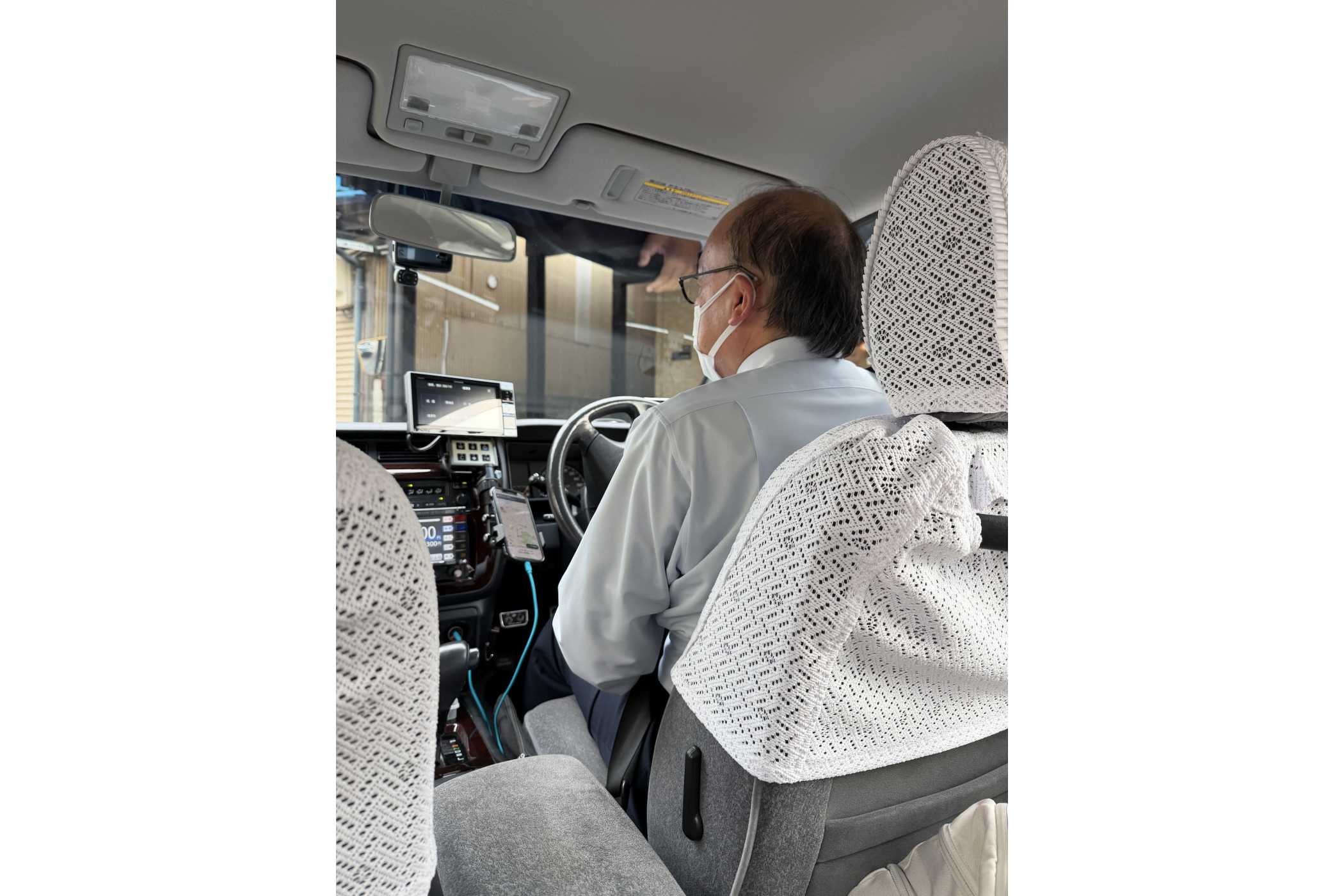
Many models still have Plexiglass screens at the front, and a large number of chauffeurs, as in the pre-COVID era, are routinely wearing a face mask in daily operations. The number of signs reminding of seatbelt requirements, airbags, payment instructions, or app features remains substantial even after years, while on at least one rear-seat screen local advertising is playing, through which the driver boosts his revenues. While for many taxi drivers it was long difficult to pay via an app or credit card, this has completely changed since the Olympics. Hardly any customer anymore pulls out cash and pays the amount shown on the tax meter in yen. In any case, most taxi drivers – whether the new Japan Taxi or the older Crown limousine – have attached themselves to the familiar platforms of Uber, Didi, S.Ride or Go, because most taxis are summoned by app. The business, especially in a metropolis like Tokyo, is conducted by the four large taxi companies Nihon Kotsu, Kokusai, Daiwa and Teito Transportation. Fewer and fewer taxis are operated by sole proprietors who group themselves under Kojin Taxis.
From the boxy Crown to the modern hybrid taxi
Whoever thinks that the old Toyota Crown models with the classic limousine body still date from the early 1980s is mistaken, because the boxy four-door versions were produced anew specifically as Japan Taxi up to 2018. Compared with the aging Crown Comfort series model, there was a simplified platform with a rigid axle to make it more robust and easier to repair. While the new taxis mostly rely on efficient hybrid drivetrains, the taxis from the early 1969s up to a few years ago were mostly on cheap autogas.
110 Years of Taxi History: Fares and a Special Day
When the first taxis began service in Tokyo more than 110 years ago, nearly four kilometers in the first tariff tier cost 60 sen, at that time a comparatively high price. Today, a typical inner-city trip, depending on duration and time of day, is equivalent to between 15 and 20 euros. By the way: in memory of the first taxi from 1912, August 5th is therefore celebrated every year in Japan as Taxi Day.
(Author: Stefan Grundhoff; press-inform)
Content automatically translated.


Taxi-Fahrzeuge (Pkw) , Taxi-Newsletter, Taxameter, Taxi-Fahrer , BZP – Deutscher Taxi- und Mietwagenverband , Straßenverkehrsordnung (StVO) , Krankenbeförderung , Weiterbildung , Taxi-Konzessionen , Verkehrspolitik , Mietwagenbranche , Taxi-Apps , Berufskraftfahrer-Qualifikations-Gesetz BKrFQG) , Taxizentralen , Personal, Gehälter, Arbeitsschutz , Wirtschaftsnachrichten , Werbung , Taxi-Folierung , Taxi-Umrüster , Straßenverkehr , Elektromobilität, Taxifuhrpark und -flottenmanagement , Taxi-Versicherungen , Hybrid, Diesel, Erdgas , Taxi-Magazin