


Ihr kostenloser Branchen-Newsletter

Lassen Sie sich von unseren Fachjournalisten einmal wöchentlich über die wichtigsten aktuellen Entwicklungen der Taxi-Branche informieren, bequem direkt in Ihre Mailbox.
Aktueller Termin

Meist gelesen
Relief package falls short: MOLO criticizes tokenism and the one-sided burden on businesses.
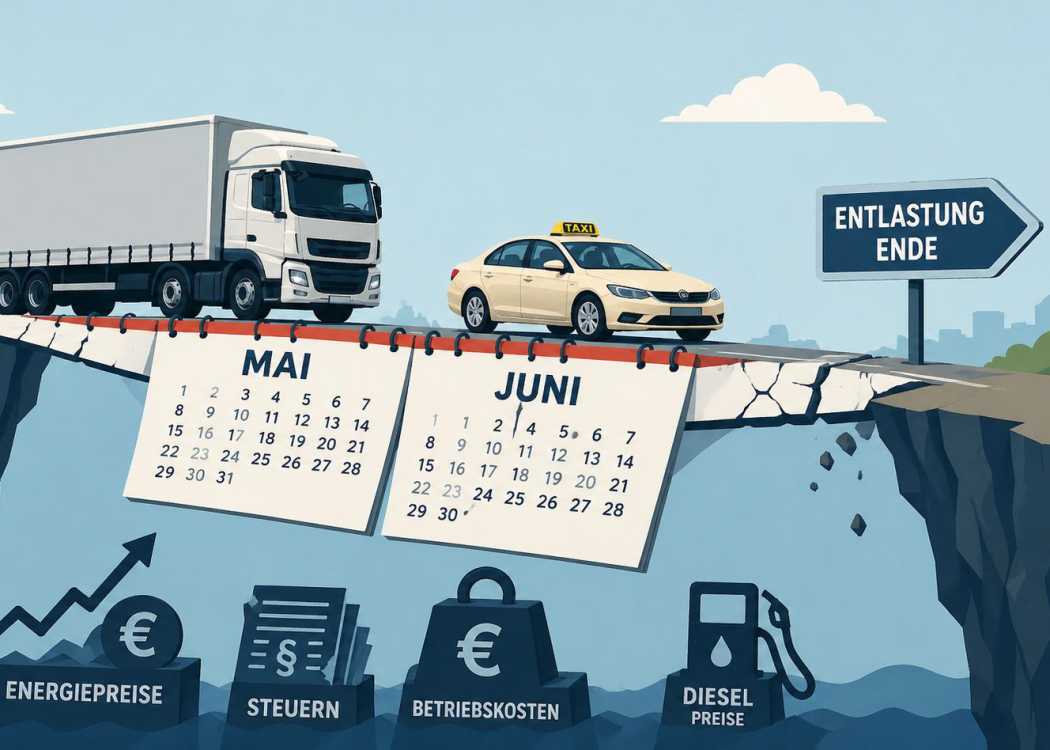
At the center of the criticism is the temporary reduction of the energy tax on diesel and gasoline. The so-called “Tank Discount 2.0” applies for two months, from May 1 to June 30, 2026. For many businesses, that is too little to enable planning. The intervention remains temporary and leaves central questions open, such as the role of alternative fuels.
“What has been decided here is not sustainable relief, but short-term symbolic politics,” says MOLO managing director Guido Bornig.
The industry needs “reliable and long-term framework conditions.” Measures that only had a piecemeal effect could not offset the ongoing cost increases.


Relief with Side Effects
Another element of the package also causes discontent: the tax-free bonus of up to 1000 euros for employees. Politically intended as relief, in practice it is perceived by many companies as an additional burden.
“Policy is shifting its responsibility here unilaterally onto employers,” says Heiko Nagel, also managing director of the association.
An expectation would arise that many businesses could not meet.
“The crucial question remains unanswered: Where is this money supposed to come from?”
The criticism targets a fundamental problem: while energy, personnel, and operating costs are rising, the leeway for additional benefits remains limited. Especially in the taxi and hire-car trades as well as in freight transport, where margins are traditionally tight, such measures can quickly lead to financial strains for operations.
System questions remain open
In addition, there is a detail that has received little attention in the political process so far: the so-called 'premium hopping' possibility. Employees could under certain circumstances receive the payment multiple times from different employers. For Bornig, this is a design flaw:
"Here, a conscious decision was made not to draw clear boundaries. This is systematically questionable and shows once again that the measures have not been thought through to the end."
The association's criticism thus goes beyond individual instruments. It targets a policy that, from the industry's perspective, mainly reacts—and thereby omits the structural causes. Fluctuating energy prices, rising levies, and intense competition have been putting pressure on companies for years.
Demand for reliable framework conditions
MOLO therefore calls for a different orientation of transport policy. The focus is on long-term solutions: instruments to limit energy price volatility, permanent tax relief, and consistent regulatory requirements. For the taxi trade and road-based passenger transport, this is of immediate importance. Calculations here are based on stable cost assumptions – short-term interventions help little if they do not open up a perspective. The association announces that it will advocate its position beyond Rhineland-Palatinate as well. Together with European partners, including the International Road Transport Union, room for more effective measures should be explored.
"We will not let up here," emphasize Bornig and Nagel. "Our goal is tangible, sustainable, and fair relief for freight and passenger transport."
Industry on standby
Until then, the situation remains tense. The relief package provides impulses, but it does not answer the question of how the transport industry can stabilize under changed economic conditions. For many companies, that means continuing to forecast in the face of uncertainty. Between fluctuating diesel prices, politically set framework conditions, and a market that tolerates few mistakes.
Content automatically translated.






Taxi-Fahrzeuge (Pkw) , Taxi-Newsletter, Taxameter, Taxi-Fahrer , BZP – Deutscher Taxi- und Mietwagenverband , Straßenverkehrsordnung (StVO) , Krankenbeförderung , Weiterbildung , Taxi-Konzessionen , Verkehrspolitik , Mietwagenbranche , Taxi-Apps , Berufskraftfahrer-Qualifikations-Gesetz BKrFQG) , Taxizentralen , Personal, Gehälter, Arbeitsschutz , Wirtschaftsnachrichten , Werbung , Taxi-Folierung , Taxi-Umrüster , Straßenverkehr , Elektromobilität, Taxifuhrpark und -flottenmanagement , Taxi-Versicherungen , Hybrid, Diesel, Erdgas , Taxi-Magazin





