2 Ausgaben kostenlos für Sie

Fachmagazin taxi heute: Ihr Zugang zu exklusiven Inhalten rund um die Taxi- und Mietwagenbranche.
Aktueller Termin

Meist gelesen
Public-transport taxi as a solution to mobility gaps: VSPV lobbies in the Bundestag for greater involvement of the taxi industry.
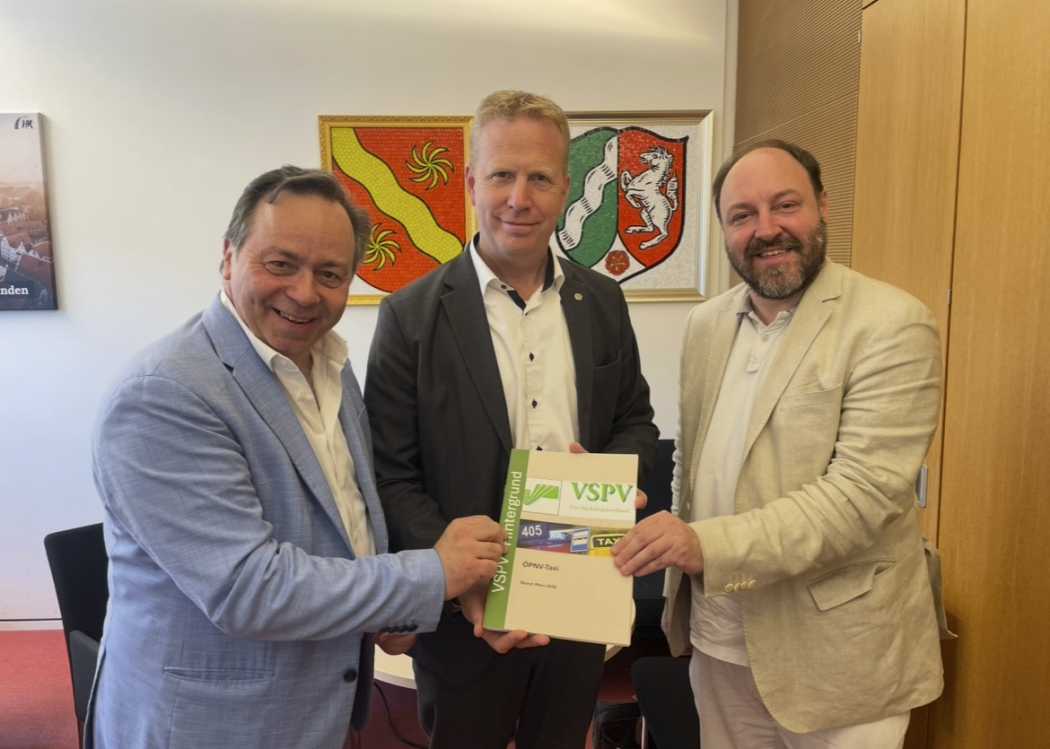
The discussion about the future of public transport often revolves around billions of investments in railways, stations, or the Deutschlandticket. But from the perspective of the Association of Private Commercial Road Passenger Transport in North Rhine-Westphalia (VSPV), one mode of transport is often overlooked that is already today widely available: the taxi. With this concern, VSPV managing director Sascha Waltemate and Patrick Meinhardt, head of the association's Berlin office, visited Member of the Bundestag Henning Rehbaum. The focus of the conversation was a brochure on the ÖPNV Taxi, which the association presented in the Bundestag.
Rehbaum, deputy chairman of the Transport Committee of the German Bundestag, expressly welcomed the initiative.
„That the VSPV has worked out the central topics in such detail and makes them available in bound form is a great idea. In this way, as transport policymakers, we have an important, practice-based assessment, coming particularly from the associations that can contribute their expertise here. And the detailed information on the ÖPNV-Taxi is very helpful in concrete political work.”
Transport policymakers with sector expertise
For the VSPV, the brochure met a dialogue partner who knows the mobility sector from different perspectives. Rehbaum was, among other things, managing director of a transport company, later worked at the Westphalian Transport Company and gained political experience as a city councilor, a member of the state parliament, and now as a member of the Bundestag. Precisely for this reason, the association hopes for backing for a topic that, in its view, will gain importance in the coming years.
Taxi to fill a service gap
Waltemate and Meinhardt see the public-transport taxi as far more than a supplement to existing transport services. For them, the concept is an important building block to reorganize mobility outside metropolitan areas.
“For us, the ÖPNV taxi as the mobility association VSPV is the central anchor to finally deliver a real quality leap nationwide in Germany in terms of a public transport initiative and mobility justice. We are somewhat concerned that, given the overall financing needs of the upcoming infrastructure measures, an ÖPNV action plan will fall short, and in the end it will come down to the question of financing the Deutschlandticket,” Waltemate and Meinhardt explain.
That concern is understandable. While large infrastructure projects regularly attract political attention, flexible mobility offerings are often pushed to the background. Many regions already struggle today with reduced bus services, a lack of evening services, or long journeys to the next stop. Mobility on demand – that is exactly where the association sees the strength of the taxi.
“That's why we campaign, wherever we can, for the taxi as part of public transport. With taxis, public authorities can counteract the undersupply of the population in rural areas and in the outer districts of large cities—especially in the evening hours and on weekends, and during daytime hours when the supply is often modest—in a targeted way. This is not a fringe topic; it is a question of participation and mobility justice.”
In fact, in numerous cities and counties, models are already being tested in which taxis or taxi-like services complement the traditional scheduled services. Call buses, dial-a-ride taxis, and flexible service forms are widely regarded as a way to provide mobility even where regular bus lines are economically scarcely viable.
A shift in perspective required
For the VSPV, however, it is not enough to roll out isolated pilot projects. The association demands a fundamental rethink in transport policy. In particular with an eye to the upcoming evaluation of the Passenger Transport Act, the association intends to actively place the issue. From the perspective of Waltemate and Meinhardt, the potential of the taxi trade has not yet been sufficiently utilized.
“The awareness that the taxi already counts as part of public transport today, but is usually not used for that purpose, let alone financed, makes clear that we need a shift in perspective. Here, the federal government, the states, and the municipalities must pull together, and the Conference of Transport Ministers should also send a clear signal.”
More than a mode of transport
The VSPV's demand thus goes beyond the interests of the industry. At its core is the question of how mobility should be organized in the future—especially in regions where traditional transport systems reach their limits. While in many places discussions are about new rail connections, electrification, and the expansion of the Deutschlandticket, the association directs attention to existing structures. Taxis are almost everywhere available, have locally knowledgeable drivers, and can be deployed flexibly. The future role of the public-transport taxi in German transport policy will be decided not least in the upcoming debates about financing public transport. In any case, the VSPV makes clear that it wants the taxi understood not only as a means of transport but as part of a comprehensive mobility strategy.
Content automatically translated.



Taxi-Fahrzeuge (Pkw) , Taxi-Newsletter, Taxameter, Taxi-Fahrer , BZP – Deutscher Taxi- und Mietwagenverband , Straßenverkehrsordnung (StVO) , Krankenbeförderung , Weiterbildung , Taxi-Konzessionen , Verkehrspolitik , Mietwagenbranche , Taxi-Apps , Berufskraftfahrer-Qualifikations-Gesetz BKrFQG) , Taxizentralen , Personal, Gehälter, Arbeitsschutz , Wirtschaftsnachrichten , Werbung , Taxi-Folierung , Taxi-Umrüster , Straßenverkehr , Elektromobilität, Taxifuhrpark und -flottenmanagement , Taxi-Versicherungen , Hybrid, Diesel, Erdgas , Taxi-Magazin