


VISION mobility kostenlos Probelesen

Die Zeitschrift VISION mobility richtet sich an mobilitätsbegeisterte Menschen bzw. Flottenmanager und begleitet den Technologiewandel in Sachen Automotive und Mobilität.
Aktueller Termin

Meist gelesen
Taxi and Rental Car Association: Markus Gossmann assumes TMV presidency

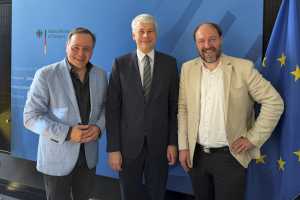
The change isn't entirely surprising, but at a time when TMV can ill afford additional issues. Thomas Kroker has stepped down from his office as president due to time constraints. The members subsequently elected the former vice-president Markus Gossmann as his successor. Kroker, however, remains involved with the industry in his other roles: He remains a board member of Taxi München eG and chairman of the Zentralverbund Taxi Deutschland eG. Gossmann knows the association and its challenges. The entrepreneur born in 1977 runs a taxi and rental-car company in Morsbach in the Oberbergischer Kreis and has headed the Fachvereinigung Personenverkehr Nordrhein Taxi-Mietwagen (FPN) since 2015. At the federal level, he has been involved for years in the interests of the SME sector. He therefore does not belong to the newcomers who still have to familiarize themselves with the structures and topics of the association.
His industry-policy priorities are also well known. Gossmann advocates in particular for economically viable framework conditions for small and medium-sized enterprises. This includes fair competitive conditions vis-à-vis platform-mediated rental cars, adequate remuneration for patient transport, and a realistic assessment of rising operating costs. In interviews, he has repeatedly pointed out how difficult the economic situation of many businesses has become. “With taxi and rental cars you won't get rich,” he summed up the situation in 2022 in a conversation with the German Medical Calculation Center.
Uwe Wieland becomes the new Vice President
There are also changes in other positions. The members elected the taxi entrepreneur Uwe Wieland from Schongau as the new Vice President. He is familiar with the association's work from his previous activity on the association council and, in particular, brings the perspective of rural regions. His previous seat on the association council will be taken by Stefan Vollert. Alfred Lehmair from Taxi München eG remains treasurer, thereby ensuring continuity in the finances. However, the new team must first tackle a substantial structural challenge. The General Association for the Transport Industry of Lower Saxony (GVN) will detach its Taxi and Rental Cars specialist association from the TMV by the end of the year and return it to the Federal Association Taxi and Rental Cars (BVTM). The Lower Saxony delegates had already approved this step at the end of August.
Lower Saxony returns to the BVTM after six years
The move has a lengthy backstory. In the summer of 2020, Lower Saxony, together with Bavaria and North Rhine-Westphalia, left the then Federal Association of Taxi and Rental Cars. There were substantial differences over the orientation of the advocacy. The Lower Saxony representatives criticized at the time a too strong focus on the concerns of large cities and taxi dispatch centers. The interests of smaller companies and the rural states were neglected. The FPN and the Bavarian state association also took action at the time.
With the return to the BVTM after six years, Lower Saxony is now making a political U-turn. The GVN justifies the decision with the wish for a unified representation of interests at the federal level. After constructive talks with BVTM, they agreed to resume cooperation. For the TMV, the departure represents a substantial setback. Lower Saxony had until now been one of the backbone pillars of the association, alongside Bavaria and North Rhine-Westphalia. With the departure, the TMV loses not only numerous member companies but also a significant part of its financial base.
Gossmann must keep the association together
Thus the new president faces a twofold task. On the one hand, he must continue the TMV's political work and represent the interests of his member associations to policymakers and the administration. On the other hand, he will have to address how the association can stabilize its organizational and financial base after the loss of Lower Saxony. The topics are not in short supply: minimum prices for rental cars, taxi tariff corridors, the control of platform-mediated rides, and the economic framework for patient transport remain on the industry-policy agenda.
Gossmann brings with him long-standing association experience and the perspective of a medium-sized entrepreneur. Whether he succeeds in repositioning the TMV in a phase when the balance of power at the federal level shifts again will be one of the defining questions of his presidency. The industry is likely to watch closely.
Content automatically translated.




Taxi-Fahrzeuge (Pkw) , Taxi-Newsletter, Taxameter, Taxi-Fahrer , BZP – Deutscher Taxi- und Mietwagenverband , Straßenverkehrsordnung (StVO) , Krankenbeförderung , Weiterbildung , Taxi-Konzessionen , Verkehrspolitik , Mietwagenbranche , Taxi-Apps , Berufskraftfahrer-Qualifikations-Gesetz BKrFQG) , Taxizentralen , Personal, Gehälter, Arbeitsschutz , Wirtschaftsnachrichten , Werbung , Taxi-Folierung , Taxi-Umrüster , Straßenverkehr , Elektromobilität, Taxifuhrpark und -flottenmanagement , Taxi-Versicherungen , Hybrid, Diesel, Erdgas , Taxi-Magazin







