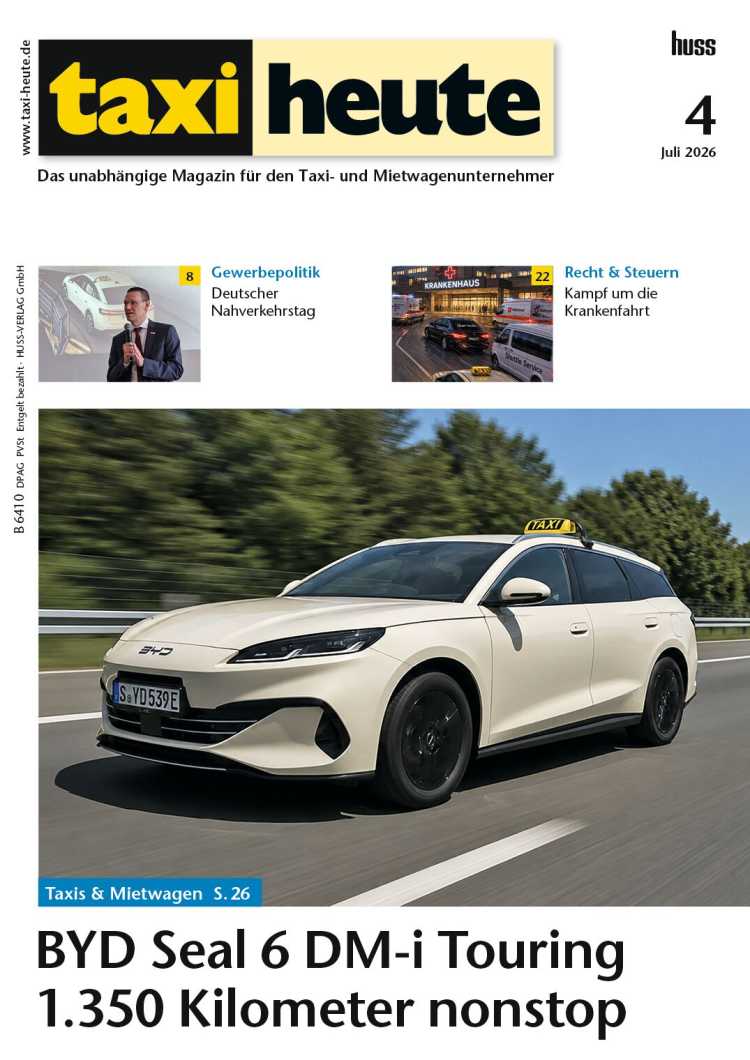
2 Ausgaben kostenlos für Sie

Fachmagazin taxi heute: Ihr Zugang zu exklusiven Inhalten rund um die Taxi- und Mietwagenbranche.
Aktueller Termin
Meist gelesen
One year after the attack: The story of the Mannheim taxi driver.

On March 3, the anniversary of the day when Mannheim's city center became the scene of a deadly attack, a driver raced through the pedestrian zone, ran down pedestrians along the Planken, and continued his drive to the E7 square. Two people died, fourteen were injured, some of them severely. While emergency services and police tried to secure care for the victims in the chaotic situation, one man played a decisive role even before the emergency services arrived: the taxi driver A. Muhammad.
Decision to Intervene
Muhammad waited that afternoon with his taxi in a side street near the town hall when he suddenly saw people running away. "I had the window a little open and saw the car driving through the crowd," he recalled two weeks after the attack in an interview with Taxi Today. That vehicles drive in the pedestrian zone is unusual, so he immediately regarded the situation as threatening.
He drove up, honked to warn pedestrians, and began the pursuit. The Planken, a long, straight stretch, ends in a dead end. Exactly there the attacker tried to turn and drive back. Muhammad angled his taxi across, so that the vehicle was blocked.
Confrontation with the Driver
The driver, a 40-year-old German from Ludwigshafen at the time, got out, aimed a weapon at him and fired. It was only later that Muhammad learned that it was merely a blank-firing pistol. "At that moment you don't know that, of course," he said. When he fled, he realized that his taxi was still running and that the perpetrator could use it to continue driving. He returned, pulled out the ignition key, and thus prevented the man from fleeing.
Chaotic situation at the scene
According to the city, the police arrived after around seven minutes.
At that time the situation was chaotic: those affected lay scattered along the route of the attack, emergency personnel tried to orient themselves, misinformation circulated on social networks. Muhammad eventually pointed the officers to the perpetrator and was later questioned as the main witness. His burden was enormous – even minutes after the incident his pulse was still at 180, as emergency personnel noted.
Between public life and privacy
Shortly after the attack, Muhammad was publicly described as the “Hero of Mannheim.” The then-mayor Christian Specht praised his brave efforts. But Muhammad himself never wanted to become a public figure. “I just want my life from before back,” he said. He gave interviews to only a few media outlets; he deliberately kept his full name private.
Besides the emotional consequences, he was mainly concerned with securing his livelihood. As a self-employed entrepreneur with five taxis, he has monthly fixed costs of around 7,000 euros. He had to work again – despite exhaustion, despite the strain, despite the ongoing attention on the street. “At the moment it’s still a bit hard, because people recognize me,” he said at the time.
The burden on the taxi industry
In the interview, A. Muhammad made clear how difficult the economic situation for taxi operators had already been before the attack. Especially the competition from Uber weighed on the local market. In Heidelberg, he reported, taxi concessions were issued on a large scale; many of these vehicles, however, effectively operated in the neighboring Mannheim. “No one adheres to the return-to-base requirement anyway,” he said. Added to that are problems such as a lack of controls and, in his view, unfair market conditions.
The industry tried to defend itself, with complaints, documentation of violations and even protests. In the end, according to Muhammad, there was often a lack of political and administrative enforcement. His wish for greater control and clearer rules was clearly on the table in the interview.
"The city of Mannheim must exercise more control – and discuss this with the surrounding cities. But now Uber is even getting holding zones at the airports – that’s then like a taxi stand!
Moreover, dealing with the city authorities is sometimes difficult. They usually don’t have specialists on hand. If you have to explain what the return-to-base requirement for rental cars actually is…"
Little backing – despite big words
As the memorial service took place at the site of the attack, Muhammad hoped for a visible sign from his colleagues. But only four taxi operators came. “It’s not about me,” he said. It was important to him to show that taxis are a reliable part of public mobility and that the industry stands together. He found the low turnout sobering.
One year later
Muhammad's action may have prevented further casualties. He himself regards his deed as obvious:
“I am not a hero. Mannheim has given me a lot. I am a Muslim. What I did is a small thing.”
But his intervention saved lives and brought the discussion about the role, responsibility and the framework conditions of the taxi trade back into focus.
One year after the attack, his story remains an example of how central taxi drivers are in everyday urban life and how much courage can be required when seconds can mean the difference between life and death.
Content automatically translated.


Taxi-Fahrzeuge (Pkw) , Taxi-Newsletter, Taxameter, Taxi-Fahrer , BZP – Deutscher Taxi- und Mietwagenverband , Straßenverkehrsordnung (StVO) , Krankenbeförderung , Weiterbildung , Taxi-Konzessionen , Verkehrspolitik , Mietwagenbranche , Taxi-Apps , Berufskraftfahrer-Qualifikations-Gesetz BKrFQG) , Taxizentralen , Personal, Gehälter, Arbeitsschutz , Wirtschaftsnachrichten , Werbung , Taxi-Folierung , Taxi-Umrüster , Straßenverkehr , Elektromobilität, Taxifuhrpark und -flottenmanagement , Taxi-Versicherungen , Hybrid, Diesel, Erdgas , Taxi-Magazin