2 Ausgaben kostenlos für Sie

Fachmagazin taxi heute: Ihr Zugang zu exklusiven Inhalten rund um die Taxi- und Mietwagenbranche.
Aktueller Termin

Meist gelesen
Market in Transition – Internal Combustion Engines in the Negative, BEVs in the Positive
The major turnaround is absent, yet the signs of change are evident. In June, almost all vehicle categories were significantly behind, with truck registrations, for instance, falling by about a third. A setback for an industry already in a phase of transition. However, behind the sober numbers lies a development that is increasingly crystallizing as the "new normal" of the market – driven by cautious demand, growing e-mobility, and a more realistic view of the mix of propulsion technologies.



Electromobility - still primarily commercial
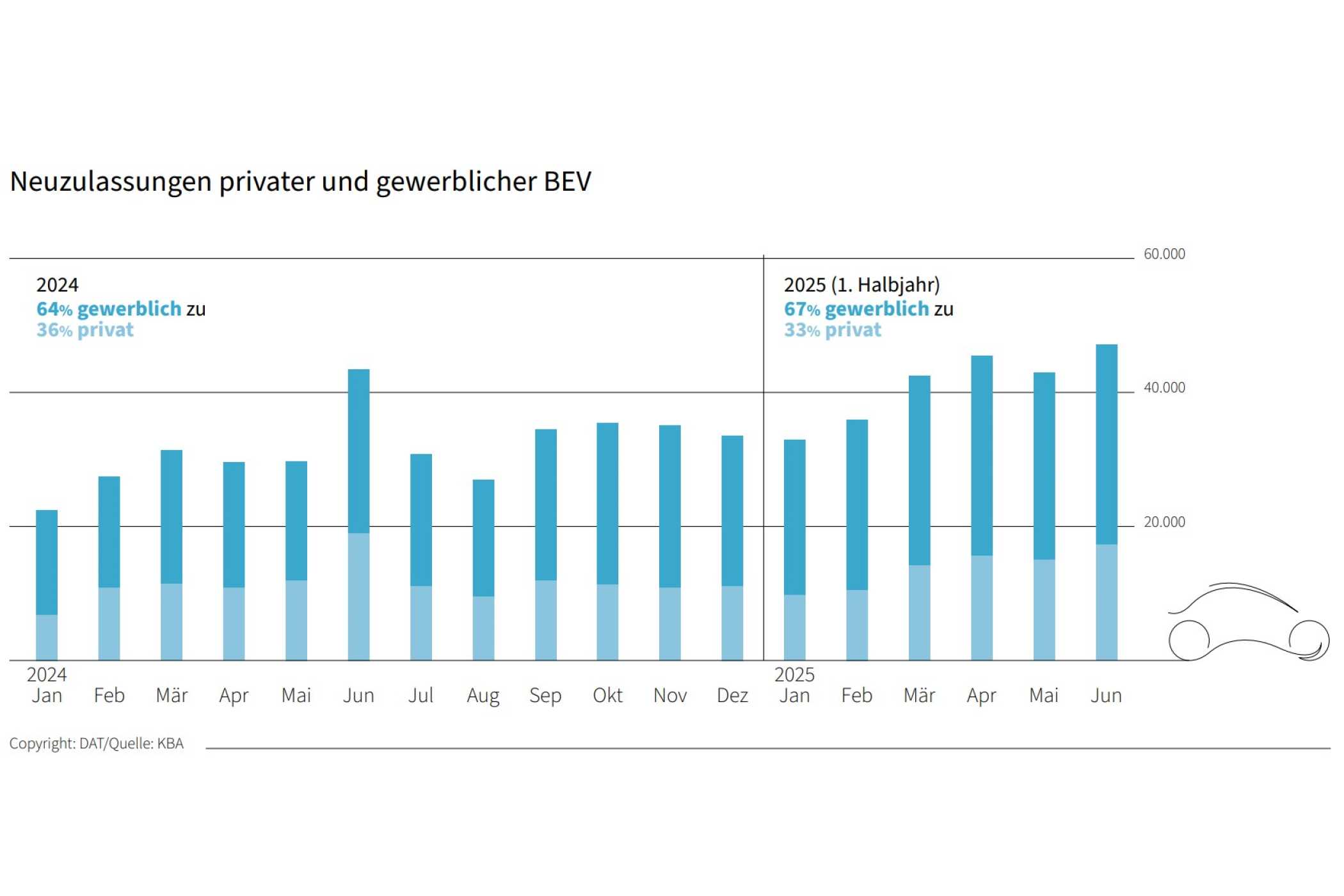
Particularly noticeable is the stabilization in the ratio of private to commercial registrations of battery electric vehicles (BEV). While private customers held back significantly in 2024, the first six months of the current year show a slight recovery: Around 82,000 privately newly registered BEVs compare to over 103,000 ownership transfers. The used market remains attractive, but the new car segment is slowly catching up.
Commercially registered BEVs still account for around two-thirds of new registrations - a ratio that has solidified since the beginning of the year. The plug-in hybrid (PHEV) remains a favorite in company fleets, mainly due to tax advantages, even though the number of pure electric cars is now twice as high on a monthly average.


A Realistic Look at Internal Combustion Engines
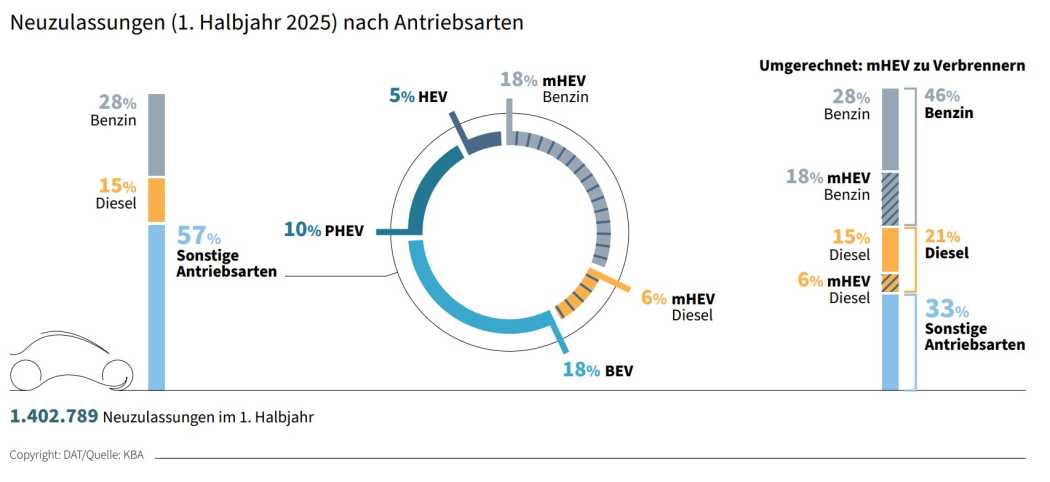
The official statistics on drive types from the Federal Motor Transport Authority count mild hybrids among electrified vehicles – a detail that distorts the market overview. Correctly categorized, a different picture emerges: Petrol vehicles remain clearly in the lead with a 46 percent market share, diesel vehicles are at 21 percent. The group of "alternative drives" - BEV, PHEV, gas, hydrogen - accounts for 33 percent, with BEVs making up the largest share at 18 percent.
This sober assessment may dispel some expectations, but it more accurately reflects the actual conditions – and helps keep the debate about the drive of the future grounded.
Residual Value Issues with E-Cars Remain
A topic that occupies both manufacturers and dealers equally is the resale value of electric vehicles. While three-year-old petrol cars currently achieve about 64 percent of their new price, comparable BEVs are only at about 50 percent – despite having a higher list price at the time of initial registration. Diesel vehicles also perform better with around 62 percent. Although the residual values for all drives are slightly decreasing, the gap remains significant and poses a consideration especially for private buyers.
The numbers from the first half of the year can be interpreted in two ways: as an expression of an economic weakness – or as a slow stabilization in a market that needs to reorganize itself. The times of state purchase incentives are over, and the technology decision increasingly lies with the customer. The market is changing. Not with big leaps, but in a direction that could prove to be more sustainable.
Content automatically translated.


Taxi-Fahrzeuge (Pkw) , Taxi-Newsletter, Taxameter, Taxi-Fahrer , BZP – Deutscher Taxi- und Mietwagenverband , Straßenverkehrsordnung (StVO) , Krankenbeförderung , Weiterbildung , Taxi-Konzessionen , Verkehrspolitik , Mietwagenbranche , Taxi-Apps , Berufskraftfahrer-Qualifikations-Gesetz BKrFQG) , Taxizentralen , Personal, Gehälter, Arbeitsschutz , Wirtschaftsnachrichten , Werbung , Taxi-Folierung , Taxi-Umrüster , Straßenverkehr , Elektromobilität, Taxifuhrpark und -flottenmanagement , Taxi-Versicherungen , Hybrid, Diesel, Erdgas , Taxi-Magazin