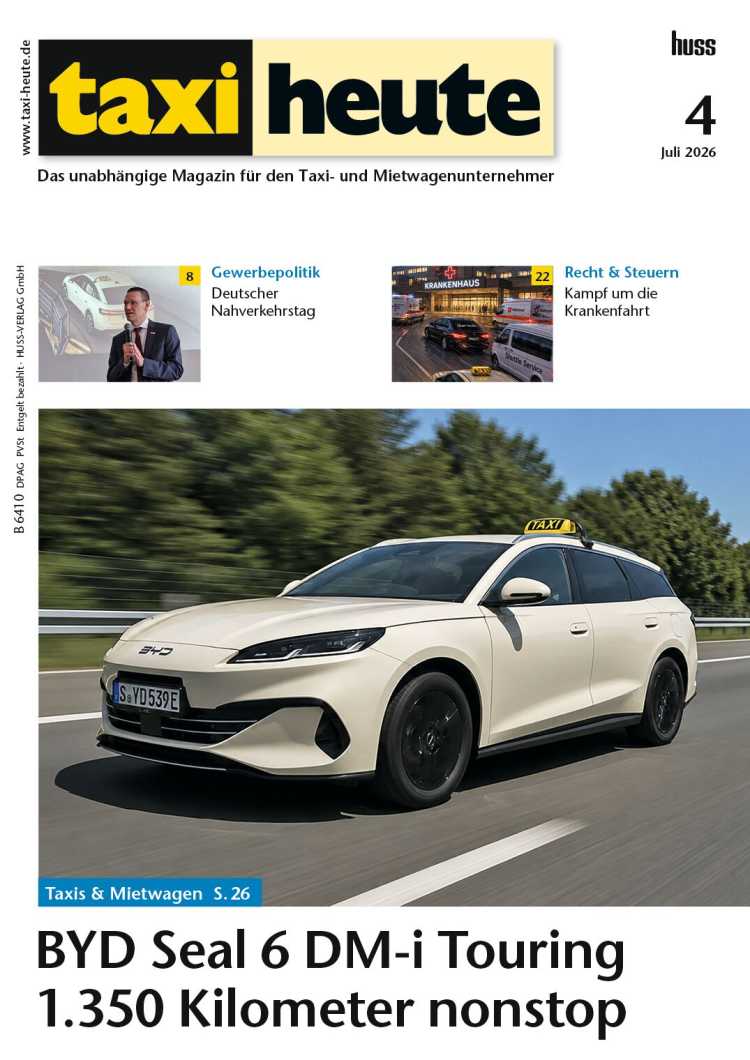
2 Ausgaben kostenlos für Sie

Fachmagazin taxi heute: Ihr Zugang zu exklusiven Inhalten rund um die Taxi- und Mietwagenbranche.
Aktueller Termin

Meist gelesen
Mobility rethought: Alternative Public Transport Summit shifts focus to taxis and on-demand transport

When people talk about public transport, they usually think of buses, trams, or regional trains. But mobility is changing. Shift work, aging populations, rural areas with sparse populations, and the desire for individual mobility options is increasingly challenging the traditional route network. It is exactly at this point that the Alternative Public Transport Summit comes into play, which will take place for the first time in Berlin on 25 November 2026. Under the motto “Modern Public Transport is more than lines” the Federal Association of Taxi and Rental Cars (BVTM) aims to kick off a discussion that goes beyond the traditional boundaries of public transport. The message is clear: Public mobility no longer consists exclusively of timetables and stops.
When the bus no longer provides every answer
The debate did not arise by chance. In many regions of Germany, transport operators are grappling with rising costs, staff shortages and declining ridership on individual routes. At the same time, political pressure is growing to ensure mobility even where traditional line services are no longer economically viable. For years, transport experts have therefore been discussing new forms of public service provision. On-call buses, on-demand shuttles, digital booking systems, and taxi services are increasingly seen as a complement to traditional public transport. Especially in off-peak periods or in rural areas, flexible offerings can often create mobility where a scheduled bus would ride empty through the countryside. The Alternative Public Transport Summit addresses exactly this development.
Science and Practice at One Table
The event will be opened by Dr. Claudia Elif Stutz, State Secretary in the Federal Ministry of Transport. Subsequently, the mobility and futures researcher Prof. Dr. Stephan Rammler will, together with Gregor Beiner, open the substantive debate. The selection of speakers already shows the organizers' claim: It is not solely about the perspective of individual transport modes, but about the question of how mobility can be organized in the future.
In the first block of topics, “Rethinking Public Transport,” the mobility expert Katja Diehl and the transport scientist Prof. Andreas Knie discuss how the understanding of public mobility must change. The focus is on whether public transport in the future should be conceived more from the needs of passengers—and less from rigid route networks.
What role will taxis play in the future?
For the taxi and car-rental industry, this discussion is of particular importance. While public debates are often shaped by large-scale projects, autonomous vehicles or new rail connections, taxis have fulfilled for decades a role that is increasingly important: they close mobility gaps.
Elderly people get to the doctor, people without their own car reach train stations, shift workers come home at night and mobility-impaired passengers gain access to transport options that would otherwise often not be reachable.
In the second theme block “Make Public Transport Work Differently” the focus is therefore on the practical implementation of new mobility concepts. From 4 p.m., Michael Oppermann, Managing Director of the Federal Association of Taxi and Car Rental, Dr. Alexandra Bensler and Benjamin Pfeifer discuss how different transport modes can be sensibly linked together.
More than just an industry debate
For the organizers, the emphasis is less on defending existing structures than on seeking new solutions.
“We want, with the Alternative Public Transport Summit, to deliberately bring together people and perspectives that rethink public mobility. The agenda shows how broad this discussion must be: from scientific and societal impulses to concrete solutions from practice to political debate. Our goal is not to simply continue existing structures, but to talk together about which offerings people will really need in the future and how we can connect them in a meaningful way,” explains Floris Cooijmans, organizer of the Alternative Public Transport Summit at the Federal Association of Taxi and Rental Cars.
The formulation points to a change that can already be observed in many European cities. Mobility is increasingly understood as a network in which different modes of transport are interconnected. The path to the goal often determines more about the quality of the offering than the question of which transport mode is used individually.
A look at the mobility of tomorrow
At the end of the event, Michael Donth, Dr. Wiebke Zimmer, Gregor Beiner and Martin Bill will discuss the future of public transport. The round will be moderated by Jana Kugoth, Editor for Transport & Smart Mobility at Tagesspiegel Background. The topics range from socially just mobility to accessibility to autonomous traffic systems and digital platforms. In this way, the summit reflects a development that is likely to shape the industry in the coming years: public mobility will need to be more diverse, more interconnected and more focused on individual needs. Whether bus, rail, taxi, shuttle or autonomous vehicle – the real question is no longer which mode of transport wins. What will be decisive is how they will work together in the future.
The Alternative Public Transport Summit will address precisely that. And to spark a debate that is relevant for cities as well as rural regions—and for an industry that has long pointed out that modern public transport often starts where the next bus line ends.
The Alternative Public Transport Summit will take place on Wednesday, 25 November 2026, in Berlin. The program begins at 2:00 PM, and networking with dinner is planned from 7:00 PM.
Further information and registration: https://bundesverband.taxi/termin/oepnv-gipfel-in-berlin/
Content automatically translated.


Taxi-Fahrzeuge (Pkw) , Taxi-Newsletter, Taxameter, Taxi-Fahrer , BZP – Deutscher Taxi- und Mietwagenverband , Straßenverkehrsordnung (StVO) , Krankenbeförderung , Weiterbildung , Taxi-Konzessionen , Verkehrspolitik , Mietwagenbranche , Taxi-Apps , Berufskraftfahrer-Qualifikations-Gesetz BKrFQG) , Taxizentralen , Personal, Gehälter, Arbeitsschutz , Wirtschaftsnachrichten , Werbung , Taxi-Folierung , Taxi-Umrüster , Straßenverkehr , Elektromobilität, Taxifuhrpark und -flottenmanagement , Taxi-Versicherungen , Hybrid, Diesel, Erdgas , Taxi-Magazin