2 Ausgaben kostenlos für Sie

Fachmagazin taxi heute: Ihr Zugang zu exklusiven Inhalten rund um die Taxi- und Mietwagenbranche.
Aktueller Termin

Meist gelesen
Electric cars in Down Under - increasingly electric

Whenever you think of Australia, you picture in your mind hopping kangaroos, parched steppes, sport-loving inhabitants and a handful of turbulent metropolises. Sydney is one such city that among world cities is usually only mentioned in the second or third tier. Situated on a protective harbour basin with a unique history, it is with around five and a half million inhabitants significantly larger than many think. If you add the other million-plus agglomerations Melbourne, Brisbane and Perth, you see how sparsely populated the country is with its more than 7.5 million square kilometres of area. Sydney is, despite its numerous historic buildings, a modern, distinctly young city. This is also evident in the street scene, because joggers, pedestrians and cyclists have long been setting the tone here. The narrow streets are crowded and even for short distances one must plan for longer times. Not only because the harbour basin, countless tunnels and the legendary Harbour Bridge are car bottlenecks that cost time – day after day.





Off-road performance in the Outback is crucial
After General Motors closed its last local Holden plant, the Australian car industry lacks a flagship. With 1.2 million new vehicles in 2025, the car industry Down Under is nevertheless doing quite well. Outside the big cities, almost everything in the road scene revolves around pickups, and even between the narrow canyons of Sydney or Melbourne there are Toyota Hilux, Ford Ranger or Mitsubishi L200 to be seen at every corner. Most of these are heavily modified with mud-terrain tires, air snorkels, LED auxiliary lights, and bull bars are an absolute must. Daily, in each state, there are serious collisions between kangaroos or armadillos and cars. No wonder that even many overland buses, police or ambulances are equipped with protective grilles. The domestic car market in Australia is dominated by Toyota, which sold just under 240,000 vehicles last year. In second place by a huge margin were Ford (94,000) and Mazda (91,000), followed by the South Korean duo Kia (82,000) and Hyundai (77,000 vehicles). More than 60 percent of the more than 1.2 million new registrations in 2025 are crossovers—mostly with all-wheel drive. The best-selling car: the midsize Ford Ranger pickup.
Tesla loses ground in Australia
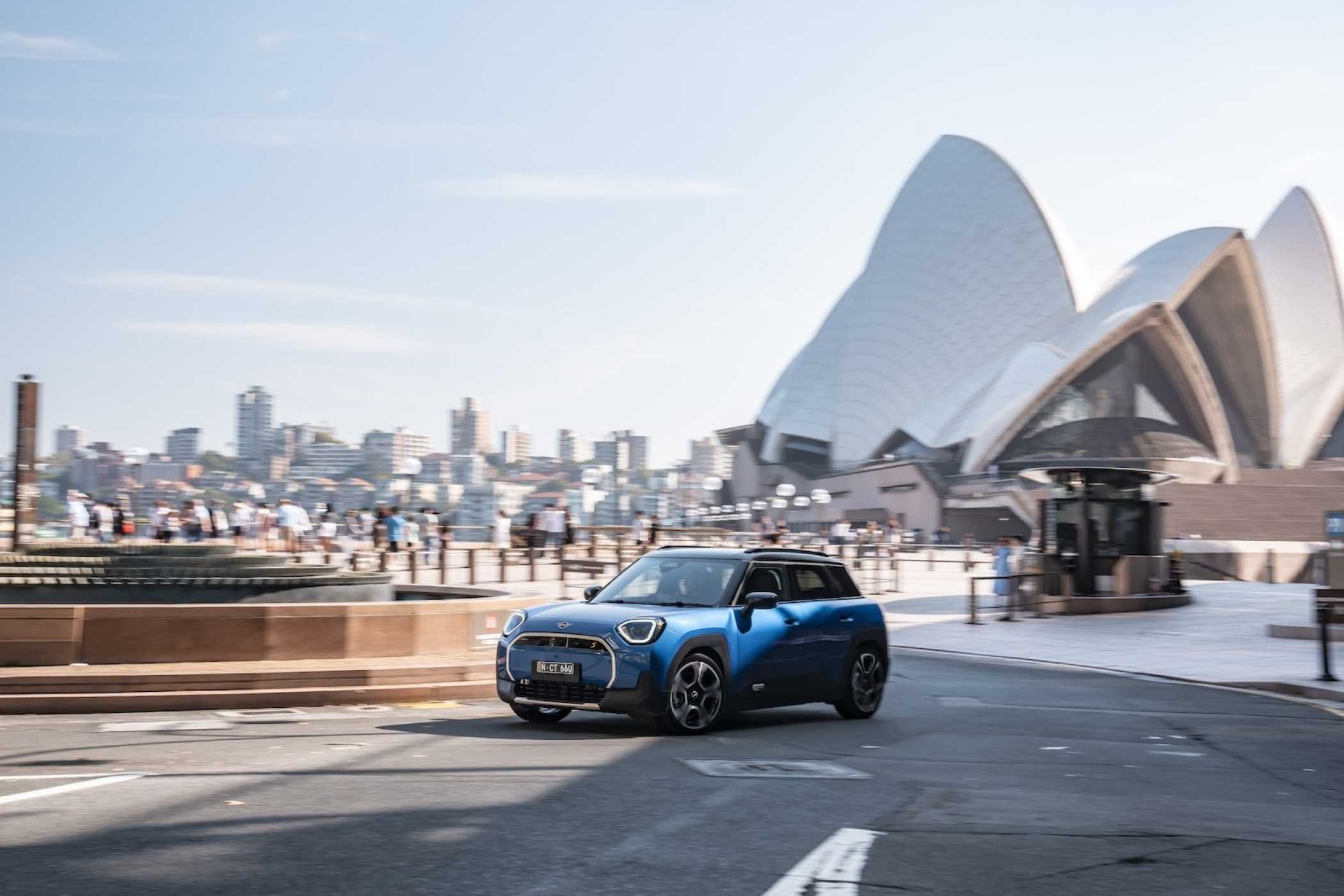
But those who look closely see that among the pickup trucks with open cargo beds under the blazing sun, even in the Southern Hemisphere more and more electric cars are mixing in. The blue Mini Aceman stands out in traffic not only because of its bold coloration. Tourists and locals turn around when the compact crossover rolls by almost silently. From the tourist district The Rock, it goes past Cruise Terminal over the Harbour Bridge to North Sydney. Here is one of the few fast charging stations, because even though electric cars with a sales share of 8.3 percent are becoming more popular, there is little progress at the charging stations. At the BP gas station there are at least two fast chargers – at a mere 75 kW. Even the market leader Tesla operates hardly any Superchargers in metropolitan areas such as Sydney. At charging stations such as Ridge Street, Queen Street or at Cammeray Square the cost per kWh ranges between 0.60 and 0.75 cents – 0.38 to 0.60 euros. Sometimes parking costs are added, and in the garages they are gigantic – quickly more than 15 euros per hour. After all, beside the charging costs, the fueling costs are also manageable. A liter of petrol costs 1.70 Australian dollars – around one euro.
“The number of charging stations here is not comparable to those in Europe,” says Alexander Brockhoff, General Manager of Mini Australia, “most customers charge their vehicles at home. We now have an electric share of around 30 percent.”
Electric share: 8 percent
Electric mobility is on the rise, especially in the cities, and the electric share nationwide is currently just over eight percent. Plug-in hybrids are also clearly on the rise, not least due to corresponding subsidies. Almost 54,000 new registrations mean an increase of 130 percent in the past year. The so-called “New Vehicle Efficiency Standard” as well as the “Federal Electric Car Discount” are expected, together with currently more than 85 models on the local market, to ensure that the numbers of plug-in models rise significantly. However, if you are traveling longer distances between the metropolises Sydney, Brisbane, Canberra or Melbourne, you should check in advance where you can charge, because the network of fast chargers is thin and more than 150 kW is as rare as a lively koala bear. Good for the range of electric models: the speed limits of up to 100/110 km/h on the highway are as strictly enforced as the 50 to 70 km/h limits in inner cities. At best you can floor it through the desolate Outback once.
Chinese manufacturers pay no tax
Not least, this is driven by car manufacturers from Asia, and especially China, which are increasingly expanding on the Australian market. Without tariff barriers they have more than replaced the now-defunct Australian car production, and so Chinese brands such as BYD, MG or Great Wall Motors are increasingly penetrating the volume segments. When it comes to high-priced models, however, there is hardly a path past vehicles from Europe and Germany. “Cars that cost more than 91,000 Australian dollars also incur a luxury tax of 33 percent,” says Johannes Schoen, responsible for Mercedes sales on the continent, “that already affects a C-Class or a GLC for us.” If the new vehicle consumes more than seven liters per 100 kilometers, the luxury tax starts at 80,000 Australian dollars.
Away from the cities, pickups dominate
Along with the endless expanses and often unpaved roads in the Outback it's no great surprise that the registrations are dominated by SUVs and pickups such as Ford Ranger / Everest, Toyota RAV4 / Hilux or Toyota Land Cruiser Prado. The two large import brands are likely to increasingly contend in the coming years with manufacturers from China and South Korea, because both nations place a strong emphasis on electric crossovers and benefit from a tariff-free zone.
Our man at the controls: Stefan Grundhoff; press-inform
Content automatically translated.


Taxi-Fahrzeuge (Pkw) , Taxi-Newsletter, Taxameter, Taxi-Fahrer , BZP – Deutscher Taxi- und Mietwagenverband , Straßenverkehrsordnung (StVO) , Krankenbeförderung , Weiterbildung , Taxi-Konzessionen , Verkehrspolitik , Mietwagenbranche , Taxi-Apps , Berufskraftfahrer-Qualifikations-Gesetz BKrFQG) , Taxizentralen , Personal, Gehälter, Arbeitsschutz , Wirtschaftsnachrichten , Werbung , Taxi-Folierung , Taxi-Umrüster , Straßenverkehr , Elektromobilität, Taxifuhrpark und -flottenmanagement , Taxi-Versicherungen , Hybrid, Diesel, Erdgas , Taxi-Magazin