Ihr kostenloser Branchen-Newsletter

Lassen Sie sich von unseren Fachjournalisten einmal wöchentlich über die wichtigsten aktuellen Entwicklungen der Taxi-Branche informieren, bequem direkt in Ihre Mailbox.
Aktueller Termin

Meist gelesen
BVTM increases pressure on municipalities: Minimum prices for rental cars regulate competition!
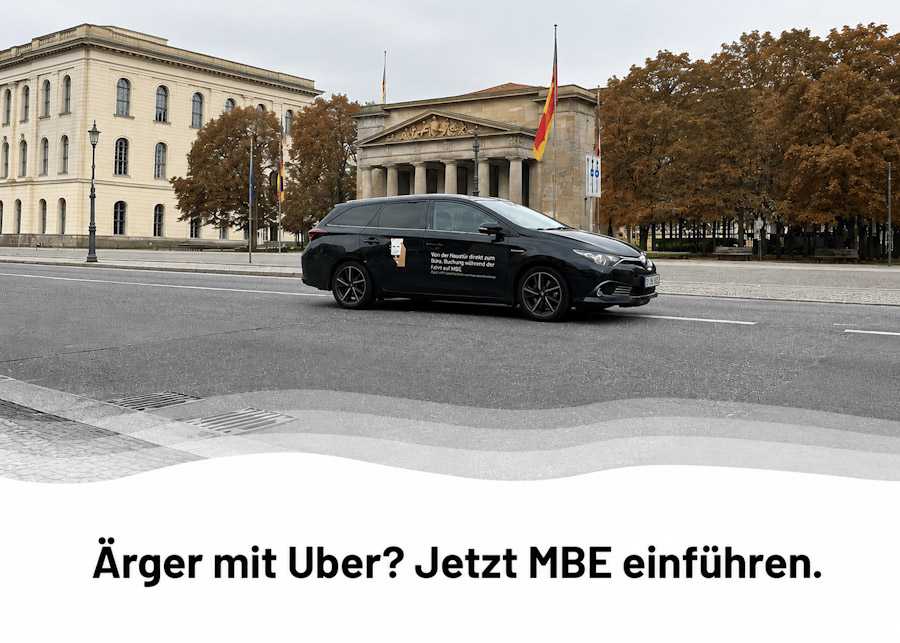
The Federal Association for Taxi and Rental Cars (BVTM) now provides a political and legal guide on how cities and municipalities can respond to this development. The message is clear: minimum transport charges for rental cars – abbreviated MBE – are currently the most effective instrument against ruinous competition in app-dispatched transport.
The significance of this paper extends beyond the taxi industry. For the guide is expressly aimed at municipal decision-makers. It should show city halls and licensing authorities a legally secure way to respond to market distortions without waiting for lengthy federal political reforms. The association does not argue solely on behalf of the taxi industry. What is notable is rather whom the paper relies on: customs authorities, experts, and the Federal Constitutional Court.


Customs control in Cologne, Munich and Berlin
The assessments by the Financial Control of Illegal Employment are particularly evident. The Cologne Customs Office points to problematic business models in the rental-car sector:
„From the review of the actual driving data we see: in part, cash payments generate under-the-table wages that the drivers then pocket, and this already amounts to fraud against the social security providers.“
The Munich Customs Office also speaks of structural problems:
„The findings primarily concern violations of social-security-related reporting and contribution obligations as well as violations of the Minimum Wage Act. According to current assessment, in numerous cases there are not isolated irregularities, but at least partly structurally designed business models.“
The Berlin Customs Office draws from this a clear conclusion:
„In conclusion, it is essential to introduce minimum tariffs in the rental-car sector to prevent the taxi trade from being completely displaced from the market.“
PBefG provides the solution
The BVTM uses these statements deliberately to increase political pressure on cities. Because since the reform of the Passenger Transport Act, municipalities have had an instrument that had long been demanded. § 51a PBefG expressly allows licensing authorities to set tariff-related regulations and, in particular, minimum transport fares, to protect the public transport interests.
For many municipalities, however, it had until now been unclear how far this latitude actually extends. This is precisely where the new guidance on action begins. It translates legal possibilities into concrete administrative steps: collect data, prepare the political decision, review existing models, and then implement minimum prices by general decree – preferably with immediate effect.
The association points to cities such as Munich, Cologne, Essen, or Heidelberg that have already adopted or introduced corresponding regulations.
Backed by expert assessments
The argumentation also gains momentum from several expert assessments. Thus, IGES Mobility concludes in a study for the city of Dortmund that:
„A minimum transport fare for rental cars is a necessary prerequisite to offset the pricing options in taxi and rental-car traffic, and is even the only suitable municipal instrument for this purpose.“
More fundamentally, the Federal Constitutional Court has already stated in an older ruling. If rental-car companies were allowed to operate without tariff binding and contracting obligation like taxis, this could, through undercutting the taxi tariff, undermine the competitiveness of taxi traffic. The debate about minimum transport fares is thus increasingly developing into a fundamental question of municipal transport policy. It is no longer solely about taxi tariffs or app discounts. At its core is the question of which rules will apply in a mobility market in which digital platforms meet public services.
Content automatically translated.



Taxi-Fahrzeuge (Pkw) , Taxi-Newsletter, Taxameter, Taxi-Fahrer , BZP – Deutscher Taxi- und Mietwagenverband , Straßenverkehrsordnung (StVO) , Krankenbeförderung , Weiterbildung , Taxi-Konzessionen , Verkehrspolitik , Mietwagenbranche , Taxi-Apps , Berufskraftfahrer-Qualifikations-Gesetz BKrFQG) , Taxizentralen , Personal, Gehälter, Arbeitsschutz , Wirtschaftsnachrichten , Werbung , Taxi-Folierung , Taxi-Umrüster , Straßenverkehr , Elektromobilität, Taxifuhrpark und -flottenmanagement , Taxi-Versicherungen , Hybrid, Diesel, Erdgas , Taxi-Magazin