2 Ausgaben kostenlos für Sie

Fachmagazin taxi heute: Ihr Zugang zu exklusiven Inhalten rund um die Taxi- und Mietwagenbranche.
Aktueller Termin

Meist gelesen
VW launches self-driving Bulli on the road
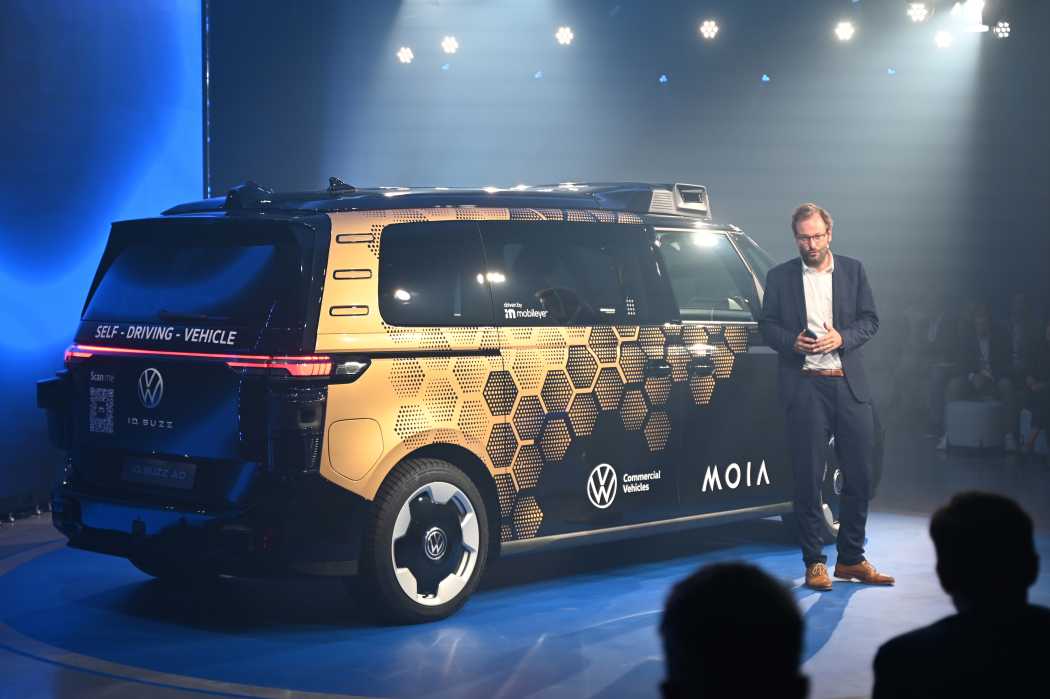
Volkswagen has presented the production version of its first fully autonomous vehicle in Hamburg. The ID Buzz AD (Autonomous Driving) is set to go into operation in Hamburg and Los Angeles starting in 2026. Regular operations in Hamburg are scheduled to begin in 2027.
"This positions the Volkswagen Group in the leading group of a billion-dollar global growth market," said Group CEO Oliver Blume at the world premiere in Hamburg. "From 2026, we will make sustainable, autonomous mobility available on a large scale in Europe and the USA."
Approval Sought by End of 2026
VW aims to obtain authorization for driverless operation at SAE Level 4 in both Europe and the USA by the end of 2026. After that, a safety driver, which has been legally required until now, could be omitted. According to VW, this would be the first approval of its kind for a series vehicle in Europe.
Production and Planned Quantities
The production of the ID Buzz AD takes place at the VW Commercial Vehicles plant in Hanover. The model is designed not as a small series but for larger quantities. The delivery of more than 10,000 vehicles is planned. By the end of 2027, 1,000 units are expected to be on the road. According to VW, ride-hailing service Uber alone has expressed interest in up to 10,000 vehicles over the next ten years.
"And there will be more contracts with customers," said Christian Senger, who is responsible for autonomous driving on the board of VW Commercial Vehicles. "We are confident that we will have more than Hamburg in Germany by 2027."
Initially, the start of regular operations in Hamburg was planned for 2026; now it is expected to begin in 2027. In the medium term, the fleet could grow to 500 self-driving e-Bullis, said Sascha Meyer from VW's in-house ride-sharing provider Moia, which operates the vehicles in Hamburg. Test drives with prototypes have been taking place there since 2023.
Technical Equipment and Vehicle Concept
The autonomous vehicle is equipped with 13 cameras, nine lidar sensors, and five radar systems. It can drive fully autonomously at speeds of up to 120 km/h. The production version differs from the previous prototype by a slightly enlarged body and offers four seats for passengers instead of the previous three.
Test Operation and Experience
Since 2021, VW has been conducting test drives with the ID Buzz AD. Currently, 100 vehicles are in use in cities such as Munich, Hamburg, Austin, and Oslo. According to the company, the test fleet has covered more than 600,000 kilometers so far.
```Focus on Fleet Customers
A sale to private customers is not intended. The reasons for this are the limited areas of use of the vehicle and the necessity of a monitoring control center. Additionally, the price would be in the low six-figure euro range. VW is specifically targeting fleet operators with the ID Buzz AD, particularly transportation companies. In Hamburg, there is a cooperation with HVV, and in Berlin, there is a corresponding letter of intent with BVG.
Market Perspective
In the short term, the company does not expect any profits from the project. In the long term, however, VW sees autonomous driving as a profitable business field with significantly higher margins than in the classic automobile sector.
Content automatically translated.



Taxi-Fahrzeuge (Pkw) , Taxi-Newsletter, Taxameter, Taxi-Fahrer , BZP – Deutscher Taxi- und Mietwagenverband , Straßenverkehrsordnung (StVO) , Krankenbeförderung , Weiterbildung , Taxi-Konzessionen , Verkehrspolitik , Mietwagenbranche , Taxi-Apps , Berufskraftfahrer-Qualifikations-Gesetz BKrFQG) , Taxizentralen , Personal, Gehälter, Arbeitsschutz , Wirtschaftsnachrichten , Werbung , Taxi-Folierung , Taxi-Umrüster , Straßenverkehr , Elektromobilität, Taxifuhrpark und -flottenmanagement , Taxi-Versicherungen , Hybrid, Diesel, Erdgas , Taxi-Magazin