VISION mobility kostenlos Probelesen

Die Zeitschrift VISION mobility richtet sich an mobilitätsbegeisterte Menschen bzw. Flottenmanager und begleitet den Technologiewandel in Sachen Automotive und Mobilität.
Aktueller Termin
Meist gelesen
What special rights apply to taxis? This is regulated by the Passenger Transportation Act (PBefG) and the Road Traffic Regulations (StVO).

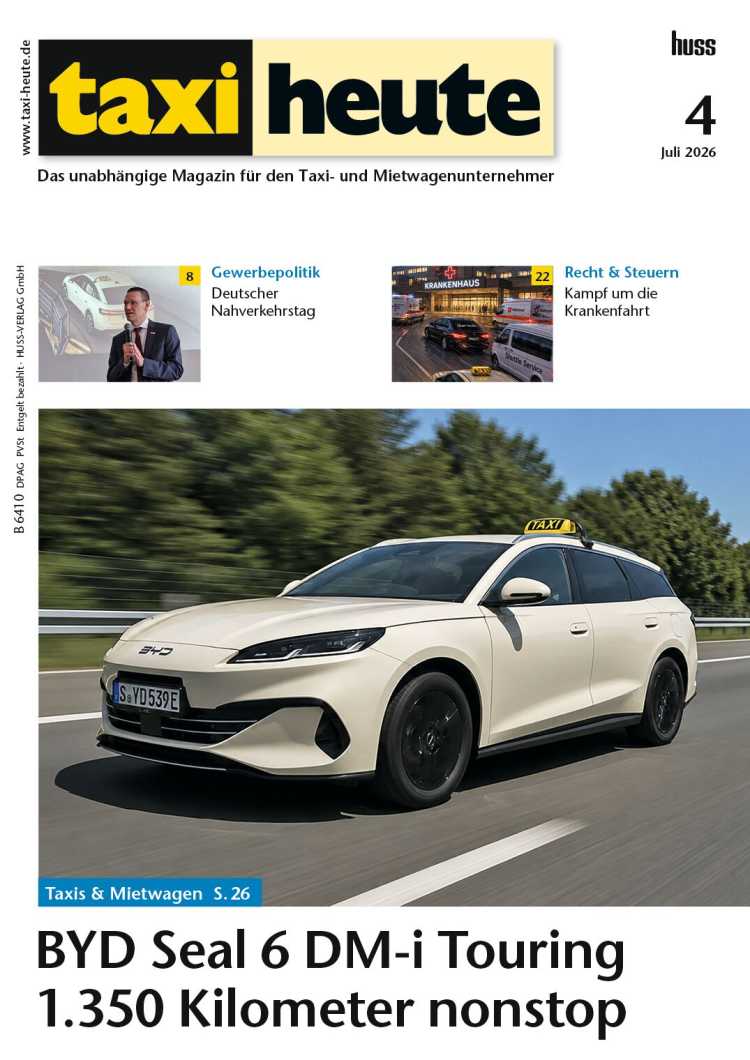
The Passenger Transport Act (PBefG) and the Road Traffic Act (StVO) not only define the rights and obligations in everyday professional life but also special features such as the color required for taxis in most federal states: light ivory.
Transport Obligation and Exceptions
The PBefG regulates the commercial transportation of persons. A central provision is the transport obligation: Taxi drivers must transport every passenger within their obligatory driving area who requests it. A refusal is only allowed in exceptional cases, for example, when there are safety concerns. This could be the case with heavily intoxicated or aggressive passengers. Additionally, taxis are required to prioritize the transportation of passengers with disabilities. Violations of these regulations can lead not only to fines but, in serious cases, also to the revocation of the concession.
Stopping in the Second Row
According to § 12 of the German Road Traffic Regulations (StVO), stopping or parking in the second row is generally prohibited. However, there is an exception for taxis: they are allowed to stop in the second row if it is necessary to allow passengers to board or alight. This must be done quickly and without compromising the safety of other road users. Anyone who parks in the second row for an extended period risks a fine starting at 55 euros.
Use of Bus Lanes
In many cities, taxis are allowed to use bus lanes to alleviate traffic and bring passengers to their destinations more quickly. However, this option is only available if supplementary signs with the inscription "Taxi frei" (Taxi free) are posted. The regulations for this vary from municipality to municipality.
Those driving in bus lanes must also observe the special signals for scheduled traffic and must not obstruct them. Stopping or parking on bus lanes is prohibited. Moreover, bus lanes on streets with rail tracks are not to be used.
No Exceptions for Speed
Even if some passengers urge for haste, taxi drivers are subject to the same speed limits as all other road users. There are no special regulations allowing higher speeds. Violations of speed limits are punished according to general guidelines. Exceeding the speed limit by 21 to 25 km/h in urban areas results in a fine of 115 euros and one point in Flensburg. Those who drive more than 70 km/h over the limit face a fine of 680 euros, two points, and a driving ban of three months.
No special rights at red lights
Running a red light is a serious violation of the Road Traffic Act and is strictly prohibited for taxis as well. Such a disregard for the rules is penalized with a fine of at least 90 euros and one point on the driving record in Flensburg if the light was red for less than one second. If the light was red for a longer time, a 200 euro fine, two points, and a one-month driving ban are imposed.
Taxi drivers do not enjoy any exceptions. The only deviation from the rule applies to emergency vehicles of the police, fire brigade, and rescue services.
Bu içerik Almancadan Türkçeye otomatik olarak çevrildi.


Taxi-Fahrzeuge (Pkw) , Taxi-Newsletter, Taxameter, Taxi-Fahrer , BZP – Deutscher Taxi- und Mietwagenverband , Straßenverkehrsordnung (StVO) , Krankenbeförderung , Weiterbildung , Taxi-Konzessionen , Verkehrspolitik , Mietwagenbranche , Taxi-Apps , Berufskraftfahrer-Qualifikations-Gesetz BKrFQG) , Taxizentralen , Personal, Gehälter, Arbeitsschutz , Wirtschaftsnachrichten , Werbung , Taxi-Folierung , Taxi-Umrüster , Straßenverkehr , Elektromobilität, Taxifuhrpark und -flottenmanagement , Taxi-Versicherungen , Hybrid, Diesel, Erdgas , Taxi-Magazin