VISION mobility kostenlos Probelesen

Die Zeitschrift VISION mobility richtet sich an mobilitätsbegeisterte Menschen bzw. Flottenmanager und begleitet den Technologiewandel in Sachen Automotive und Mobilität.
Aktueller Termin

Meist gelesen
Dataforce study shows significant declines in new registrations of BEVs in December 2024, while commercial vehicles are on the rise.

In Germany, the passenger car market ended the last month of the year with a decline of 7.1 percent. Particularly noticeable was the significant 17.3 percent drop in private new registrations. Other sales channels also fell below their previous year's levels. The only exception was car rental companies, with an increase of 14.9 percent. The primary reason for the weak performance of the private market lies in the sales of electric vehicles. BEVs plummeted by 64 percent compared to December 2023. So, only a little more than a third of the comparison value was registered.
However, this comparison is also distorted by early registrations last year because registering in December 2023 was the last opportunity to apply for the environmental bonus. That it is a special effect is also shown by the development of the BEV market share in the private market. In December, 15.3 percent of buyers opted for an electric car, slightly more than the annual average (14.9%).


The annual balance shows a negative result with a decrease of 1.0 percent compared to the previous year. With 2.817 million new registrations, the German car market is still well below its long-term average.
Tactical registrations improve the result
In the market segments, there was a significant shift from demand-driven channels Private (-2.1%) and Relevant Fleet Market (-6.7%) towards tactical registrations for Car Rentals (+2.7%), Vehicle Trade (+9.2%), and Vehicle Manufacturing (+4.4%). Although this is strongly influenced by the respective starting levels—hardly any tactical registrations during the semiconductor shortage, catch-up effects in the fleet market in 2023—it is evident that car demand is severely impacted by the weak economic situation, general uncertainty, as well as high new car prices.



“In 2025, there will only be slight improvements in these factors; for a real change in trend, more momentum is needed,” explains Benjamin Kibies of Dataforce Verlagsgesellschaft für Business Informationen mbH.
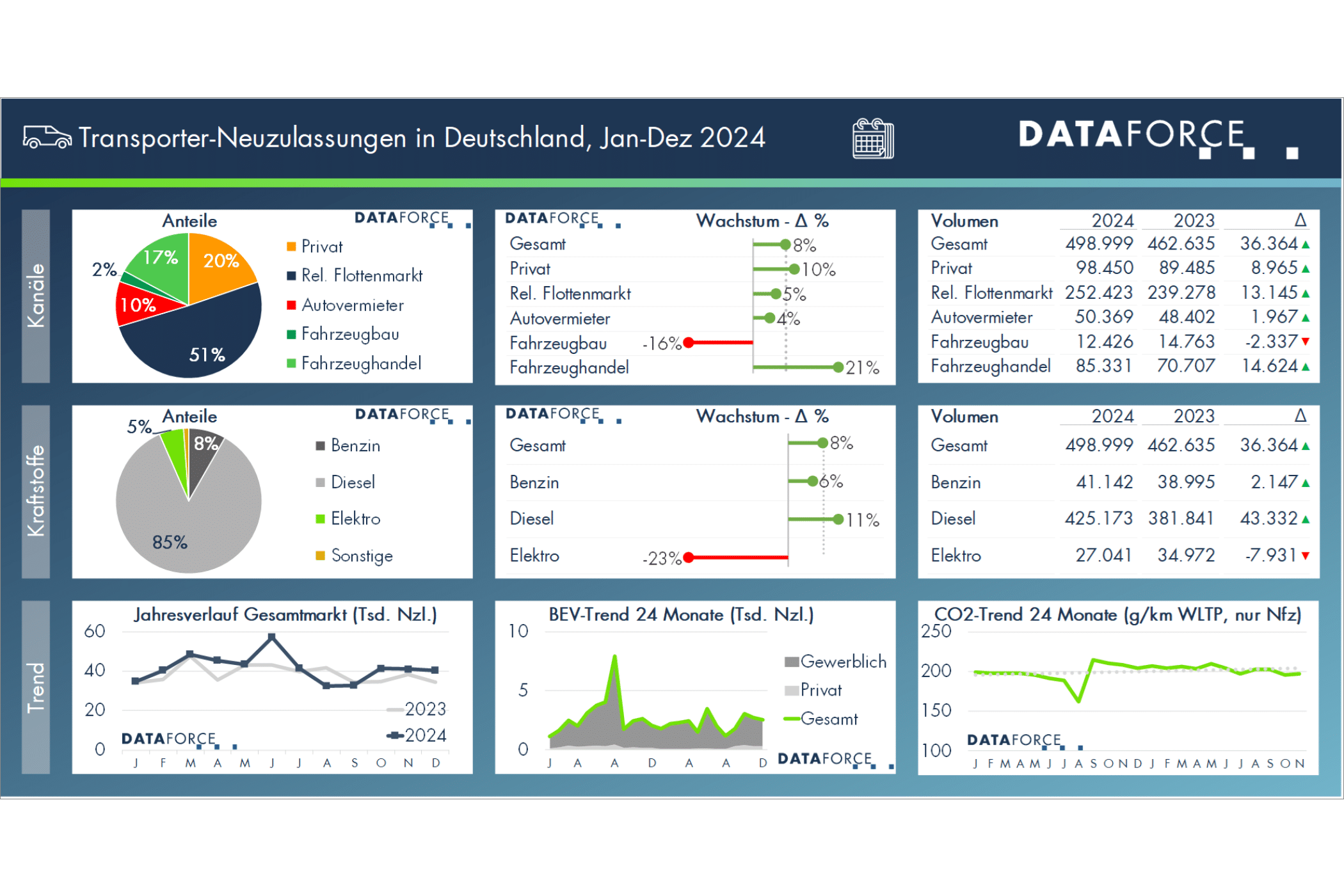
While the December business in the passenger car market was rather subdued, the van business developed almost stormily in the past month. New registrations of light commercial vehicles and passenger car utilities climbed by 21.2 percent to one of the highest December values ever. There were particularly sharp increases in the private market as well as in the self-registrations by vehicle manufacturers and dealers.
The reason for this strong growth lies less in the improving economy and more in purchases being brought forward. For in the course of the CO2 targets discussion for passenger cars, it is often overlooked that commercial vehicle manufacturers also have to meet significantly stricter requirements from 2025, while at the same time finding it even harder to mass-produce electric vehicles. In December 2024, however, a lower BEV share was still sufficient, allowing manufacturers to deliver more vehicles overall.
The annual balance for the van market also turns out significantly more positive with an 8 percent increase than in the passenger car market. Especially the private demand for passenger car utilities for use as family taxis or motorhomes has increased significantly by 10.0 percent.
The biggest challenge for 2025 will be to increase electric sales. Currently, only 5 percent of vans are delivered as BEVs. To completely avoid fines, the proportion would need to double. Since such a development is unlikely, manufacturers will probably have to pass the fines onto the prices of combustion engine vans.
Bu içerik Almancadan Türkçeye otomatik olarak çevrildi."Apart from the expected collapse in private electric registrations, the car market performed quite decently in December. However, the weak overall annual balance could not be salvaged by the last month. In 2025, the challenges for the automotive industry will be even greater, as significantly more electric vehicles need to be sold. At least there are slight improvements in economic parameters, and customers can look forward to price reductions and new small and compact electric cars," Benjamin Kibies concludes.






Taxi-Fahrzeuge (Pkw) , Taxi-Newsletter, Taxameter, Taxi-Fahrer , BZP – Deutscher Taxi- und Mietwagenverband , Straßenverkehrsordnung (StVO) , Krankenbeförderung , Weiterbildung , Taxi-Konzessionen , Verkehrspolitik , Mietwagenbranche , Taxi-Apps , Berufskraftfahrer-Qualifikations-Gesetz BKrFQG) , Taxizentralen , Personal, Gehälter, Arbeitsschutz , Wirtschaftsnachrichten , Werbung , Taxi-Folierung , Taxi-Umrüster , Straßenverkehr , Elektromobilität, Taxifuhrpark und -flottenmanagement , Taxi-Versicherungen , Hybrid, Diesel, Erdgas , Taxi-Magazin