Ihr kostenloser Branchen-Newsletter

Lassen Sie sich von unseren Fachjournalisten einmal wöchentlich über die wichtigsten aktuellen Entwicklungen der Taxi-Branche informieren, bequem direkt in Ihre Mailbox.
Aktueller Termin

Meist gelesen
Uber & Co. - when citizens' income, part-time work and undeclared work come together
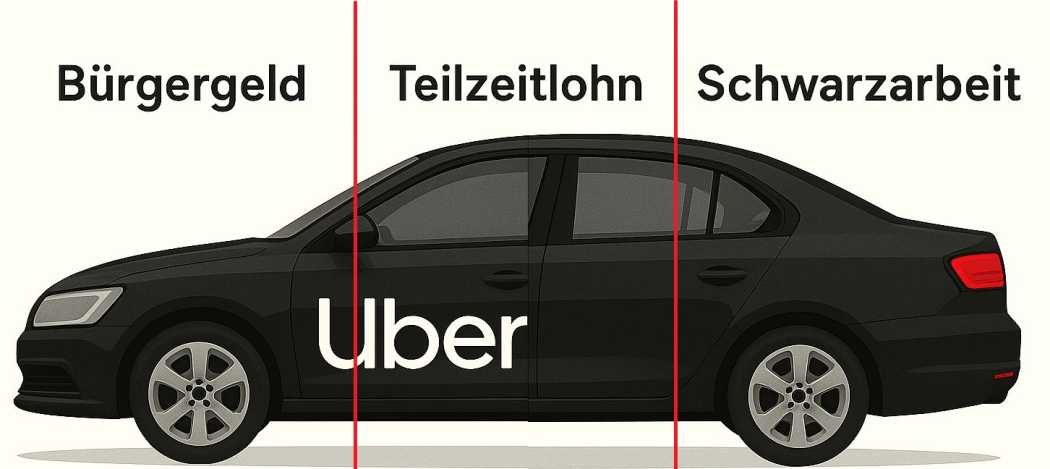
In "The Job Center Trap: What's Going Wrong with Citizens' Income?" job center employees report that many benefit recipients top up not because of low wages, but due to too few working hours. This is particularly noticeable among drivers for Uber and Bolt.
"It is kind of strange," says Marcel Eichenseher from the job center, "in certain industries part-time work is actually unusual, but among our clients it is quite common."
Around 90 percent of Citizens' Income top-up recipients work part time, according to the documentary. For drivers for platform services like Uber or Bolt, another suspicion arises: in addition to official income and state support, undeclared work is said to play a significant role. The customs authority speaks of a kind of "one-third solution" — one third regular income, one third Citizens' Income, one third undeclared pay. To get to the bottom of this practice, investigators access driver data from the apps.
As expected, Uber and Bolt deny responsibility
The companies themselves deny responsibility. Uber and Bolt see themselves as mere intermediaries and emphasize that in the event of violations they “respond immediately”—up to and including suspending individual drivers. Yet evidence shows that the problem is systemic.
Uber drivers anonymously described working up to ten hours a day while earning below the minimum wage. There are also reports of repaying earnings to subcontractors or of forged documents. The problem now apparently has also been recognized by the responsible tax office. According to its own statements, the Federal Ministry of Finance is currently working on a law intended to curb undeclared work in the taxi and private hire vehicle sector more effectively. The plans primarily include digital checks and an expansion of inspections.
Customs authorities have long been active as well
In May, almost 1,600 drivers were checked nationwide and more than 260 business records were reviewed. In the process, officials uncovered violations of the minimum wage, unpaid social security contributions, and illegal employment arrangements. The Frankfurt public prosecutor’s office also searched 49 properties linked to subcontractors of Uber and Bolt. The investigation concerns aggravated tax evasion and documented undeclared work; in one case, investigators found cash in the freezer.
Not isolated cases, but a system
This produces a picture that goes far beyond isolated cases. Experts see the Bürgergeld as a breeding ground for informal employment because income is not always closely monitored. Especially in economically uncertain times, this increases the incentive to conceal income.
The taxi and private hire industry, by contrast, is subject to stricter controls. Now, policymakers finally seem intent on increasing enforcement pressure on platform operators. Whether tougher laws and more intensive inspections will suffice remains to be seen. What is clear, however, is this: The interplay of state benefits, legal part-time work, and undeclared cash not only poses a challenge to the welfare state, but also distorts competition and ultimately drives the taxi industry into ruin.
Content automatically translated.




Taxi-Fahrzeuge (Pkw) , Taxi-Newsletter, Taxameter, Taxi-Fahrer , BZP – Deutscher Taxi- und Mietwagenverband , Straßenverkehrsordnung (StVO) , Krankenbeförderung , Weiterbildung , Taxi-Konzessionen , Verkehrspolitik , Mietwagenbranche , Taxi-Apps , Berufskraftfahrer-Qualifikations-Gesetz BKrFQG) , Taxizentralen , Personal, Gehälter, Arbeitsschutz , Wirtschaftsnachrichten , Werbung , Taxi-Folierung , Taxi-Umrüster , Straßenverkehr , Elektromobilität, Taxifuhrpark und -flottenmanagement , Taxi-Versicherungen , Hybrid, Diesel, Erdgas , Taxi-Magazin