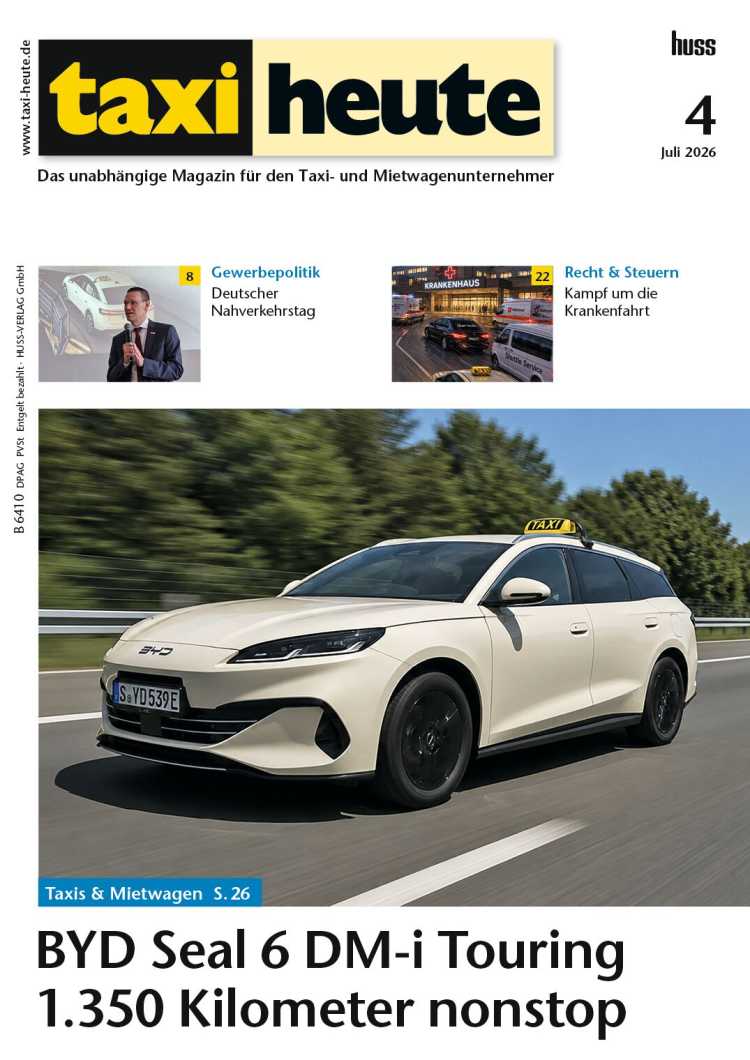
Ihr kostenloser Branchen-Newsletter

Lassen Sie sich von unseren Fachjournalisten einmal wöchentlich über die wichtigsten aktuellen Entwicklungen der Taxi-Branche informieren, bequem direkt in Ihre Mailbox.
Aktueller Termin
Meist gelesen
Toyota bZ4X Touring: Electric Wagon with Taxi Potential from 2026

The Touring is technically based on the well-known bZ4X, but differs significantly in form and purpose. The body lengthened by 14 centimeters brings it to 4.83 meters in length – this not only creates new proportions but, above all, more cargo space. With 600 liters of trunk volume with the rear seat upright, the car offers about a third more storage space than the SUV base model. For taxi operations, this means: more space for luggage, strollers, walkers – and a back seat that remains comfortable even on longer journeys.
The rear seats are foldable in a 40:60 ratio. This is not maximally flexible, but it is sufficient for most everyday scenarios. However, like the regular bZ4X, there is no frunk – that is, no storage space under the front hood.


Functional inside, striking outside
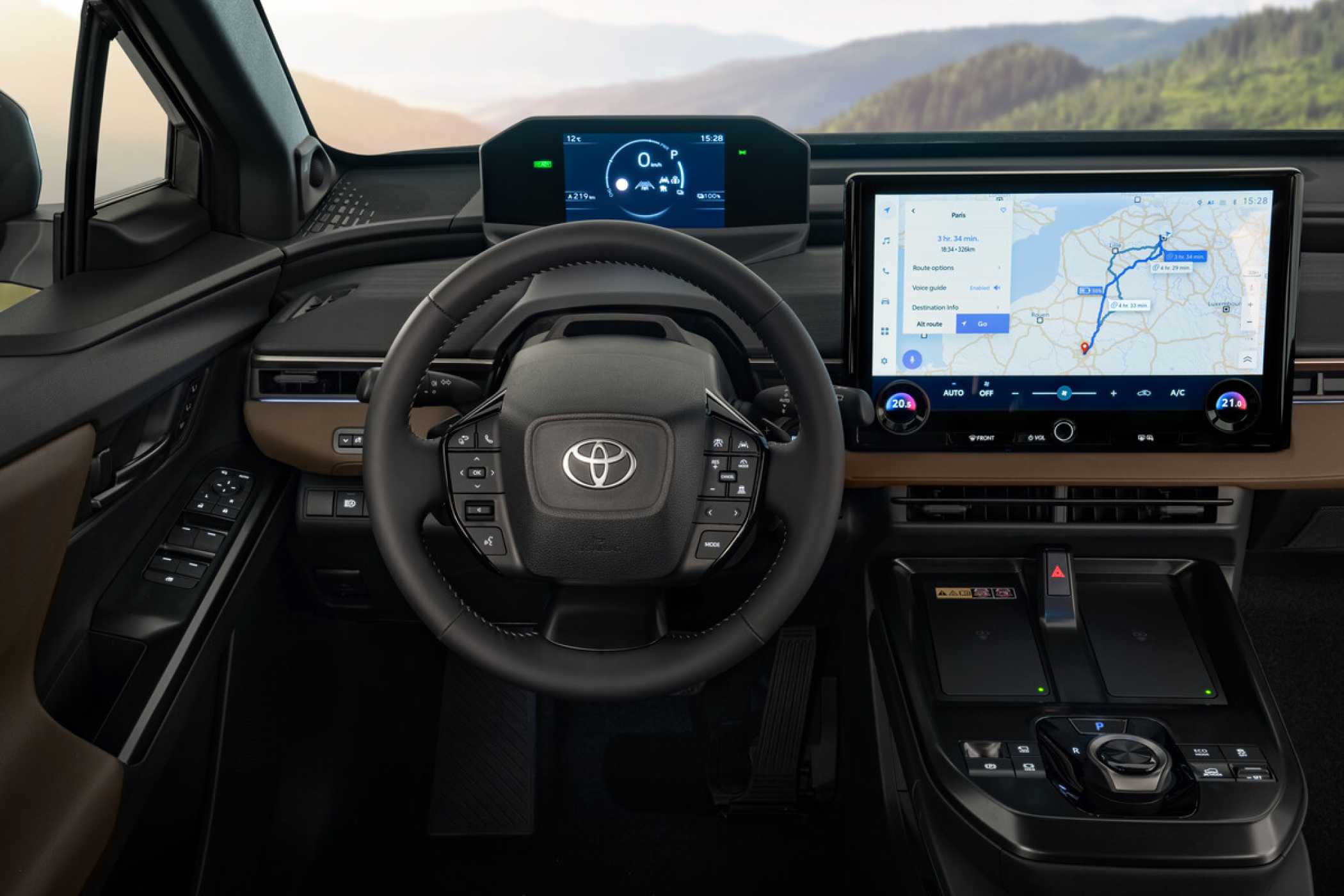
In the cockpit, the Touring adopts the design of the bZ4X facelift announced for 2026. New is a center console with more storage compartments and connectivity options for mobile devices. The large 14-inch display offers for the first time a navigation function that automatically suggests charging stations along the route based on the battery status. Particularly in taxi operations, where reliability counts, this is a practical detail.
The steering wheel with its multitude of buttons requires some getting used to. The menu navigation is logical, but not without quirks – those familiar with the Prius will find their way around more quickly. The workmanship also appears solid without aspiring to premium claims.
Externally, Toyota focuses on robustness: black wheel arch trims, roof rails, roughly designed rims. With the Touring, they specifically target active customers – but the robust design should also suit urban operations.
Two drives, clear orientation
Toyota offers the bZ4X Touring in two power levels. The front-wheel drive delivers 165 kW (224 hp), the all-wheel drive up to 280 kW (380 hp) – the former is completely sufficient for downtown, especially since all-wheel drive is rarely a must in taxi operations.
Both variants use a 74.7-kWh battery, which, according to WLTP, should allow up to 560 kilometers of range. Realistically, it's more likely to be 400 to 450 kilometers in mixed operation – depending on weather, topography, and load. Charging is done via DC with up to 150 kW – enough to charge 70 percent in half an hour. For charging at the home wallbox, 11 kW is standard, with an optional 22-kW onboard charger – of interest to fleets that rely on alternating current.





Technology with a Focus on Operation
Technically, the Touring introduces several innovations: for instance, so-called eAxles with silicon carbide semiconductors that aim to improve efficiency. The battery is water-cooled, and a preconditioning before the charging process can be activated automatically or manually. In winter operation, this could significantly improve charging times.
Practical for large-scale suitability: The towing capacity is 1,500 kilograms.
Maintenance, Warranty, and Availability
Toyota relies on its usual long-term promise for the Touring: Up to ten years or 250,000 kilometers warranty on the battery – provided there is regular maintenance and a documented battery check. The previous warranty of one million kilometers is no longer officially communicated but is still an indication of trust in the technology.
The market launch is scheduled for the first half of 2026. Toyota has not yet announced prices. Based on experience, the entry price is unlikely to be less than 50,000 euros – the target group is still broad: municipal fleets, taxi operators with charging infrastructure, but also driving schools or shuttle services.
The Toyota bZ4X Touring indeed has potential for use in commercial passenger transport. It offers plenty of space, a practical range, and a solid technology package. What is still missing is the taxi equipment from the factory, but converters will certainly address the station wagon soon. If the price remains competitive, the Touring could be seen more often in light ivory in front of train stations, hotels, or airports in the future.
Content automatically translated.




Taxi-Fahrzeuge (Pkw) , Taxi-Newsletter, Taxameter, Taxi-Fahrer , BZP – Deutscher Taxi- und Mietwagenverband , Straßenverkehrsordnung (StVO) , Krankenbeförderung , Weiterbildung , Taxi-Konzessionen , Verkehrspolitik , Mietwagenbranche , Taxi-Apps , Berufskraftfahrer-Qualifikations-Gesetz BKrFQG) , Taxizentralen , Personal, Gehälter, Arbeitsschutz , Wirtschaftsnachrichten , Werbung , Taxi-Folierung , Taxi-Umrüster , Straßenverkehr , Elektromobilität, Taxifuhrpark und -flottenmanagement , Taxi-Versicherungen , Hybrid, Diesel, Erdgas , Taxi-Magazin