


Ihr kostenloser Branchen-Newsletter

Lassen Sie sich von unseren Fachjournalisten einmal wöchentlich über die wichtigsten aktuellen Entwicklungen der Taxi-Branche informieren, bequem direkt in Ihre Mailbox.
Aktueller Termin

Meist gelesen
TMV warns of the consequences of the planned pension reform for taxi and rental car businesses.
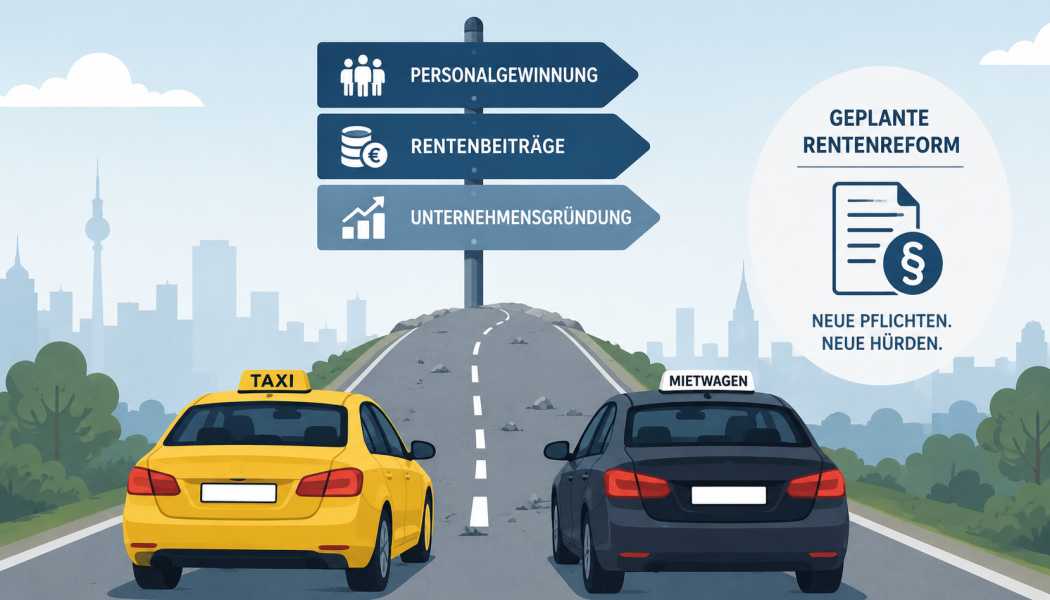
The Retirement Security Commission handed over its final report with around 33 recommendations to Chancellor Friedrich Merz and Federal Minister of Labour Bärbel Bas on June 23, 2026. Although the report was not initially published in full, its central contents have already become known through media reports. The Taxi and Rental-Car Association Germany (TMV) views in particular two proposals critically: the far-reaching abolition of contribution-free mini-jobs and the mandatory inclusion of newly founded self-employed into the statutory pension insurance.
Mini-jobs as an important component of workforce planning
According to the known recommendations, contribution-free mini-jobs should in the future essentially be open only to pupils. For the majority of marginally employed people, this would, according to the association's view, amount to a de facto end of the previous model.
Nationwide, around seven million people are engaged in marginal employment. Media reports say that up to 6.8 million employees could be affected by the changes. The Halle Institute for Economic Research has calculated that for many employees net losses could result, while the state would stand to gain around 4.5 billion euros in additional revenue.
Impact on ride services and school transport
According to the TMV, minijobs play an important role, especially in the taxi, rental car and medical transport sectors. Auxiliary drivers would regularly cover night, weekend and shift peaks, as well as compensate for short-notice absences.
Also in the school transport sector, retirees as well as homemakers are frequently employed, who take on only a few trips in the morning and afternoon. The association fears that additional social security contributions could reduce the attractiveness of these activities. This could lead to staffing shortages and increase costs for municipal contracting authorities.
Drivers with secondary employment particularly affected
The association also points to numerous drivers who perform their activity alongside a main employment. If these employment relationships were to be structured in the future as subject to social security contributions, billing as a second job could be carried out under tax class VI. In the association's assessment, this could reduce the willingness to take on additional ride services.
New burdens for founders
The TMV also critically assesses the recommendation to in the future include all newly founded and thus far not mandatorily insured self-employed individuals in the statutory pension insurance. For existing self-employed individuals, according to available information, grandfather protections should apply.
Additionally, there is a planned capital pillar with an initial contribution of one percent, later rising to two percent. Since self-employed persons would have to bear their contributions completely themselves, this would create additional financial burdens, especially in the startup phase.
The association points out that the taxi and rental car trade is predominantly composed of sole proprietorships and micro-enterprises. Founders would have to make substantial investments in vehicles and licenses at the outset. Additional mandatory contributions could complicate the economic situation in this phase.
Policy demands
The TMV therefore calls for the preservation of the mini-job as a flexible employment instrument. In addition, the association demands comprehensive impact assessments prior to legislative implementation, as well as transitional and hardship provisions for affected industries.
For new self-employed individuals, the association advocates for an unbureaucratic freedom of choice between statutory and equivalent private retirement provision, a two-year founder's grace period, and a profit-based contribution assessment. Furthermore, the TMV calls for early and binding involvement of the trade in the further legislative process.
According to the association, the proposed measures would mainly lead to higher financial burdens for businesses and employees, without permanently solving the structural challenges of pension financing. (Source: Taxi and Rental Car Association Germany)
Content automatically translated.





Taxi-Fahrzeuge (Pkw) , Taxi-Newsletter, Taxameter, Taxi-Fahrer , BZP – Deutscher Taxi- und Mietwagenverband , Straßenverkehrsordnung (StVO) , Krankenbeförderung , Weiterbildung , Taxi-Konzessionen , Verkehrspolitik , Mietwagenbranche , Taxi-Apps , Berufskraftfahrer-Qualifikations-Gesetz BKrFQG) , Taxizentralen , Personal, Gehälter, Arbeitsschutz , Wirtschaftsnachrichten , Werbung , Taxi-Folierung , Taxi-Umrüster , Straßenverkehr , Elektromobilität, Taxifuhrpark und -flottenmanagement , Taxi-Versicherungen , Hybrid, Diesel, Erdgas , Taxi-Magazin







