


2 Ausgaben kostenlos für Sie

Fachmagazin taxi heute: Ihr Zugang zu exklusiven Inhalten rund um die Taxi- und Mietwagenbranche.
Aktueller Termin

Meist gelesen
Taxi-heute-Test Ford E-Tourneo Custom AWD: The electric bus for taxis, hotels and Alpine regions.
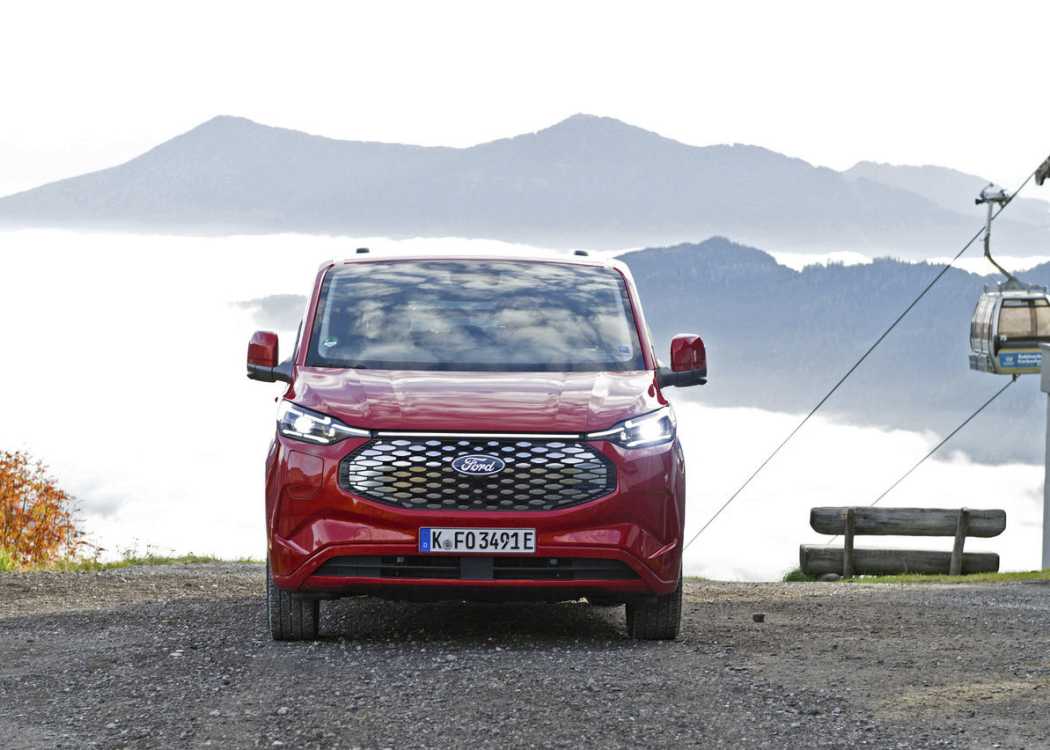
The mountain calls, the passenger is waiting, and there is still snow on the Alpine pass. For a shuttle service in Tyrol or a hotel operation in the Bernese Oberland, these are not exotic scenarios, but part of the business. The service vehicle must reliably bring people and their luggage to their destination – even when the road is steep, slick or narrow. That is exactly where the Ford E-Tourneo Custom AWD comes in: it combines the space of a van with a fully electric drivetrain and, for the first time in this model range, with an electric all-wheel drive. Especially in mountainous regions, the all-wheel drive could be of interest to taxi companies, hotels and shuttle services. But range, charging planning and the purchase price require careful calculation. Entering the world of electric all-wheel-drive large vans at Ford is not cheap: The variant with 218 hp costs around €72,000; for the more powerful version with 285 hp around €81,000 will be due.
Two motors, strong acceleration and traction
The AWD version uses one electric motor on the front axle and one on the rear axle. Unlike a conventional all-wheel drive, there is no mechanical link between the axles. The electronics distribute the drive power across the two motors and can adjust it to the respective driving conditions. That helps when starting on snow, on wet inclines or on loose ground. Ford offers the E-Tourneo Custom AWD with two power outputs: 160 kW (218 hp) and 210 kW (285 hp). The combined torque is 617 or 630 newton-metres, depending on the variant. This ensures the large van remains confident on the road even when several passengers and their luggage are on board. In addition to the Normal, Eco and Sport drive programs, the AWD model offers additional modes for slippery conditions and loose surfaces: "Slippery" and "Trail." They adjust the drive control to the respective situation. This is not only a concrete advantage for mountain regions.




















Shuttle daily routine and airport transfers
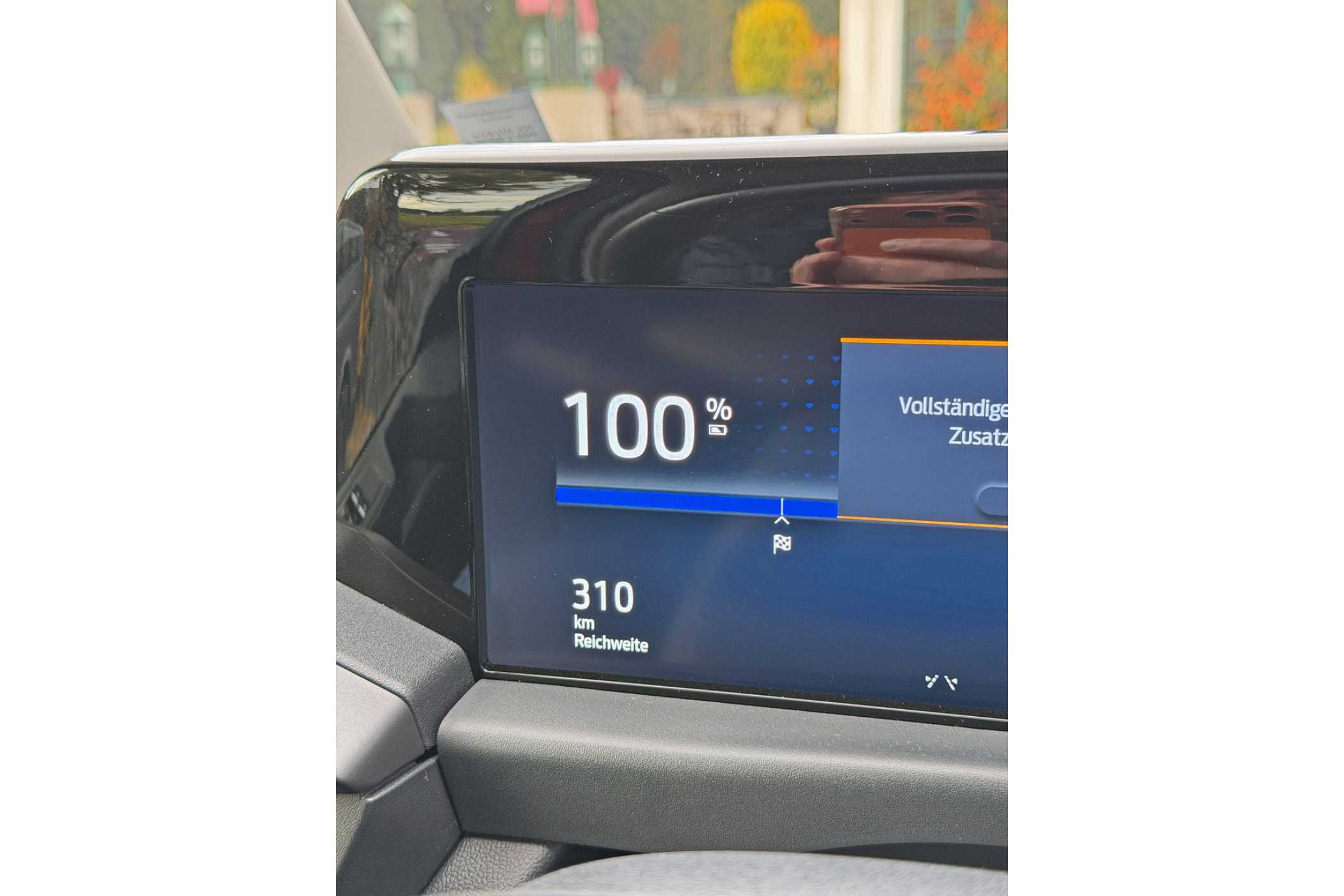
With the 2026 model year, Ford has increased the usable battery capacity to 71 kWh. For the E-Tourneo Custom AWD, the manufacturer cites a WLTP range of up to 315 kilometers. That is a laboratory value, not a promise for winter operation in the mountains. Cold, heating, high highway speeds, inclines, and payload typically reduce range noticeably. For operation this means: those who in the morning take guests from the train station to the hotel, during the day drive regional excursions, and charge the bus at the depot in the evening, can find a suitable deployment profile with the Ford. It becomes more difficult with long airport transfers, all-day tours, or spontaneous additional assignments over long distances. Here, operations should not plan with the advertised range, but with their own experience and a reserve for detours and cold days.
At a DC fast-charging station, the Ford can accept up to 125 kW. The charging ramp from ten to 80 percent is estimated by the manufacturer at around 29 minutes. At an 11-kW AC wallbox, the same charging window would take approximately four hours and 40 minutes. For many commercial users, overnight charging is likely the most economical option: The bus is anyway at the depot, and the next shift starts with a full battery. The key point, therefore, is less the maximum charging power than the organization of operations. A hotel with its own charging infrastructure can top up the vehicle between transfers or charge it overnight. A taxi company without a fixed parking space is more dependent on public charging points—and must factor in dwell times into shift planning.
Space for passengers, luggage and skis
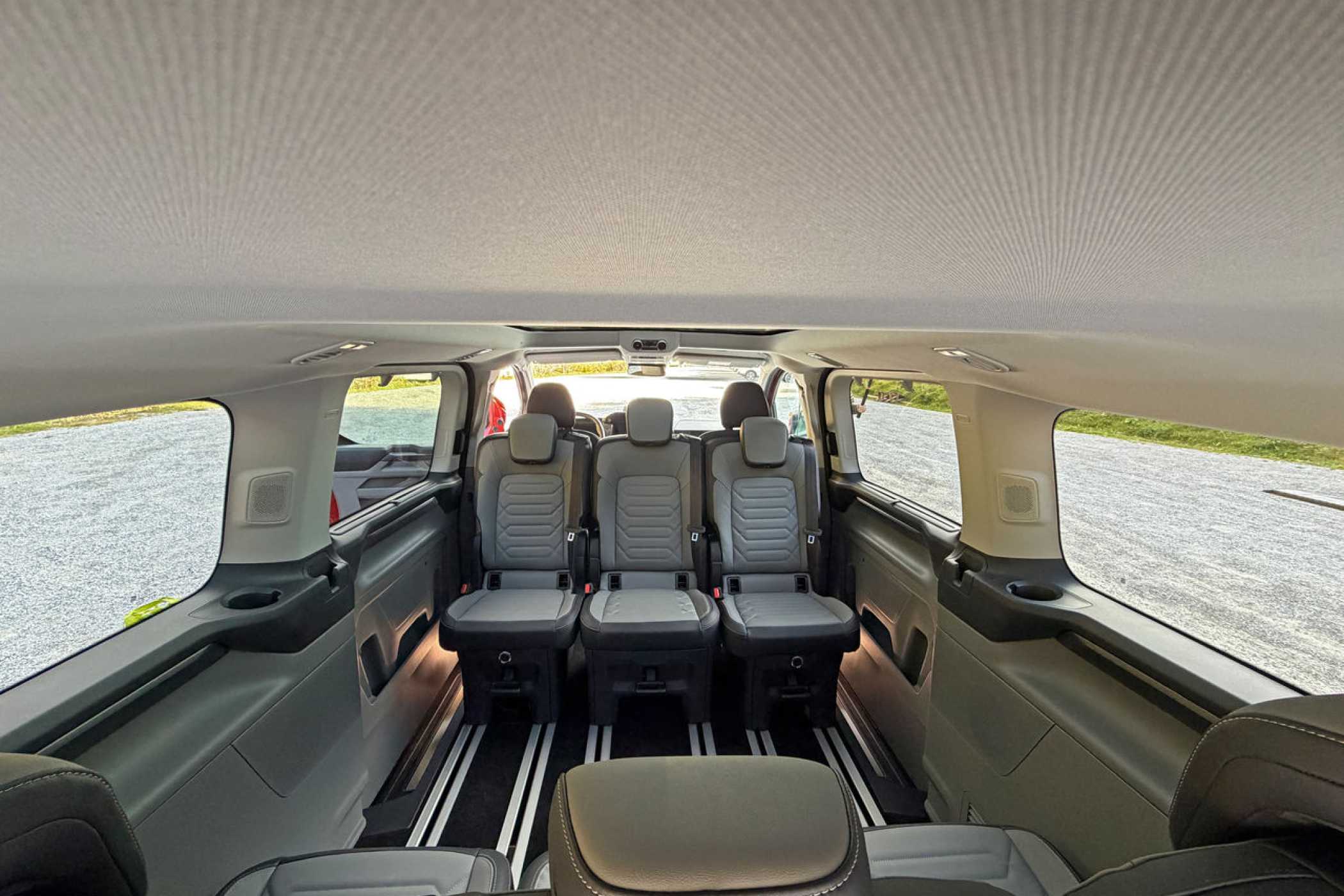
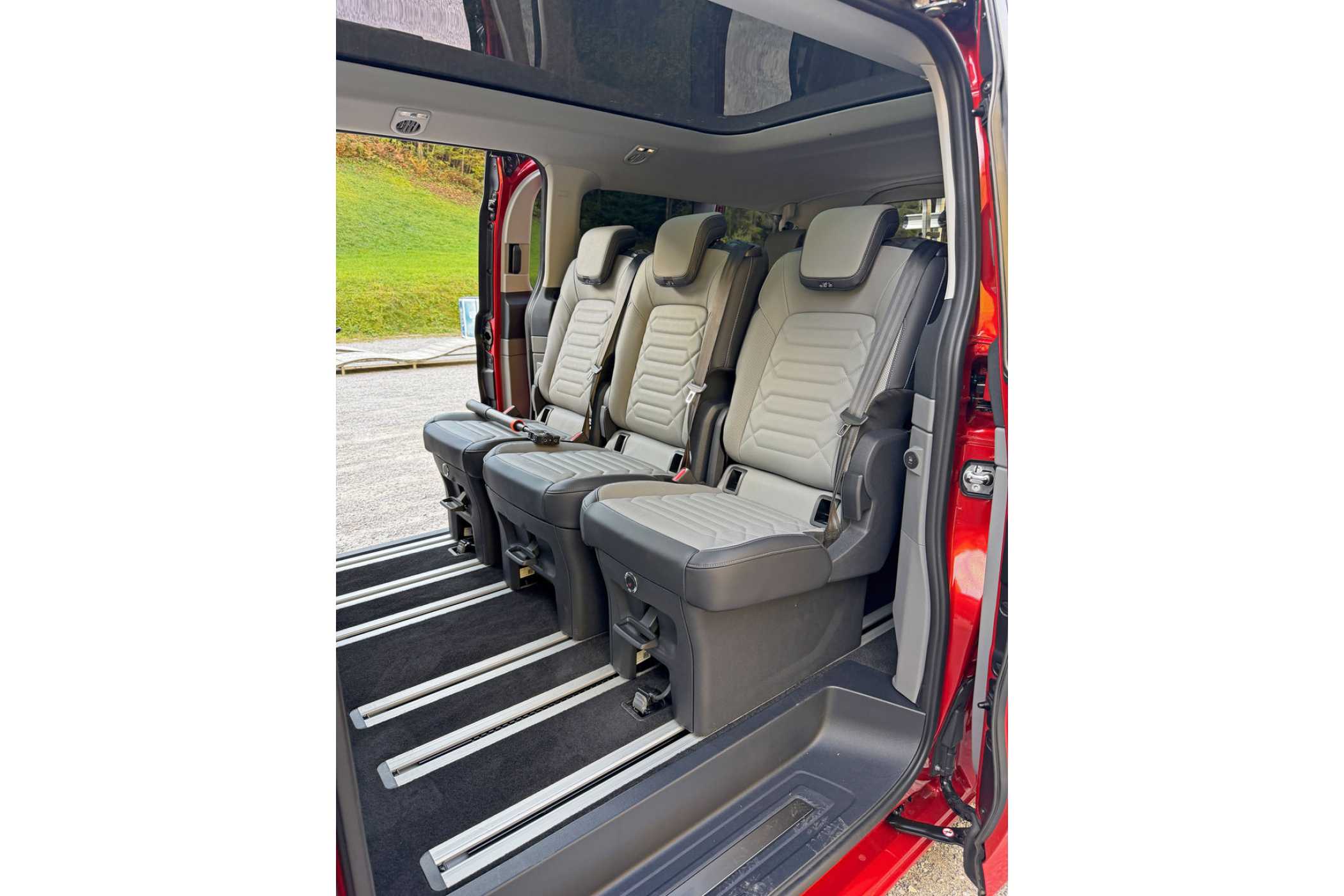
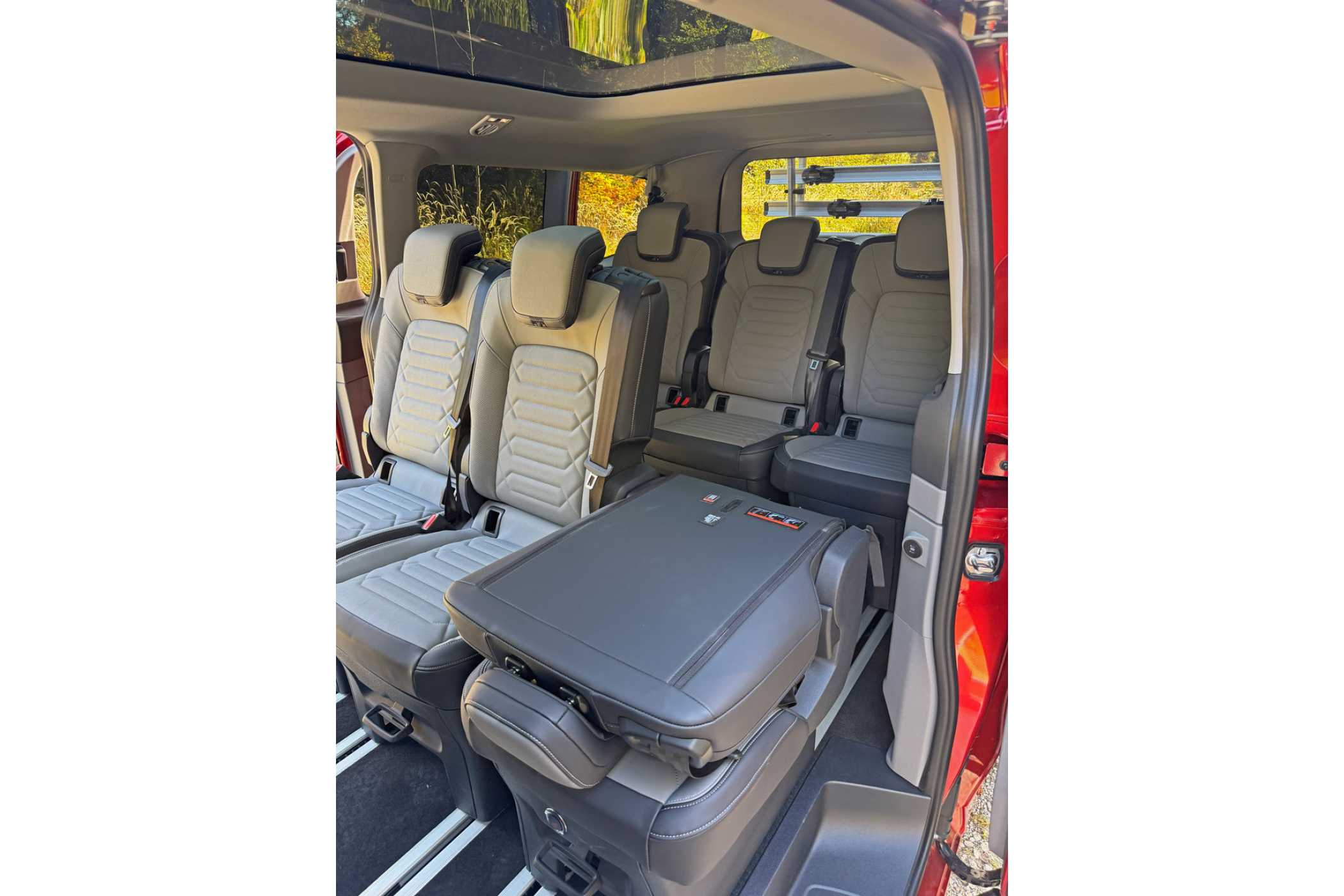
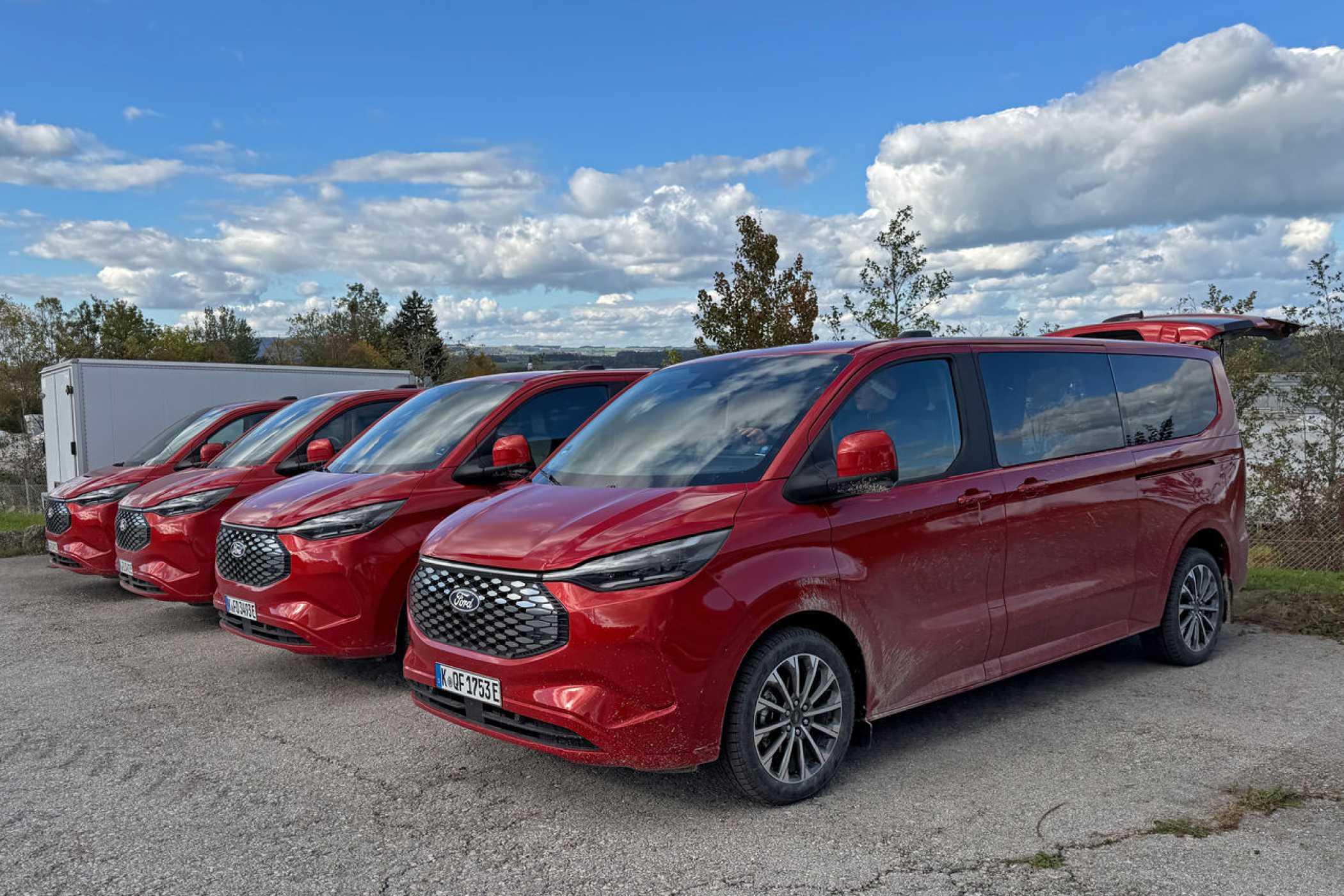
Its most important attribute is the space. The E-Tourneo Custom is available in two lengths: The short version measures 5.05 meters, the long 5.45 meters. The width is just over two meters without the exterior mirrors, and the height is around two meters depending on the equipment. This makes the Ford spacious, but in tight old-town streets, hotel forecourts and parking garages it requires a bit of attention. Depending on configuration, up to nine people can be accommodated. The individual seats can be moved, folded, or removed. This allows the interior to be adapted to different tasks: more seating for a travel group, more legroom for hotel guests, or more space for luggage and sports equipment. According to Ford, the maximum luggage volume in the short version is up to 4,640 liters, in the long up to 5,908 liters – each with an appropriately reconfigured interior and folded down or removed seats.
An important point is payload capacity. A lot of space does not automatically mean that all seats can be occupied by heavy adults and that large amounts of luggage can be loaded. Our E-Tourneo in the long version shows a slim payload reserve when fully occupied – a maximum of 643 kilograms. Those who regularly travel with eight or nine people and a lot of luggage should not calculate the weight by eye alone.
This is how the electric large-capacity van drives
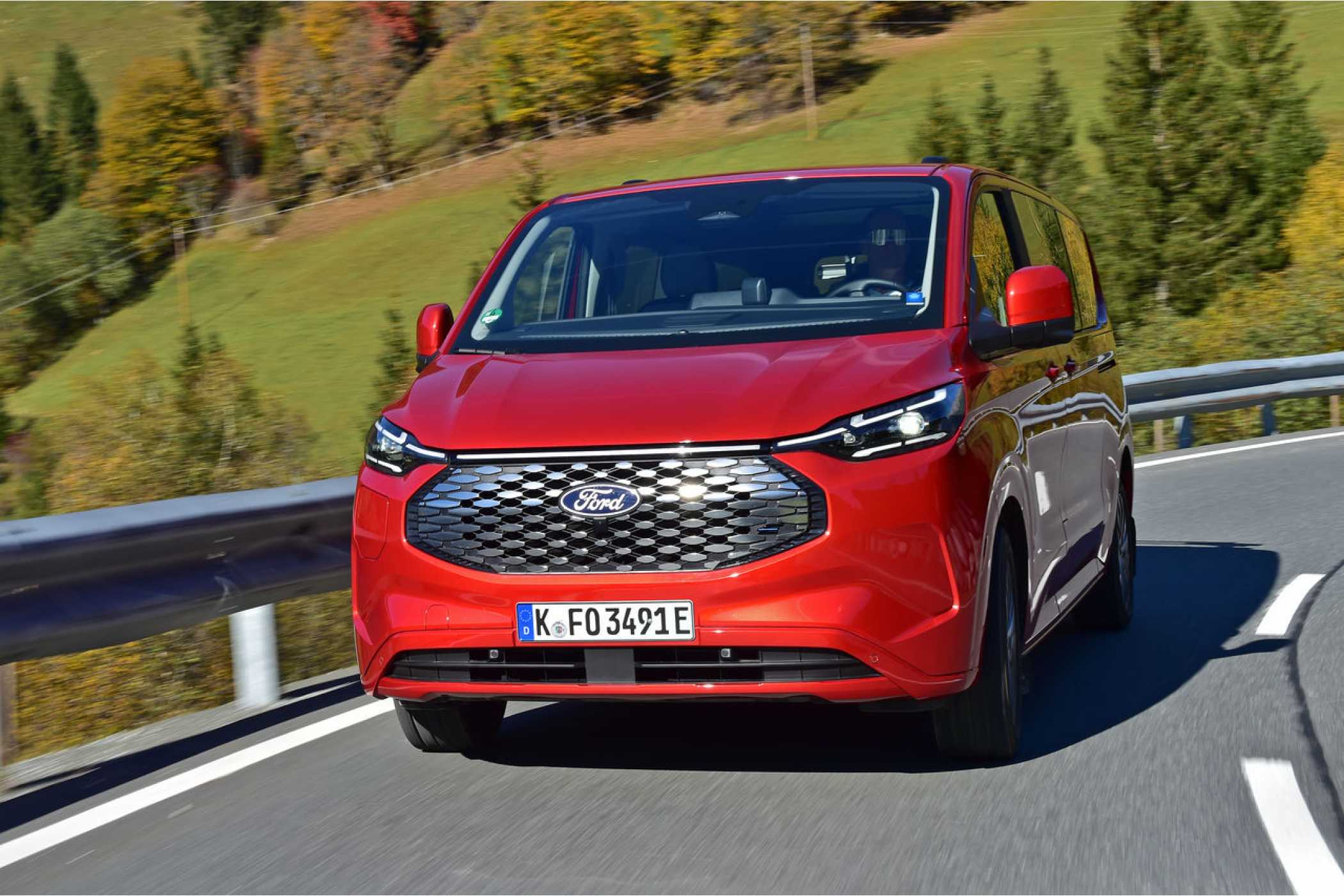
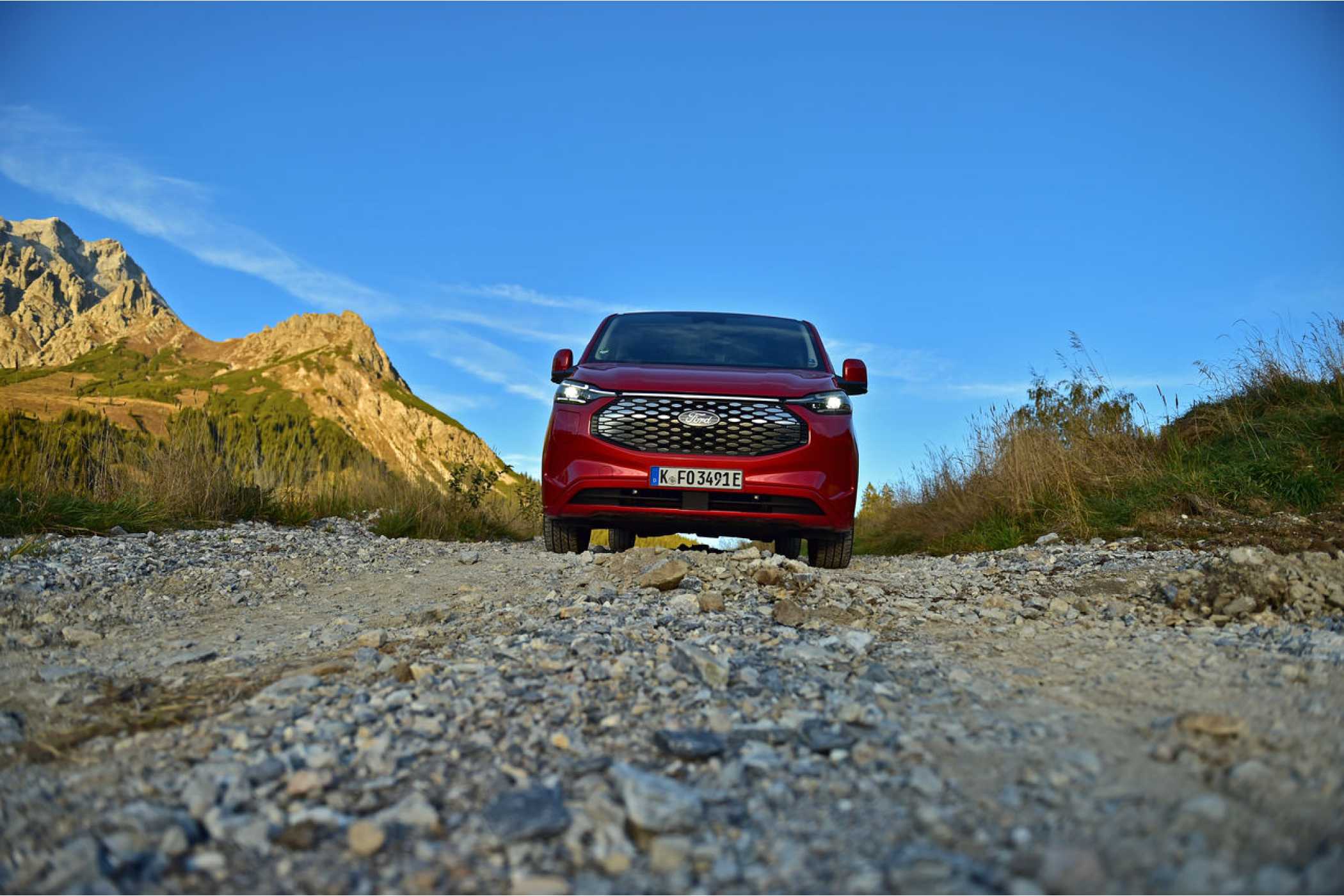
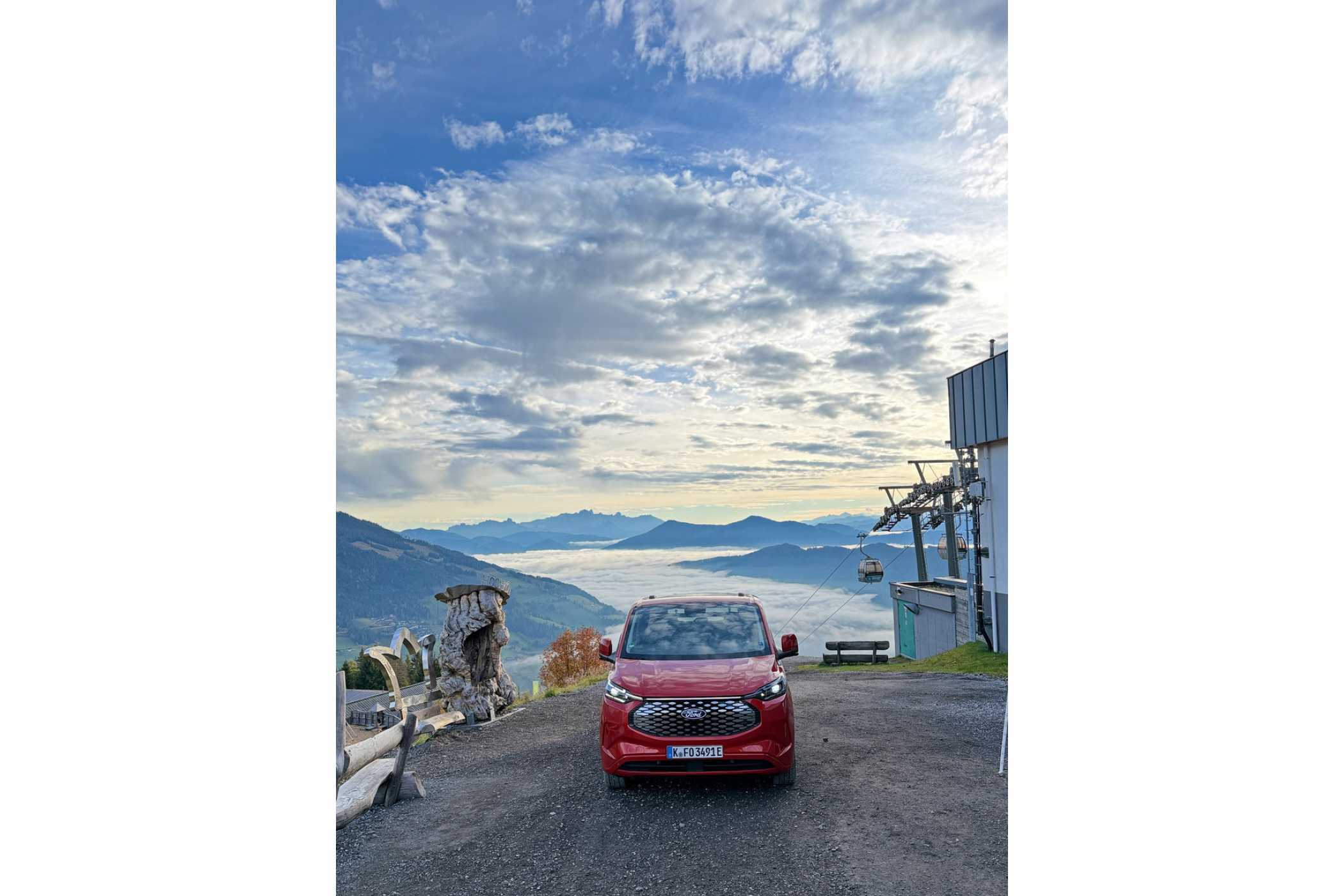
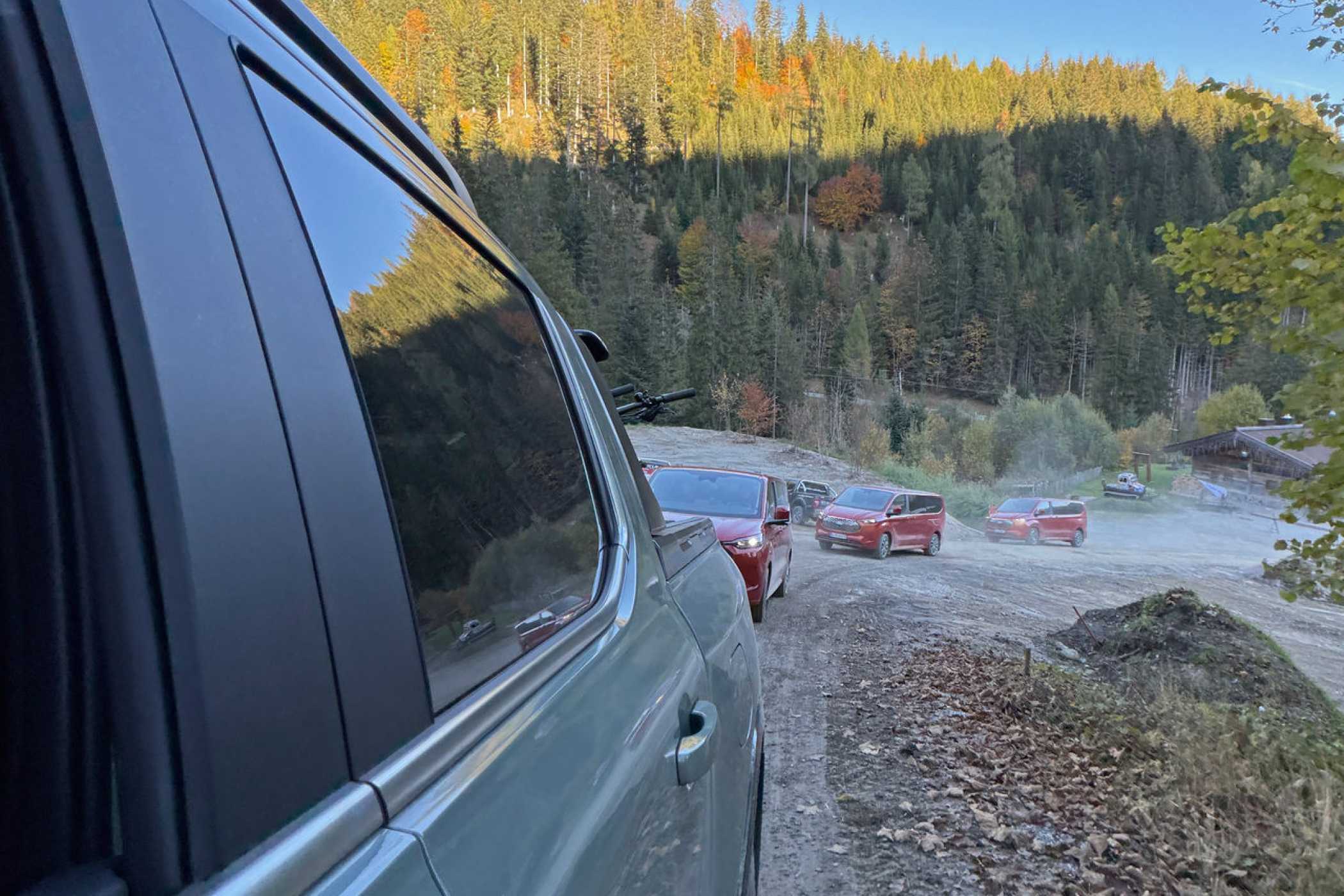
Ford invited us for test drives to Austria, because all-wheel drive is especially important in taxi and shuttle operations in mountainous regions. On the first day we drove on highways, country roads and mountain passes. Here the E-Tourneo Custom comes across as pleasantly unflustered. The steering is easy to operate, the suspension tuned for comfort. That suits the vehicle's character: those transporting passengers do not need artificial sportiness, but a calm ride. The battery's low center of gravity helps stabilise the bodyshell. In fast corners the height and weight of the van remain noticeable. The electric drive hardly intrudes acoustically, the large window surfaces create an airy sense of space. Especially the passengers in the rear rows benefit from the generous space. Depending on the equipment there are additional ventilation nozzles and separate climate control for the rear. The cockpit combines digital instruments with a large central screen; the feel is more robust than luxurious. The controls are generally geared toward everyday use, but as with many modern cars, not all functions are accessible at first glance.
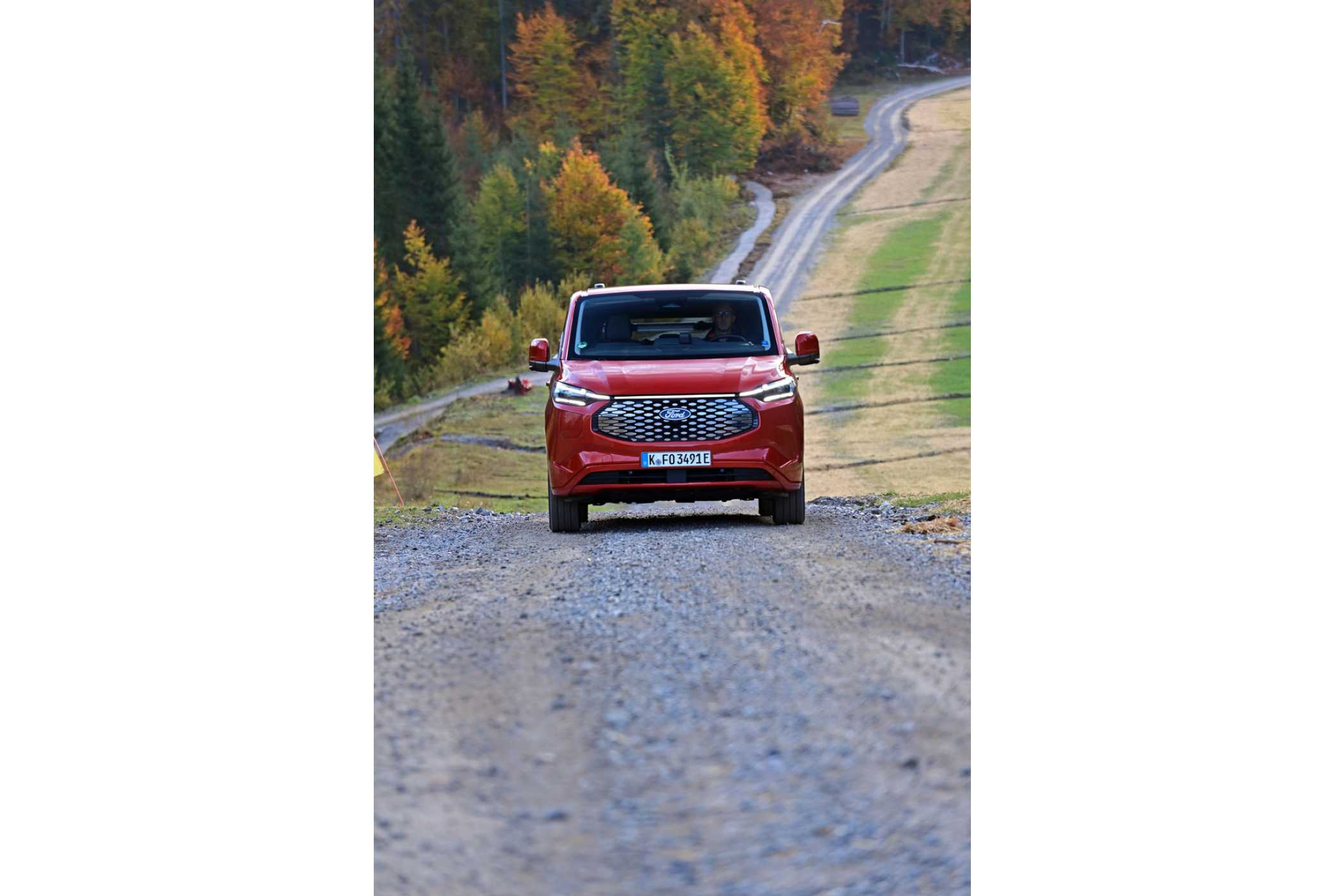
On the second day we then headed off-road with Ford. Of course, the E-Tourneo Custom is not an SUV, but a full-fledged people carrier. Nevertheless, during the excursions on unpaved roads we always had the feeling that we had not yet pushed the vehicle to its limits, even though the suspension of the van is the same as in the rear-wheel-drive version and the ground clearance remained unchanged. The electric all-wheel drive also delivers power to the road on unpaved surfaces. For commercial use, maneuverability is also relevant. The turning circle is 10.9 meters for the short and 12.1 meters for the long version, according to Ford. That is workable for a vehicle of this size, but it does not make it a nimble city car. In tight driveways, underground garages or historic town centers, the vehicle length remains a factor.
A bus for all eventualities?
For taxi companies and hotels, calculating total cost of ownership is decisive. The calculation can be especially favorable if the bus covers many planned kilometers and regularly charges at its own site. A hotel that parks the vehicles at night can strategically use the charging period. A taxi company with varying assignments and long periods of deadheading must, by contrast, calculate more precisely. The real range should be determined based on typical routes, winter conditions, and the number of passengers. The WLTP range of up to 315 kilometers should not be understood as a guaranteed daily performance in winter or on motorways. Those who have the charging infrastructure and the deployment plan under control, on the other hand, get a spacious, powerful passenger bus that can showcase its strengths especially in alpine shuttle traffic. And local emission-free capability can also be relevant when municipalities, hotels or clients increasingly demand low-emission mobility offerings.
Technical data: Ford E-Tourneo Custom AWD
Drivetrain: Two electric motors, electric all-wheel drive
Power: 160 kW (218 hp) or 210 kW (285 hp)
Torque: 617 or 630 Nm, combined
Usable battery capacity: 71 kWh
WLTP range: Up to 315 km
Maximum DC charging power: 125 kW
DC charging time, 10–80 percent: About 29 minutes
Length: 5.05 m or 5.45 m
Width excluding mirrors: 2.03 m
Height: Depending on variant about 1.96–2.02 m
Sitzplätze: Depending on configuration up to nine
Achtigelast gebremst: Braked trailer load: Up to 2,000 kg, depending on equipment
Wartungsintervall: According to Ford, two years, with no mileage limit
Content automatically translated.


Taxi-Fahrzeuge (Pkw) , Taxi-Newsletter, Taxameter, Taxi-Fahrer , BZP – Deutscher Taxi- und Mietwagenverband , Straßenverkehrsordnung (StVO) , Krankenbeförderung , Weiterbildung , Taxi-Konzessionen , Verkehrspolitik , Mietwagenbranche , Taxi-Apps , Berufskraftfahrer-Qualifikations-Gesetz BKrFQG) , Taxizentralen , Personal, Gehälter, Arbeitsschutz , Wirtschaftsnachrichten , Werbung , Taxi-Folierung , Taxi-Umrüster , Straßenverkehr , Elektromobilität, Taxifuhrpark und -flottenmanagement , Taxi-Versicherungen , Hybrid, Diesel, Erdgas , Taxi-Magazin







