2 Ausgaben kostenlos für Sie

Fachmagazin taxi heute: Ihr Zugang zu exklusiven Inhalten rund um die Taxi- und Mietwagenbranche.
Aktueller Termin

Meist gelesen
One-Sided Voices, Complex Reality: Why Personal Examples Distort the Minimum-Price Debate.
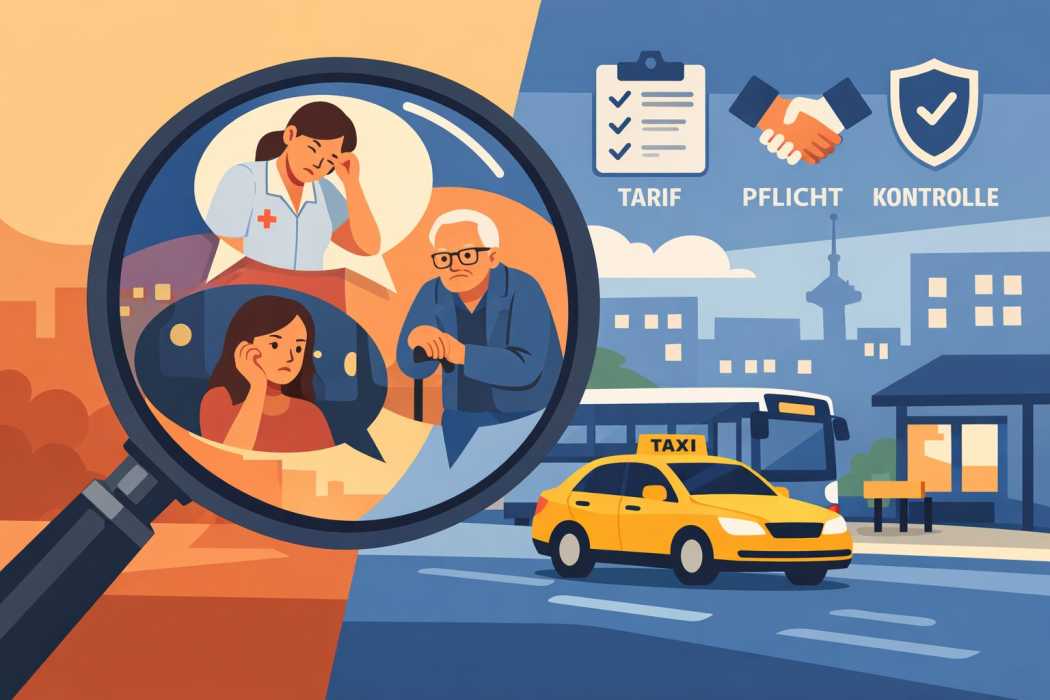
But they only depict a fragment of reality. And precisely therein lies the problem. The argument follows a clear pattern: if prices for rental cars rise, mobility becomes unaffordable. In doing so, it is tacitly assumed that cheap platform rides are the only viable option.
Taxi as part of the solution – not the problem
That is too narrow. The taxi trade has for decades fulfilled precisely those functions described in the letters: safe rides home at night, reliable transportation for those with limited mobility, availability even where public transport has gaps. Unlike platform providers, taxis are subject to fixed rules – fare obligations, obligation to transport, operating obligation.
This structure ensures that a taxi will operate even when it is hardly economically viable. Whoever argues that minimum prices would restrict mobility ignores the fact that these very rules are the foundation for comprehensive coverage.
The price in the app isn't the whole truth
- From the Uber website: Sandra H., a nurse on call, writes: “I can't pay 25–30 euros for every ride, because it's simply too expensive and my employer doesn't pay for it."
The nurse's letter refers to rising costs. That is understandable. But it also raises a fundamental question: Who bears the real costs of mobility?
When rides are offered today at prices below the real costs, there is no social equalization — but a shift. Low prices are made possible by precarious working conditions, tax avoidance or inadequate controls. A minimum price would not eliminate this imbalance, but at least make it visible.
Safety is not a platform feature
The safety argument also deserves closer consideration. The user who feels safer in Uber than on buses and trains describes a subjective perception. Objectively, however, the taxi sector imposes stricter requirements: screened drivers, vehicles officially regulated by authorities, clear responsibilities.
- From the Uber website: Andrea V. puts the sense of safety into words: “Especially as a woman, I feel much safer on the late-night journey home in Uber than on the bus and train.”
- From the Uber website: Ben S. from Cologne’s north highlights the lack of bus and rail options and adds: “Don’t let the North fall further behind by making ride services like Uber unattractive as well—especially in the evening hours, people rely on such services.”
Safety is not an option in the taxi trade, but part of regulation. If platform providers address this need without meeting the same regulatory framework, an imbalance arises—not in favor of passengers, but to the detriment of those who strictly comply with these standards.
Mobility as a Public Service
The narrowing of the debate becomes particularly evident in the reference to the retiree who cannot afford “expensive taxis.” Here, a social problem is individualized. The question of how people with limited mobility can participate in public life cannot be answered by market prices alone.
- From Uber's website: Hans-Jürgen B., a retiree, emphasizes: “I regularly rely on transportation by ride services, as I have difficulty walking. (...) I cannot afford expensive taxis. If ride services were really to become more expensive, I will only rarely be able to participate in public life and thus I will lose my quality of life.”
The taxi is part of the provision of public services. It complements public transport where this reaches its limits. If this function is to be preserved, there must be stable economic framework conditions – and these include prices that reflect the actual costs.
Emotion does not replace regulatory policy
The published submissions are persuasive because they show concrete fates. They do not, however, replace regulatory analysis. Minimum prices in the taxi market are not intended to make mobility more expensive, but to correct distortions of competition.
Without this correction, a market emerges in which those who push rules the farthest—or circumvent them—prevail. The question, therefore, is not whether individual trips will become more expensive. The question is whether a reliable, regulated mobility offering remains. The taxi stands for exactly this offering. And it can fulfill this role only if competition is not decided solely by the lowest price.
Content automatically translated.


Taxi-Fahrzeuge (Pkw) , Taxi-Newsletter, Taxameter, Taxi-Fahrer , BZP – Deutscher Taxi- und Mietwagenverband , Straßenverkehrsordnung (StVO) , Krankenbeförderung , Weiterbildung , Taxi-Konzessionen , Verkehrspolitik , Mietwagenbranche , Taxi-Apps , Berufskraftfahrer-Qualifikations-Gesetz BKrFQG) , Taxizentralen , Personal, Gehälter, Arbeitsschutz , Wirtschaftsnachrichten , Werbung , Taxi-Folierung , Taxi-Umrüster , Straßenverkehr , Elektromobilität, Taxifuhrpark und -flottenmanagement , Taxi-Versicherungen , Hybrid, Diesel, Erdgas , Taxi-Magazin