2 Ausgaben kostenlos für Sie

Fachmagazin taxi heute: Ihr Zugang zu exklusiven Inhalten rund um die Taxi- und Mietwagenbranche.
Aktueller Termin

Meist gelesen

Sofia Taxi Union threatens protests over stagnating tariffs
The National Taxi Union has filed an application with the Sofia municipality to raise taxi tariffs in the capital. The drivers want to raise the minimum daytime rate to 1.74 leva per kilometer and the night rate to 2 leva [approx. 1 EUR, editor's note] per kilometer – an increase of about 30%. The union argues that tariffs have not been raised for three years, while the minimum wage used to calculate social security contributions has risen by 52% since 2022 and depreciation costs for vehicles have increased by about 40%. The drivers warn that they are ready to organize protests if their demands are not met. (October 2025, Source: kinsights.capital.bg/politics_and_society/2025/10/15/4841039_the_day_in_3_news_bulgarian_companies_return_to_growth/)
Novinite.com reports the background to the demands for taxi fare increases as follows:
- Significantly increased operating costs: According to industry calculations, various cost components for taxi operation have risen by 20% to 600% (e.g., maintenance, spare parts, insurance, levies).
- Tariffs unchanged since 2022: Taxi prices in Sofia have not been adjusted for three years, although the law requires the municipalities to review the minimum and maximum tariffs annually.
- Legal inertia of the city administration: The National Taxi Union has requested tariff changes for three consecutive years, but the city council has not responded, which, according to the association, constitutes a violation of statutory provisions.
- Additional burden due to euro transition: The upcoming introduction of dual-currency display (lev + euro) and the necessary reconfiguration of over 20,000 taximeters increases the administrative and financial burden.
The combination of rising costs and missing tariff adjustments, according to taxi drivers, leads to the maintenance of an economically viable, safe and high-quality taxi operation becoming increasingly difficult. (October 2025, novinite.com/articles/234854/)
New tariff rule in Sofia: taxi prices rise by almost 19% from 2026
From next year, taxi tariffs in Sofia will rise by 18.6%. The increase is based on a new methodology that the city council applies to adjust taxi tariffs after the National Taxi Union submitted a formal request to raise the tariffs in the capital. This price increase will be implemented by raising the minimum tariffs – a step intended to restrict competition in the low-price segment and to lead to widespread fare increases. Some experts argue that a market-oriented approach that abolishes the minimum tariffs and lets competition determine prices would be a more effective solution. (October 2025, Source: kinsights.capital.bg/politics_and_society/2025/10/24/4844298_the_week_sofia_airport_expands_taxi_fares_rise_economy/)
Bulgaria extends deadline for double taxi fare display until October 2025
The Bulgarian government has postponed the deadline for displaying taxi tariffs in leva and euro to the end of October 2025. Manufacturers and taxi companies had warned that updating more than 20,000 taximeters by the original deadline at the beginning of August would not be feasible. [Reason for the change: The euro will become the official currency in Bulgaria from January 2026 and will replace the Bulgarian lev in the exchange rate of 1 EUR = 1.95583 BGN. However, the existing currency remains accepted during a transition period, so there is the obligation to double-display the prices. Ed.] (August 2025, Source: https://www.fiscal-requirements.com/news/4238)
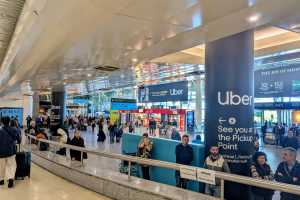
Editor's note: Uber has been effectively banned in Bulgaria since 2015.
Following Uber's Bulgaria expansion in 2014, a significant union organization – Union Taxi – expressed concerns about unfair competition and urged the Bulgarian Commission for the Protection of Competition (CPC, the national competition authority) to completely ban the ride-hailing service. Uber was accused by several driver unions of causing financial losses to legitimate taxi companies by “stealing” customers and employing inappropriate tactics. After several such petitions by the union confederation, Uber was effectively banned by the CPC in 2015, after which Uber withdrew from the Bulgarian market. This Uber ban remains in force in Bulgaria to this day.
Moreover, the ban led to new legal regulations that obliged taxi companies to provide their drivers with employment contracts and social security, to declare their revenue, and to pay income tax. The new requirements met resistance from the taxi companies, as they had previously also worked with self-employed drivers. (Source: European Trade Union Confederation, etuc.org/sites/default/files/page/file/2023-05/ETUC_country%20report_Bulgaria-EN.pdf#page=5)
Content automatically translated.


Taxi-Fahrzeuge (Pkw) , Taxi-Newsletter, Taxameter, Taxi-Fahrer , BZP – Deutscher Taxi- und Mietwagenverband , Straßenverkehrsordnung (StVO) , Krankenbeförderung , Weiterbildung , Taxi-Konzessionen , Verkehrspolitik , Mietwagenbranche , Taxi-Apps , Berufskraftfahrer-Qualifikations-Gesetz BKrFQG) , Taxizentralen , Personal, Gehälter, Arbeitsschutz , Wirtschaftsnachrichten , Werbung , Taxi-Folierung , Taxi-Umrüster , Straßenverkehr , Elektromobilität, Taxifuhrpark und -flottenmanagement , Taxi-Versicherungen , Hybrid, Diesel, Erdgas , Taxi-Magazin