2 Ausgaben kostenlos für Sie

Fachmagazin taxi heute: Ihr Zugang zu exklusiven Inhalten rund um die Taxi- und Mietwagenbranche.
Aktueller Termin

Meist gelesen
Emergency ordinance in Amberg: How a diesel surcharge complements the taxi tariff
The city council's decision of April 27, 2026 follows a development that has been putting the industry under pressure for weeks. Rising fuel prices, triggered by the geopolitical tensions in the Middle East, are hitting a sector whose cost structure is heavily dependent on diesel. The Bavarian Association of Taxi and Rental Vehicle Companies (LVBTM) speaks of significant, partly existence-threatening burdens. Even small price increases per liter add up to noticeable additional costs given a taxi's typical mileage.
Tariff adjustments take a long time
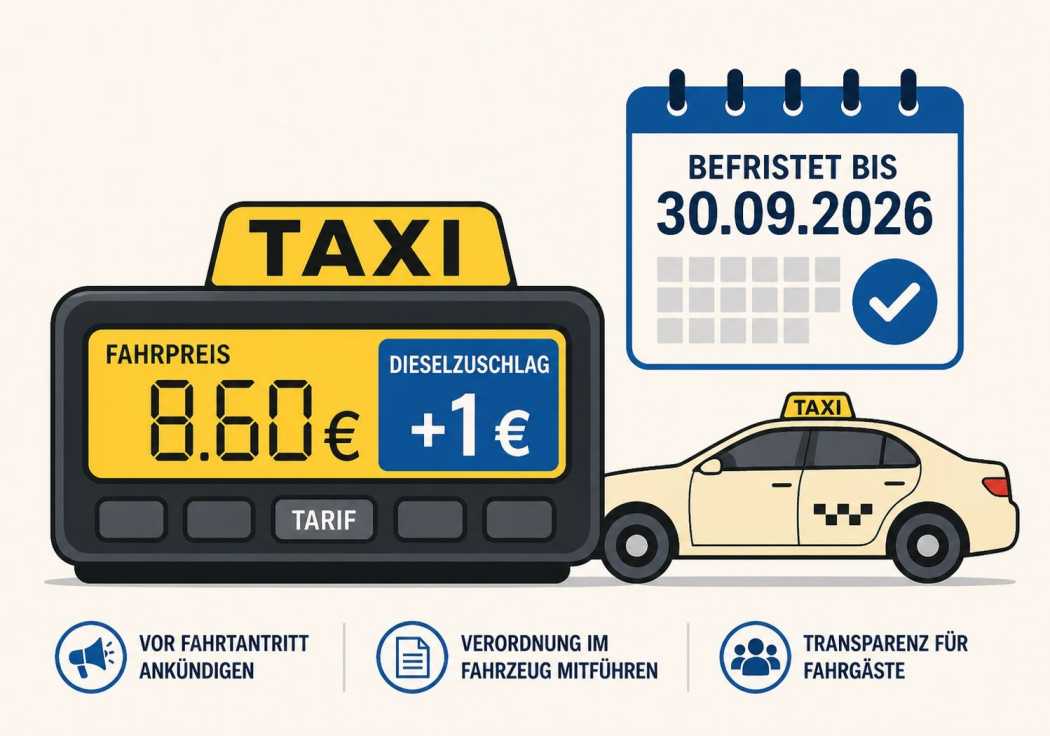
The problem lies not only in the market, but in the system. Taxi tariffs are regulated; adjustments take place through administrative procedures that take time. Short-term cost increases are hardly captured in this way. This is exactly where the Amberger Ordinance comes into play. It does not permanently modify the existing tariff, but adds a temporary surcharge: one euro per ride, valid until September 30, 2026.
The legal basis is § 51 of the Passenger Transport Act, which entrusts municipalities with the setting of transportation fares. The city uses this framework to collect a kind of variable cost cushion. The surcharge must be announced before the trip begins, and the regulation must be carried in the vehicle – transparency thus becomes an operational obligation.
LVBTM's Demand Implemented
The impulse for this construction comes from the industry itself. LVBTM had previously explicitly urged the approval authorities to incorporate fuel price developments more strongly into tariff decisions. In an accompanying information sheet, the association outlined the possibility of a temporary surcharge as a pragmatic solution. The justification is evident: A regular tariff adjustment is not feasible in the short term, but the economic situation of the mostly small-scale businesses does not allow postponement.
The surcharge is not a neutral instrument. It hits short trips relatively harder than long ones and indirectly benefits businesses with alternative drivetrains. Both are accepted. Given the urgency, the association's argument holds that practicality must take precedence. The time-limited nature also follows this logic: Six months are regarded as a period in which the energy price situation either stabilizes—or a regular tariff readjustment can be prepared.
Modest additional costs for the passenger
For the passengers, the regulation means above all one thing: predictability with a surcharge. One euro per trip is modest, but noticeable. For the companies, however, it's about ensuring liquidity in day-to-day operations. The surcharge takes effect immediately, without reconfiguring taximeters or lengthy approval processes.
Whether the Amberg model will catch on remains to be seen. The structural question behind it is bigger: How does a regulated market respond to volatile costs? The answer here, for the time being, is provisional — with an instrument deliberately kept simple and precisely for that reason politically and administratively palatable. In Amberg, it becomes evident that tariff policy is not only thought of in intervals, but increasingly also in response times.
Content automatically translated.




Taxi-Fahrzeuge (Pkw) , Taxi-Newsletter, Taxameter, Taxi-Fahrer , BZP – Deutscher Taxi- und Mietwagenverband , Straßenverkehrsordnung (StVO) , Krankenbeförderung , Weiterbildung , Taxi-Konzessionen , Verkehrspolitik , Mietwagenbranche , Taxi-Apps , Berufskraftfahrer-Qualifikations-Gesetz BKrFQG) , Taxizentralen , Personal, Gehälter, Arbeitsschutz , Wirtschaftsnachrichten , Werbung , Taxi-Folierung , Taxi-Umrüster , Straßenverkehr , Elektromobilität, Taxifuhrpark und -flottenmanagement , Taxi-Versicherungen , Hybrid, Diesel, Erdgas , Taxi-Magazin