Ihr kostenloser Branchen-Newsletter

Lassen Sie sich von unseren Fachjournalisten einmal wöchentlich über die wichtigsten aktuellen Entwicklungen der Taxi-Branche informieren, bequem direkt in Ihre Mailbox.
Aktueller Termin

Meist gelesen
Alliance Against Misregulation: VSPV and Taxpayers' Federation Join Forces

It is less about symbolic closeness than about concrete intersections. Both sides see tax and levy policy as a field in which political decisions have immediate consequences for businesses and employees. When the Taxpayers' Federation collects examples of failed expenditure policy in its annual 'Black Book', in the view of the VSPV these are not merely abstract misallocations – but burdens that permeate into day-to-day business practice.
Tax policy is decisive – also for the taxi and rental-car industry
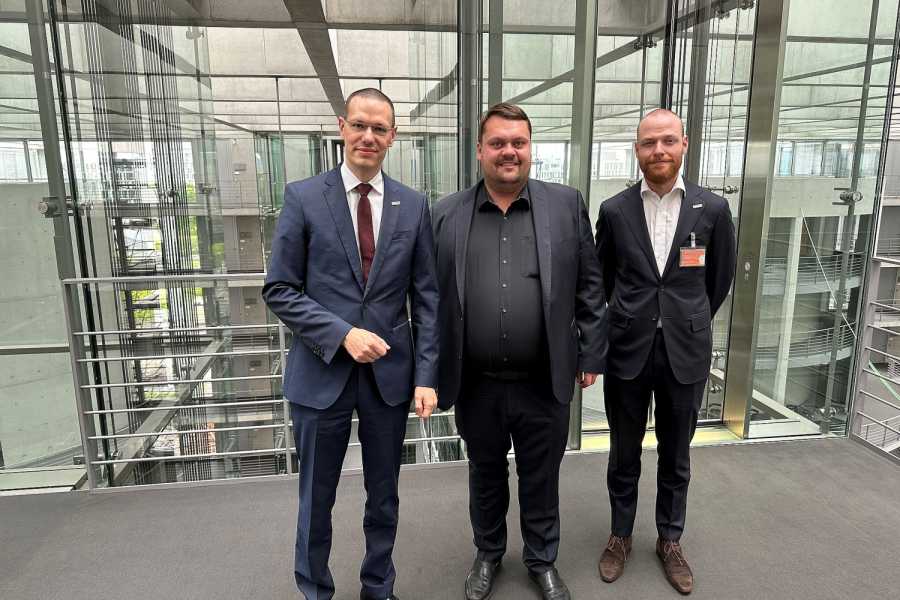
Sascha Waltemate, Geschäftsführer des VSPV, describes the association as the representative body of around 800 companies with about 10,000 employees. For him, cooperation is a logical step: SMEs rely on reliable framework conditions, especially in a regulated market like the taxi and rental-car industry. Tax policy is often underestimated in this context – but it decisively determines the economic leeway.
Auch Patrick Meinhardt, Generalbevollmächtigter des Verbands und Leiter des Hauptstadtbüros, setzt auf den strategischen Mehrwert kurzer Wege. Mit der Mitgliedschaft im Berliner Landesverband des Steuerzahlerbundes will der VSPV seine Präsenz auf Bundesebene verstärken. Die Idee dahinter: fachliche Expertise aus der Mobilitätspolitik direkt in politische Netzwerke einspeisen – ohne den Umweg über langwierige Abstimmungsprozesse.
Regular exchange agreed
This approach is met with an open ear by the Taxpayers' Federation. President Reiner Holznagel emphasizes the importance of dialogue with mid-sized associations. For his organization, which sees itself as a watchdog over public spending, concrete practical indications are decisive. Especially passenger transport, with its diverse regulations and funding structures, regularly provides starting points for criticism—and thus for political intervention.
The collaboration should therefore go beyond sporadic meetings. An regular exchange has been agreed, which enables both sides to evaluate developments early and to align positions. For the VSPV this also means systematically contributing its own observations—e.g., where public funds are used inefficiently from the industry's perspective.
VSPV brings the perspective of the mobility industry into the discussion
In the background lies a common diagnosis: The dividing line does not run between the state and the economy, but between functioning and dysfunctional structures. Where public funds fail to achieve their effect, pressure on companies and taxpayers grows equally. The new cooperation sees itself as an attempt to shrink this gap—not through fundamental/systemic critique, but through continuous influence.
The claim is formulated: more clout through the bundling of interests. In a policy field, characterized by details and responsibilities, that could be decisive.
Content automatically translated.


Taxi-Fahrzeuge (Pkw) , Taxi-Newsletter, Taxameter, Taxi-Fahrer , BZP – Deutscher Taxi- und Mietwagenverband , Straßenverkehrsordnung (StVO) , Krankenbeförderung , Weiterbildung , Taxi-Konzessionen , Verkehrspolitik , Mietwagenbranche , Taxi-Apps , Berufskraftfahrer-Qualifikations-Gesetz BKrFQG) , Taxizentralen , Personal, Gehälter, Arbeitsschutz , Wirtschaftsnachrichten , Werbung , Taxi-Folierung , Taxi-Umrüster , Straßenverkehr , Elektromobilität, Taxifuhrpark und -flottenmanagement , Taxi-Versicherungen , Hybrid, Diesel, Erdgas , Taxi-Magazin