VISION mobility kostenlos Probelesen

Die Zeitschrift VISION mobility richtet sich an mobilitätsbegeisterte Menschen bzw. Flottenmanager und begleitet den Technologiewandel in Sachen Automotive und Mobilität.
Aktueller Termin

Meist gelesen
Autonomous local transport on the verge of a breakthrough? A new project aims to speed up the approval of shuttle vehicles.
While Germany has debated autonomous driving for years, the discussion has quietly shifted. For a long time, the question centered on whether the technology actually works. The more exciting question now is: How will it be brought into regular operation?
Two projects, which have now been unveiled almost simultaneously, provide an initial answer to this. In the Rhine-Main region, a further large-scale test field for autonomous mobility in public transport is launched with KIRA+. Parallel to this, a nationwide project begins that aims to significantly accelerate the approval of autonomous vehicles. Together, both initiatives tell a story about the next phase of autonomous driving: It's no longer about demonstrations, but about scaling up.


From the pilot project to the model region
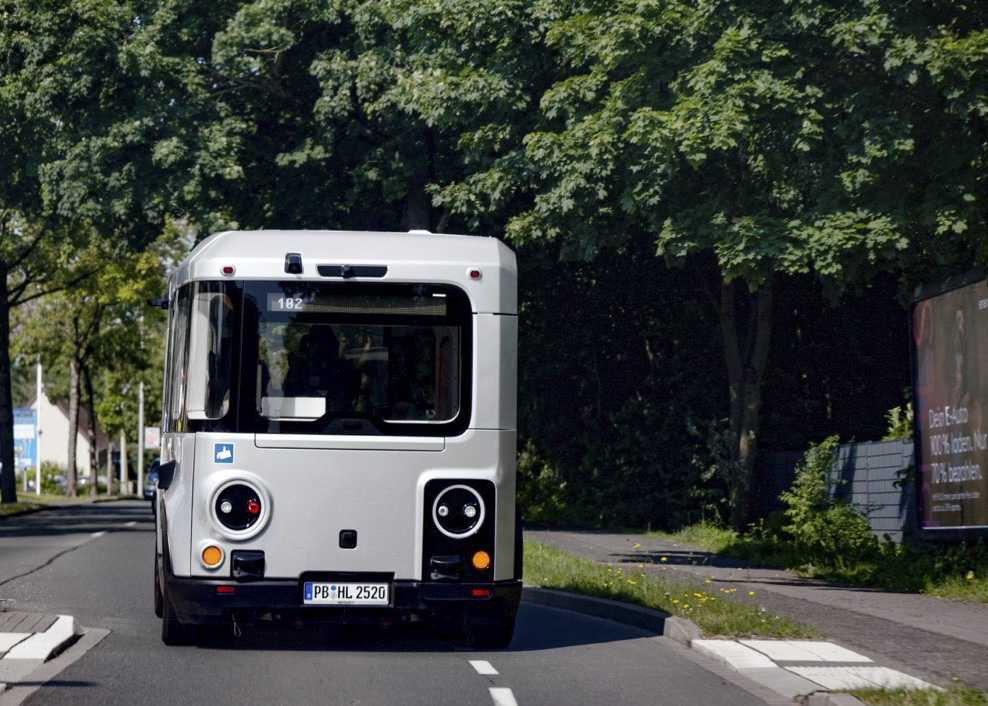
With KIRA+, the Rhein-Main-Verkehrsverbund (RMV), Deutsche Bahn, and the vehicle manufacturer HOLON continue their activities in autonomous driving. From 2027 autonomous vehicles are planned to be in operation in parts of Darmstadt and in the Offenbach district. The HOLON urban is used, a vehicle developed specifically for public transport. The electrically powered shuttle offers five seats as well as a wheelchair space and has been designed from the outset for continuous operation in public transport. The real difference from many previous projects lies, however, less in the vehicle than in the objective.
“With KIRA+ we build on the experiences gathered so far with autonomous driving and test the further-developed technology in vehicles designed for use in public transport,” says RMV managing director Prof. Knut Ringat. “We are thereby taking a decisive step closer to the model region we are aiming for in the RMV.”
A model region means more than just another test area. The aim is a transport space in which autonomous vehicles are no longer just objects of research, but become part of the regular local transport offering. Deutsche Bahn is also already looking beyond the pilot operation.
“Autonomous driving offers the chance of a faster, cheaper and digital mobility offering,” says Harmen van Zijderveld, CEO of DB Regio AG. “However, the decisive thing is to meaningfully integrate autonomous vehicles into public transport.”
The real bottleneck lies with the authorities
That's the vision. But between a functioning vehicle and a nationwide deployment lies a hurdle that has comparatively little discussion around it so far. While public attention is usually focused on the type approval of autonomous vehicles, experts now see another problem: the so-called operating-area permit.
Simply put, it decides where an autonomous vehicle is actually allowed to drive. Each region requires its own permit for this. So far there are hardly standardized procedures for this. This is precisely where a new consortium steps in, which includes RMV, DB Regio and HOLON among others, as well as the Federal Motor Transport Authority, DEKRA, the Munich Transport and Tariff Association, Hessen Mobil, and other authorities and organizations.
Its goal may sound initially unremarkable, but could be decisive for the industry: the duration of an approval procedure is to drop to around three months in the future. Currently, the operating-area permit is regarded in many places as an administrative bottleneck. Authorities must carefully check whether the capabilities of an autonomous vehicle precisely match the conditions of a planned deployment area. Road widths, curve radii, road surfaces, intersections, or other special traffic situations must be considered.
Especially in operating areas with several thousand route kilometers, this quickly becomes a complex task. Therefore the project partners intend to largely digitalize and automate the process. Using HOLON urban, for the first time complete permit procedures will be piloted and documented as exemplars.
Standardization instead of bespoke production
For the manufacturers, it is about much more than administrative simplification.
“Only when a vehicle described once can be approved in different regions by the same procedure does the predictability required for serial production and ramp-up arise,” says the project consortium.
This statement describes the core of the problem. As long as each region practically develops its own approval procedure, autonomous traffic remains a pilot project. Only standardized processes create the prerequisites for a broader market rollout. HOLON also sees this as the crucial step. Managing Director Dr. Sven Herzig notes that HOLON urban after Hamburg and Paderborn is now to be deployed on public roads in a third German region.
“What matters for us is the direction we are aiming for,” says Herzig. “With RMV and DB Regio, here two of the major players in German public transport are working toward a model region in which autonomous vehicles are to become a large part of the regular offering. This scale is the benchmark by which autonomous mobility must be measured.”
What does this mean for local public transport?
For now, the vehicles will still be operated with security personnel on board. Fully autonomous offerings remain, for the time being, a thing of the future. Nevertheless, there are indications of where the journey is headed. Transport companies expect autonomous shuttles to enable more flexible service formats, better access to sparsely populated areas, and new on-demand offerings between conventional bus lines. Especially in regions that currently struggle with staff shortages and rising operating costs, autonomous vehicles are seen as a possible building block for future mobility concepts.
However, the current state of development also shows: The challenges lie less on the road now than in the procedures behind them.
The vehicles can already operate in many places. Now authorities, manufacturers and transport companies must prove that approvals can keep pace. For only when autonomous vehicles not only function technically but can also be approved within a reasonable time will individual pilot projects truly become a new chapter in public transport.
Content automatically translated.



Taxi-Fahrzeuge (Pkw) , Taxi-Newsletter, Taxameter, Taxi-Fahrer , BZP – Deutscher Taxi- und Mietwagenverband , Straßenverkehrsordnung (StVO) , Krankenbeförderung , Weiterbildung , Taxi-Konzessionen , Verkehrspolitik , Mietwagenbranche , Taxi-Apps , Berufskraftfahrer-Qualifikations-Gesetz BKrFQG) , Taxizentralen , Personal, Gehälter, Arbeitsschutz , Wirtschaftsnachrichten , Werbung , Taxi-Folierung , Taxi-Umrüster , Straßenverkehr , Elektromobilität, Taxifuhrpark und -flottenmanagement , Taxi-Versicherungen , Hybrid, Diesel, Erdgas , Taxi-Magazin