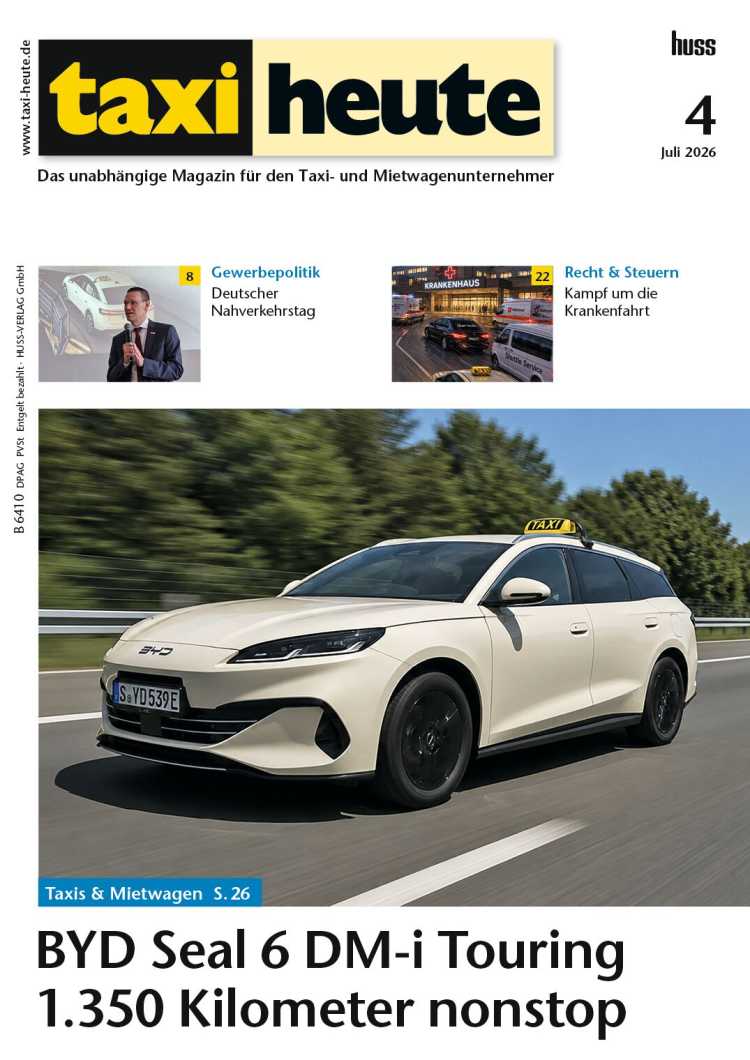
2 Ausgaben kostenlos für Sie

Fachmagazin taxi heute: Ihr Zugang zu exklusiven Inhalten rund um die Taxi- und Mietwagenbranche.
Aktueller Termin

Meist gelesen
Autonomous driving is set to open up new perspectives for Saxony's automotive industry.

Saxony will gradually introduce autonomous vehicles into the regular operation of public transport by 2030. The Free State thus combines not only new mobility offerings but also industrial policy goals. Autonomous driving should enable additional value creation at the interface of the automotive industry, semiconductors, software and research.
In spring, 19 partners from business, science, municipalities and politics signed a joint declaration of intent. The initiative falls in a phase in which the Saxon automotive industry already has to master the shift to electromobility. At the same time, international competition for technologies for automated and autonomous vehicles is growing.
International competition is increasing
The Association of German Transport Companies sees Germany under pressure in autonomous driving. The international development is driven mainly by the United States and China. In the view of the association, therefore a national strategy, additional investments and better framework conditions are required.
New business fields are also emerging for industry in Saxony and eastern Germany, according to regional companies. The Chemnitz-based technology company FDTech points to a high density of specialized providers in the region. Their competencies range from the development of algorithms and sensors to the safeguarding of vehicle functions.
The technologies are not limited to the automotive industry. Possible applications include, among others, public transportation, logistics, agriculture and the construction industry.
Saxony bets on semiconductors and software
The Saxon state government sees economic opportunities particularly in the integration of different technology sectors. Autonomous driving combines robotics, artificial intelligence, sensor technology and data management.
According to the Ministry of Economic Affairs, Saxony has for this a strong automotive and mechanical engineering industry, the microelectronics cluster Silicon Saxony, as well as universities and research institutions. Software development, system validation and digital services could supplement traditional vehicle manufacturing in the future.
Thus, the industrial policy outlook is not exclusively focused on vehicle production. Development, testing and digital applications should also enable additional value creation.
Pilot projects prepare for practical deployment
The Free State is already funding research and pilot projects for automated and autonomous driving. At the Technical University of Dresden, in the Smart Mobility Lab in Schwarzkollm, a test hall for autonomous systems is being built.
In Leipzig, the joint project Saxon Initiative for Automated Shuttle in public transport is also intended to prepare the deployment of driverless shuttle buses. In parallel, Saxony supports municipalities and transport companies with feasibility studies and preparations for the later deployment of autonomous vehicles.
There are already practical operating experiences. The automated shuttle bus “Flash” has been in test operation since 2023 in the North Saxony district. There is currently still an operator on board for safety in the vehicle. Prospectively, monitoring is to be carried out remotely via a control center.
Autonomous shuttles for rural regions
With the “Vision 2030: Autonomous Driving in Saxony's public transport,” Saxony aims to gradually integrate autonomous vehicles into regular operation. A focus is the urban periphery and rural regions where new mobility options are to be developed.
A concrete project is planned in Dorfhain in the district of Saxon Switzerland-Eastern Ore Mountains. There, an autonomous shuttle bus is to connect the municipality with Edle Krone railway station, thereby complementing the offerings in local public transport.
However, for broader deployment, further prerequisites must be created. According to the assessment of the Ministry of Infrastructure, Germany now has both experience from research and pilot projects and a legal framework for autonomous vehicles. For the transition to regular operation, there must be enough vehicles, the necessary infrastructure, and qualified personnel. In addition, the ministry sees a need for reliable funding from the federal government and support for model regions.
Whether autonomous driving will develop into a growth engine for Saxony's industry remains open. At the Saxon Industry Dialogue in Chemnitz, the technology was already treated as a possible building block for the industrial structural change. At the same time, Germany stands in international competition in the development and introduction of autonomous mobility. (Source: dpa)
Content automatically translated.



Taxi-Fahrzeuge (Pkw) , Taxi-Newsletter, Taxameter, Taxi-Fahrer , BZP – Deutscher Taxi- und Mietwagenverband , Straßenverkehrsordnung (StVO) , Krankenbeförderung , Weiterbildung , Taxi-Konzessionen , Verkehrspolitik , Mietwagenbranche , Taxi-Apps , Berufskraftfahrer-Qualifikations-Gesetz BKrFQG) , Taxizentralen , Personal, Gehälter, Arbeitsschutz , Wirtschaftsnachrichten , Werbung , Taxi-Folierung , Taxi-Umrüster , Straßenverkehr , Elektromobilität, Taxifuhrpark und -flottenmanagement , Taxi-Versicherungen , Hybrid, Diesel, Erdgas , Taxi-Magazin