


VISION mobility kostenlos Probelesen

Die Zeitschrift VISION mobility richtet sich an mobilitätsbegeisterte Menschen bzw. Flottenmanager und begleitet den Technologiewandel in Sachen Automotive und Mobilität.
Aktueller Termin

Meist gelesen
Why Munich taxi drivers are protesting in Fürstenfeldbruck and Freising

With persistent honking and determined presence, the drivers drew attention to an issue that increasingly pressures them: the growing number of rental car providers from the districts surrounding the state capital, distorting the taxi market in Munich. It has been observed for some time: More and more vehicles with "FFB," "FS," or "ED" license plates are taking orders in Munich - often on behalf of platforms like Uber.
Criticism of cheap providers - and the lack of control
The annoyance is specifically directed at providers that operate as rental car companies and are thus subject to different rules than classic taxis. Particularly controversial is the so-called return obligation: rental cars are not allowed to simply wait for the next customer after completing a ride but must return to the company headquarters - unless a new order is in place. It has been proven many times that many do not adhere to this.


“They practically drive like taxis - but without their obligations,”
was the sentiment in the small square in front of the district office. Representatives of the drivers met there with employees of the district authority to present their point of view. The accusation: distortion of competition, favored by a licensing practice that many consider too lax.
“We have free choice of employment in Germany. If an entrepreneur wants to register a rental car business, we will of course approve it. And we are here in Fürstenfeldbruck not responsible for the situation in Munich,” explained Dr. Ines Roellecke, spokeswoman for the Fürstenfeldbruck district office.
460 applications - in less than three years
In fact, the number of rental car concessions has risen significantly, for example in the district of Fürstenfeldbruck. In 2022 it was still 140 - by June 2025 there are already 460. This has consequences for the administration. Because if an application is not processed within three months, it is automatically considered approved. In justified cases, an extension for processing the application by a further three months can be granted, but then the application is through, explained Ms. Roellecke further. The requirements are formally high. Among other things, reliability, economic capacity, and expertise must be examined. But with the increase in applications, the pressure on the licensing offices also grows.
“The city of Fürstenfeldbruck is responsible for controlling the rental car companies. The district office FFB cannot simply say they are not responsible,” emphasized Sezai Curuk, a taxi entrepreneur from Munich who co-organized the protests.


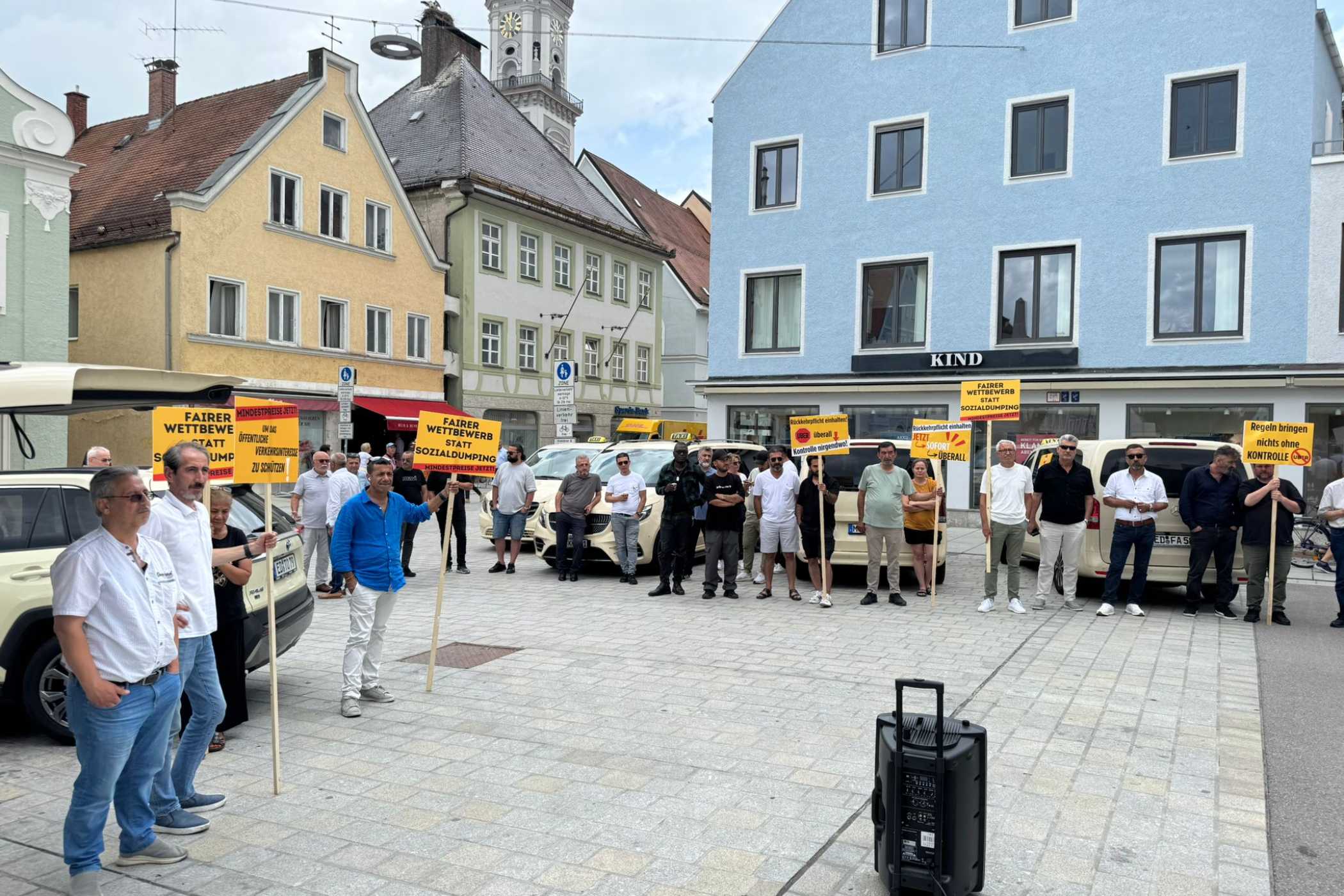

Protest with Rules
The protest march, which led through several streets around the district office, remained peaceful. The route had been coordinated with the police in advance – including restrictions on honking. Residents should be spared, and students not disturbed: In front of the secondary school, a honking ban was in place out of consideration for ongoing final exams. In front of the district office, however, the taxi drivers were allowed to make themselves heard – which they did emphatically.
Ignorance and Overload
On Friday, the Fürstenfeldbruck District Office showed a willingness to discuss. It was said that the internal review process would be re-examined. Additionally, an exchange at the specialist department level with the representatives of the taxi industry was promised. Further information would also be passed on to the appropriate authorities.
Nevertheless, it was alarming how little the employees knew about the topic of taxis. The processing of applications from new rental car companies in the Fürstenfeldbruck District Office is the responsibility of one person. According to the employees, the staff is too scarce to carry out inspections. They are already at their limit with the current situation (in which almost every application gets approved).
The fact that basic information, such as the requirement for rental cars to return to the operating base or the proper proof of an operating base, came as a surprise to the district office was telling.
Gregor Beiner, a taxi entrepreneur and board member of the BVTM, put it this way:
“There is great ignorance among the authorities. But unfortunately also a great lack of interest – we from the association regularly offer information events for cities and municipalities. No one from Fürstenfeldbruck has attended yet.”
Despite the loud criticism, the demonstrators remained polite. “The Munichers were very friendly,” it was said afterward by the authorities. There is hope that the employees of the Fürstenfeldbruck District Office have been made more aware of the needs of the taxi industry through the demonstration and discussions.
Content automatically translated.





Taxi-Fahrzeuge (Pkw) , Taxi-Newsletter, Taxameter, Taxi-Fahrer , BZP – Deutscher Taxi- und Mietwagenverband , Straßenverkehrsordnung (StVO) , Krankenbeförderung , Weiterbildung , Taxi-Konzessionen , Verkehrspolitik , Mietwagenbranche , Taxi-Apps , Berufskraftfahrer-Qualifikations-Gesetz BKrFQG) , Taxizentralen , Personal, Gehälter, Arbeitsschutz , Wirtschaftsnachrichten , Werbung , Taxi-Folierung , Taxi-Umrüster , Straßenverkehr , Elektromobilität, Taxifuhrpark und -flottenmanagement , Taxi-Versicherungen , Hybrid, Diesel, Erdgas , Taxi-Magazin







