


Ihr kostenloser Branchen-Newsletter

Lassen Sie sich von unseren Fachjournalisten einmal wöchentlich über die wichtigsten aktuellen Entwicklungen der Taxi-Branche informieren, bequem direkt in Ihre Mailbox.
Aktueller Termin

Meist gelesen
Taxi prices in Thuringia are rising: the industry calls for further tariff adjustments.
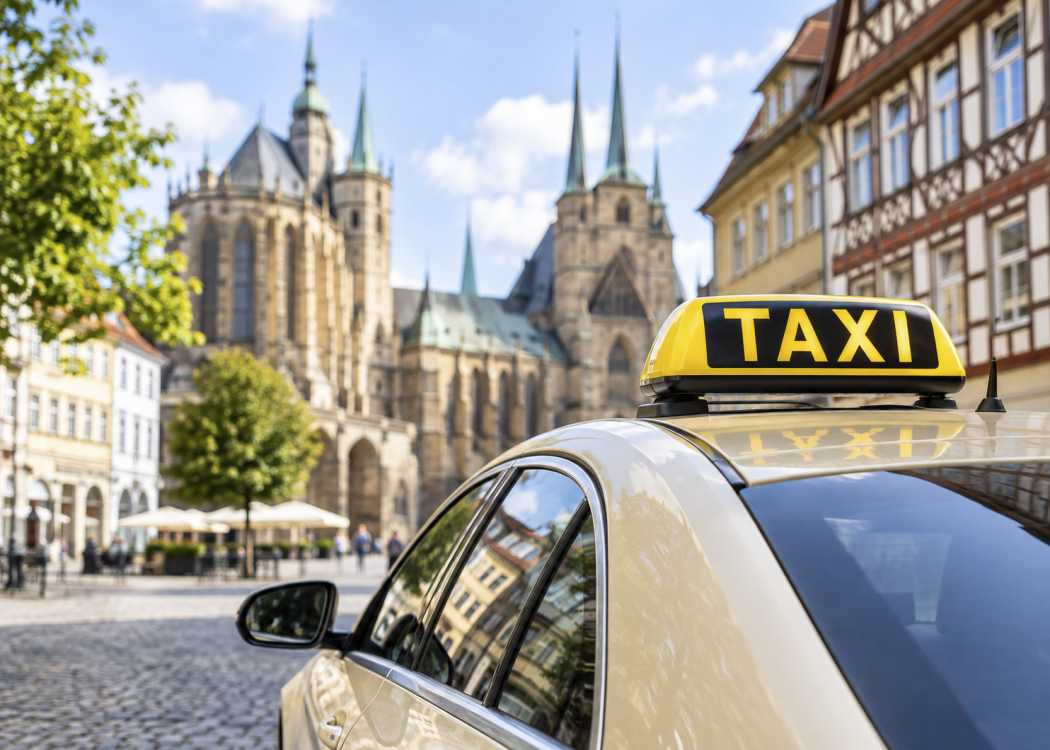
If you take a taxi in Thuringia, you have to dig deeper into your pocket in many places. In several cities, fares have been raised this year; further changes are on the horizon. But for the taxi companies, that's only a partial success. Rising personnel, vehicle and fuel costs cannot be fully offset everywhere by the new prices, according to the Thuringia State Association of the Transport Industry (LTV). In Erfurt, taxi prices rose by an average of around 13 percent, according to the city. Weimar and Suhl have also adjusted their fares. In Jena, the increase is set to take effect on December 1: daytime trips will cost 11 percent more, and nighttime trips 16 percent more. Gera had already raised its prices last year. No further changes are currently planned in the remaining independent cities.
Minimum wage drives up costs
How large the economic pressure is is shown by the development in Jena. Since the last tariff adjustment in 2023, personnel costs have risen by 16 percent, mainly as a result of the minimum wage increases. Vehicle costs have risen by a further nine percent, the city announced. The fact that taxi prices in Jena are already comparatively high has been taken into account in the recalculation. For the companies, the decision still comes late.
„In Jena, the entrepreneurs have been waiting for an adjustment since 2023. What was requested is no longer viable,” says Martin Kammer from the LTV.
The entrepreneurs are nevertheless glad that there is at least an increase. For besides personnel costs, expenditures for fuel and vehicles have also risen. Kammer points to a peculiar ity of the taxi trade: The companies must bear rising operating costs themselves, but cannot independently adjust their prices. The tariffs are set by the responsible municipalities or districts. There are no government subsidies that could offset part of the extra burden for taxi companies.
One euro more for the ride?
The fact that tariff adjustments are progressing only slowly in many places is adding to the industry's difficulties. In some districts, the entrepreneurs have been waiting for higher prices for years, reports the Chamber. The procedures are difficult; progress is often hard to achieve. The concern about losing passengers with higher tariffs, however, is understandable but not decisive. For a short taxi ride within a city, a price increase might amount to perhaps one euro.
"I think that's manageable. We're not talking about things people can no longer afford," said the Chamber.
For the companies, it is more about at least partially offsetting their increased costs. After all, a taxi must be able to be operated economically – regardless of whether the ride is two or twenty kilometers long.
Large disparities between urban and rural areas
The degree of strain in Thuringia depends strongly on location. While fares in cities such as Gera and Erfurt are, according to the association, adequate for the companies, in some districts it looks significantly worse. Particularly in Schmalkalden-Meiningen and Sonneberg the economic situation is difficult. There, the last fare adjustments date back a long time. The development reveals a structural problem of the Thuringian taxi market: uniform cost increases meet regional fare regulations and economic conditions that vary greatly. What works in a larger city can already become a problem in a predominantly rural district.
For the taxi companies it remains crucial, therefore, that the municipalities and districts regularly review the fares. Because when staff, vehicles and fuel become more expensive, while transport prices remain unchanged for years, the calculation comes under increasing pressure. The recent increases are therefore for many operators less a step forward than an attempt not to fall behind.
Content automatically translated.





Taxi-Fahrzeuge (Pkw) , Taxi-Newsletter, Taxameter, Taxi-Fahrer , BZP – Deutscher Taxi- und Mietwagenverband , Straßenverkehrsordnung (StVO) , Krankenbeförderung , Weiterbildung , Taxi-Konzessionen , Verkehrspolitik , Mietwagenbranche , Taxi-Apps , Berufskraftfahrer-Qualifikations-Gesetz BKrFQG) , Taxizentralen , Personal, Gehälter, Arbeitsschutz , Wirtschaftsnachrichten , Werbung , Taxi-Folierung , Taxi-Umrüster , Straßenverkehr , Elektromobilität, Taxifuhrpark und -flottenmanagement , Taxi-Versicherungen , Hybrid, Diesel, Erdgas , Taxi-Magazin







