VISION mobility kostenlos Probelesen

Die Zeitschrift VISION mobility richtet sich an mobilitätsbegeisterte Menschen bzw. Flottenmanager und begleitet den Technologiewandel in Sachen Automotive und Mobilität.
Aktueller Termin

Meist gelesen
CAM Electric Mobility Study 2026: Tesla and China gain market shares – Electric cars reach the mass market
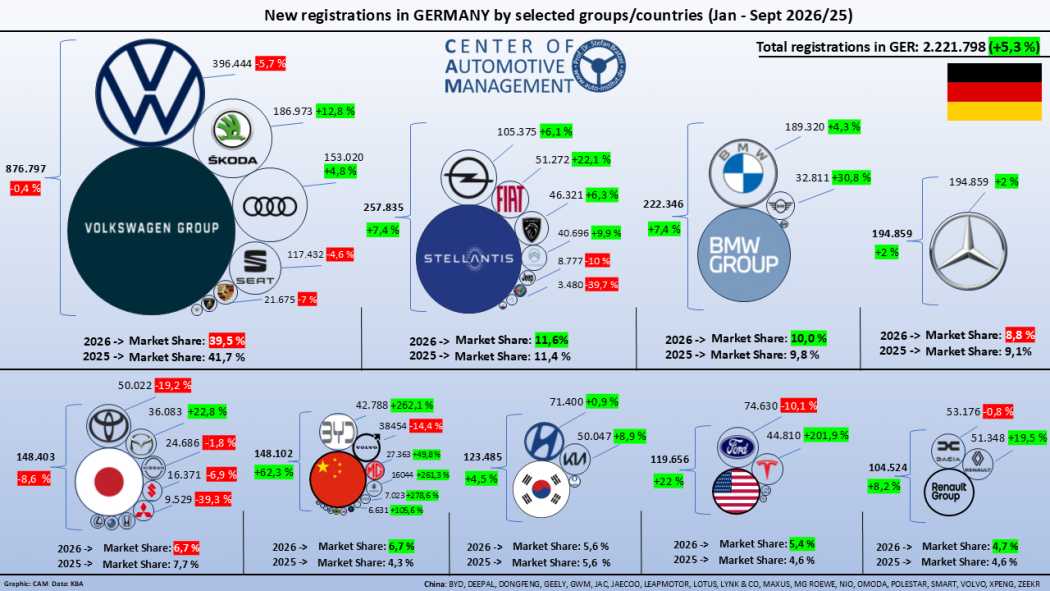
Electromobility has reached a new phase in Germany. What had long been regarded as a promise of the future is now clearly visible in the registration figures. In September 2026, more than one in three newly registered passenger cars was a battery-electric vehicle. At the same time, the balance of power on the car market is shifting noticeably: Tesla is growing rapidly, Chinese manufacturers are catching up, while numerous established brands are losing market share. This is shown by the current Electromobility Report from the Center of Automotive Management (CAM). The figures show a market that is right in the middle of an upheaval.
After the first nine months of the year, 604,144 battery-electric vehicles (BEV) had already been registered in Germany. This corresponds to a 58 percent increase compared with the same period of the previous year. Notably: By the end of September, more electric cars had been registered than in the entire year 2025. The development becomes especially clear when looking at September. With 88,599 newly registered electric vehicles, the BEV share reached a record high of 34.5 percent. Pure electric cars thus stood clearly ahead of traditional gasoline and diesel vehicles, which together accounted for only 26.4 percent of the market.
“The electric car has entered the mass market in Germany,” says the study leader Prof. Dr. Stefan Bratzel. “In September, more than one in three new cars was a pure EV, and after nine months more BEVs have been newly registered than in the entire year 2025.”


Tesla and China on a growth trajectory
However, not all manufacturers benefit equally from this growth. The market leader remains the Volkswagen Group. But despite its strong position, market share falls from 41.7 to 39.5 percent. While the core brand Volkswagen loses slightly in registrations, Skoda can gain significantly.
The real winners, however, come from the United States and China. Tesla almost tripled its new registrations and increased sales by 202 percent to 44,810 vehicles. With that, the American manufacturer now even ahead of the Chinese industry leader BYD. Chinese manufacturers overall are also gaining massive importance. Their combined market share rose within a year from 4.3 to 6.7 percent. With 148,102 new registrations they are now almost on par with the Japanese manufacturers.
BYD is growing particularly strongly. The brand increased its registrations by 262 percent to 42,788 vehicles, thereby already overtaking Volvo on the German market. MG, Leapmotor and Xpeng also report clear gains. The development shows that the competition for electric mobility has long since become global. While German manufacturers dominated the market for decades, new players with competitive prices and modern technology are now pushing into Europe.
Difficult times for traditional manufacturers
Not all manufacturers benefit from market growth. Especially the Japanese brands are under pressure. Their combined market share fell from 7.7 to 6.7 percent. Market leader Toyota even lost 19.2 percent of its sales volume. Only Mazda managed to grow against the trend, with an increase of 22.8 percent. Ford also had declines and lost more than ten percent of its sales in the German market. BMW, Mercedes-Benz, as well as the Korean manufacturers Hyundai and Kia appear somewhat more stable. Nevertheless, this also shows: The growing electric market does not automatically guarantee rising market shares.
“Tesla and the Chinese manufacturers gain market shares with a strong price-performance ratio; many established manufacturers are losing,” analyzes Bratzel. “The electric market is growing – but not automatically for the German manufacturers.”
Internal combustion engines are losing significance
While electric cars are gaining ground, traditional powertrains are losing substantial ground. In September, new registrations of gasoline cars fell by 29.2 percent year-on-year. Diesel models lost 20.1 percent. Plug-in hybrids were able to keep their market share steady at around eleven percent.
Taken together, electric cars and plug-in hybrids now account for 45.4 percent of all new registrations in Germany. This brings the market closer to a point where electrified drivetrains could become the dominant form of propulsion. CAM cites several factors behind this development: the now significantly broader range of new electric vehicles, government incentives, and still-high fuel prices.
What does this mean for the taxi business?
For taxi operators, the development is more than a statistical snapshot. Many manufacturers are now prioritizing their development budgets for electric vehicles. The supply of electric MPVs, vans and SUVs is growing steadily, while traditional diesel models are increasingly disappearing from the model ranges.
At the same time, economic viability remains a decisive factor. High acquisition costs, charging times, and regional differences in charging infrastructure continue to slow the switch for many operators. On the other hand, rising fuel prices and stricter climate regulations will further increase the pressure for electrification.
The current CAM report thus shows not only a shift in the automotive market. It also describes the direction in which the taxi business will move in the long term – it will become increasingly electric. What will be decisive is which manufacturers offer suitable vehicles under economically viable conditions – and which operators find the right time to switch.
Content automatically translated.





Taxi-Fahrzeuge (Pkw) , Taxi-Newsletter, Taxameter, Taxi-Fahrer , BZP – Deutscher Taxi- und Mietwagenverband , Straßenverkehrsordnung (StVO) , Krankenbeförderung , Weiterbildung , Taxi-Konzessionen , Verkehrspolitik , Mietwagenbranche , Taxi-Apps , Berufskraftfahrer-Qualifikations-Gesetz BKrFQG) , Taxizentralen , Personal, Gehälter, Arbeitsschutz , Wirtschaftsnachrichten , Werbung , Taxi-Folierung , Taxi-Umrüster , Straßenverkehr , Elektromobilität, Taxifuhrpark und -flottenmanagement , Taxi-Versicherungen , Hybrid, Diesel, Erdgas , Taxi-Magazin