2 Ausgaben kostenlos für Sie

Fachmagazin taxi heute: Ihr Zugang zu exklusiven Inhalten rund um die Taxi- und Mietwagenbranche.
Aktueller Termin

Meist gelesen
Efficiency at any price: How Tesla in Grünheide follows the realities—and tells them differently at the same time.
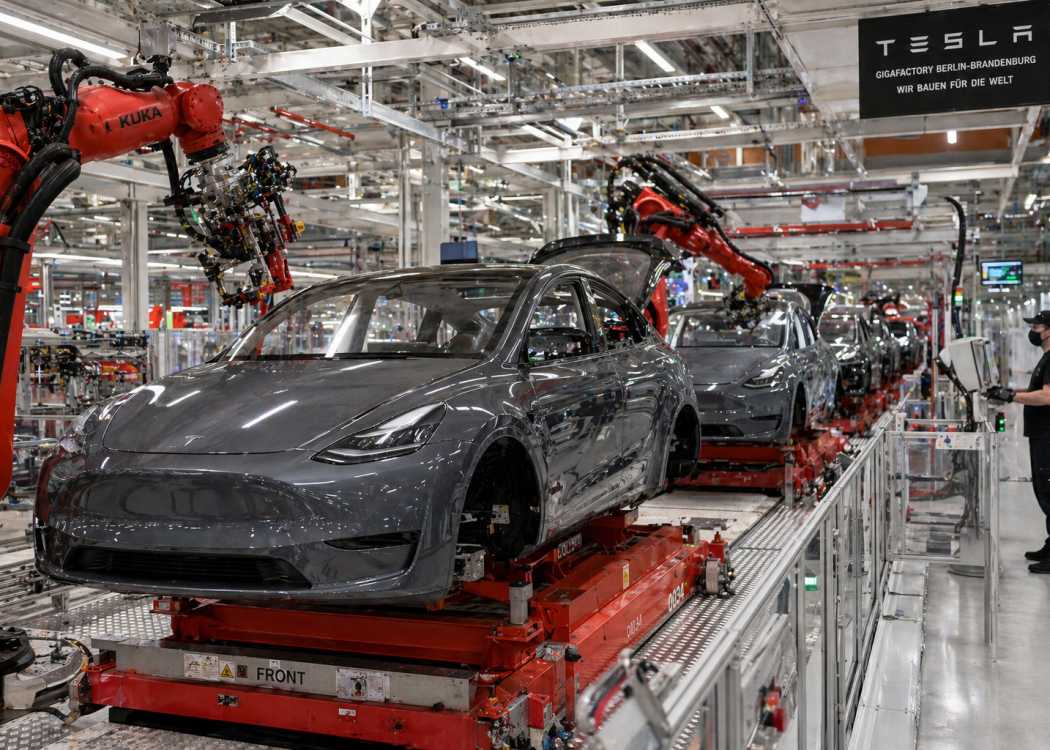
Plant manager André Thierig emphasized at the Hannover Messe the central driver of development: efficiency. “The idea of efficiency truly drives us forward,” he said. Especially in light of high wage costs in Germany, the plant must remain competitive – especially against manufacturers from China. The answer to this is clear: automation and optimized processes.
The figures confirm this course. In the past two years, Tesla in Grünheide has eliminated around 1,700 positions – despite rising production. What seems contradictory at first glance follows the logic of an industry under constant cost and innovation pressure. Productivity replaces personnel; efficiency becomes a prerequisite for growth.
Claims and Reality
What is remarkable is less the development itself than its communication. Even in spring 2024, Elon Musk announced that he planned to cut about ten percent of jobs worldwide. For Grünheide, however, Thierig initially denied such cuts. At the time there was talk of moderate adjustments: around 300 temporary workers fewer, plus about 400 positions through voluntary programs. A larger downsizing was not planned. This portrayal also found approval in politics. The then Brandenburg economics minister Jörg Steinbach spoke of "a sense of proportion."
Looking back, this assessment seems too optimistic. After all, the structural development in Grünheide also followed the familiar patterns of the industry: rising efficiency, falling staffing needs.
Employee representations are not welcome at the Tesla plant. Although there is a works council, it operates in an environment without collective bargaining coverage and with a management style that is more centrally controlled. Tesla CEO Elon Musk had in February warned the workforce at the Grünheide plant against too much influence from employee representatives and unions:
„Things will certainly become more difficult when there are, so to speak, external organizations that push Tesla in the wrong direction,“ said the CEO in a video message to the workforce. “We will not shut down the factory, but realistically we will not expand either.”
Competition as a constant
Thierig himself now provides the explanation. The pressure of competition leaves no alternative. Those who do not continuously improve their processes fall behind. In this reading, the elimination of jobs is not a contradiction to growth, but its prerequisite. Every saved job secures the remaining ones. This argument is not new in the industry. However, it gains in sharpness, since manufacturers from China with cheaply produced electric vehicles are pushing into the European market. For plants in high-wage countries, the pressure to adapt thereby intensifies.
Lost credibility
The discussion about Grünheide nevertheless has a second level. It concerns the handling of the public and the workforce. Critics accuse the management of initially glossing over the development and later relativizing it. Thierig himself sharpened the debate when he contradicted media reports and lamented a discrepancy between public portrayal and the actual situation.
“There is a large gap between what is said to the public and how it really is,” he said last year — linked to the wish that “there will be no more lying.”
The criticism is directed less at the diagnosis itself than at the sender. Whoever first issues the all-clear and later points to economic pressures loses credibility, according to the tenor. But as long as Thierig successfully turns the “efficiency screw” at Tesla's plant in Grünheide, it will please Tesla CEO Elon Musk — and thus at least one job at the plant is secured: Thierig's.
Market logic and expectations
For the employees the situation remains ambivalent. On the one hand production is growing, on the other hand the number of jobs is decreasing. Political support, as Steinbach demonstratively phrased, changes little in that. Tesla itself is currently planning new hires again — around 1,000 positions could be added. At the same time, the management makes clear that the pressure for efficiency continues.
“There is more to come,” Thierig said with a view to further adjustments.
Electromobility, globalization and automation are interwoven—and are changing not only products but also work structures. This development is hardly stoppable—but it should be communicated honestly as well.
Content automatically translated.





Taxi-Fahrzeuge (Pkw) , Taxi-Newsletter, Taxameter, Taxi-Fahrer , BZP – Deutscher Taxi- und Mietwagenverband , Straßenverkehrsordnung (StVO) , Krankenbeförderung , Weiterbildung , Taxi-Konzessionen , Verkehrspolitik , Mietwagenbranche , Taxi-Apps , Berufskraftfahrer-Qualifikations-Gesetz BKrFQG) , Taxizentralen , Personal, Gehälter, Arbeitsschutz , Wirtschaftsnachrichten , Werbung , Taxi-Folierung , Taxi-Umrüster , Straßenverkehr , Elektromobilität, Taxifuhrpark und -flottenmanagement , Taxi-Versicherungen , Hybrid, Diesel, Erdgas , Taxi-Magazin