VISION mobility kostenlos Probelesen

Die Zeitschrift VISION mobility richtet sich an mobilitätsbegeisterte Menschen bzw. Flottenmanager und begleitet den Technologiewandel in Sachen Automotive und Mobilität.
Aktueller Termin

Meist gelesen
Taxi tariffs and taxi stands: VSPV advances cooperation with NRW.MOBIDROM.
Mobility data are often invisible – and yet they determine how well transportation systems function. Whether navigation services take road closures into account, taxi stands are found, or fares can be calculated digitally: Behind many applications lie datasets that must be maintained, provided and interconnected.
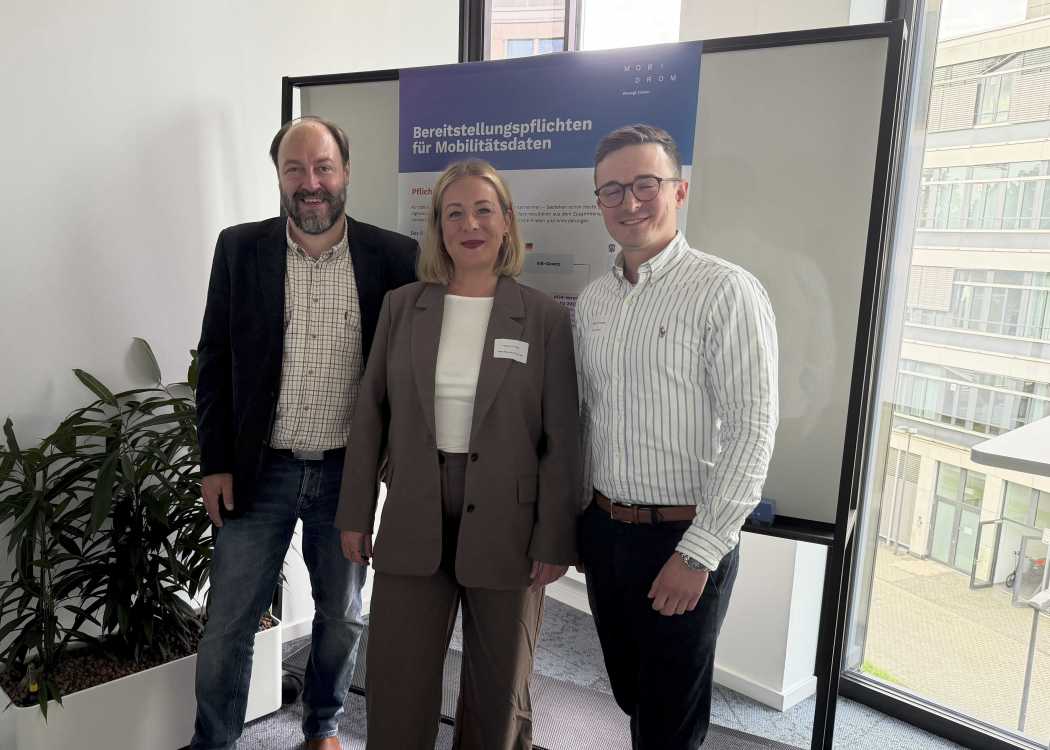
The significance of this topic for the mobility industry is now evident at NRW.MOBIDROM GmbH's open house. There, the Association of Private Commercial Road Passenger Transport of North Rhine-Westphalia (VSPV) used the opportunity to exchange with representatives from authorities, municipalities and mobility service providers. Managing Director Sascha Waltemate sought conversations at the event's various topic hubs, which were deliberately designed as open discussion forums.
Technical discussions in the spotlight
This format proved to be advantageous. Instead of traditional lectures, spontaneous encounters and professional discussions were at the center. As a result, conversations emerged that would hardly have arisen within a strictly structured event framework.
A focus was the question of how mobility data should be provided in the future. Together with Isabell Frisch from NRW.MOBIDROM GmbH and Tobias Schiestel from the Ministry of Environment, Nature Conservation and Transport of the State of North Rhine-Westphalia, Waltemate discussed the legal framework. In particular, it concerned transferring existing data provisioning obligations from the Passenger Transportation Act into the newly framed Intelligent Transport Systems Act (IVSG) as well as the amendment of the North Rhine-Westphalia Roads and Paths Act.
How practical these topics are was demonstrated by a spontaneous exchange with representatives of the city of Herford. The municipality, due to its size, is not obliged to provide traffic-related orders digitally. Nevertheless, voluntary publication of information about road closures or traffic disruptions could yield a tangible benefit. Navigation and routing services could integrate such data directly into their systems and thereby guide road users more effectively. The VSPV explicitly supports this approach. From the association's perspective, both transport companies and passengers benefit from as comprehensive data availability as possible. Information that is provided beyond statutory minimum requirements can help make traffic flows more efficient and avoid detours.
How to find taxi stands in NRW
Another joint concern of VSPV and MOBIDROM concerns recording taxi stands in North Rhine-Westphalia. The goal is to make the locations visible on the Verkehr.NRW portal. This could particularly benefit those unfamiliar with the area who are looking for a taxi stand. The improved discoverability should also help to integrate taxis more strongly into digital mobility offerings.
The display of taxi tariffs on Verkehr.NRW was also on the agenda. In discussions with Pascal Wett, Product Owner of the MOBIDROM data platform, the question was how tariff information could in the future be machine-readable and thus usable for digital applications.
A trigger for the current initiative was a legal hurdle: The NRW State Office for Metrology and Weights did not consider itself able to hand over the taxi tariffs to MOBIDROM. The VSPV responded pragmatically and provided an initial sample dataset. Now the association and platform operator are jointly working on a procedure to make tariff data available in as universally usable a form as possible. Possible applications include those that, on neutral platforms, enable price calculations or automatically read tariff information.
Further digitization in the transport sector
For Waltemate, the collaboration with MOBIDROM is already far more than a single project.
"MOBIDROM is a key player in mobility data. Since its founding there has been close exchange and fruitful cooperation on a multitude of topics," said the VSPV managing director. The benefit of such events lies primarily in direct dialogue: "Open House Day has once again shown how valuable the networking between authorities, industry and service providers is when it comes to bringing mobility data into practice."
The discussions in Düsseldorf made clear that digitization in the transport sector is not solely a technical question. It depends on the willingness of different actors to provide data, to develop standards, and to work together to develop solutions. For the taxi industry, these very unassuming foundations could in the future determine how visible and integrated its offerings become in the digital mobility world.
Content automatically translated.




Taxi-Fahrzeuge (Pkw) , Taxi-Newsletter, Taxameter, Taxi-Fahrer , BZP – Deutscher Taxi- und Mietwagenverband , Straßenverkehrsordnung (StVO) , Krankenbeförderung , Weiterbildung , Taxi-Konzessionen , Verkehrspolitik , Mietwagenbranche , Taxi-Apps , Berufskraftfahrer-Qualifikations-Gesetz BKrFQG) , Taxizentralen , Personal, Gehälter, Arbeitsschutz , Wirtschaftsnachrichten , Werbung , Taxi-Folierung , Taxi-Umrüster , Straßenverkehr , Elektromobilität, Taxifuhrpark und -flottenmanagement , Taxi-Versicherungen , Hybrid, Diesel, Erdgas , Taxi-Magazin