Ihr kostenloser Branchen-Newsletter

Lassen Sie sich von unseren Fachjournalisten einmal wöchentlich über die wichtigsten aktuellen Entwicklungen der Taxi-Branche informieren, bequem direkt in Ihre Mailbox.
Aktueller Termin

Meist gelesen
Munich is castrating itself!
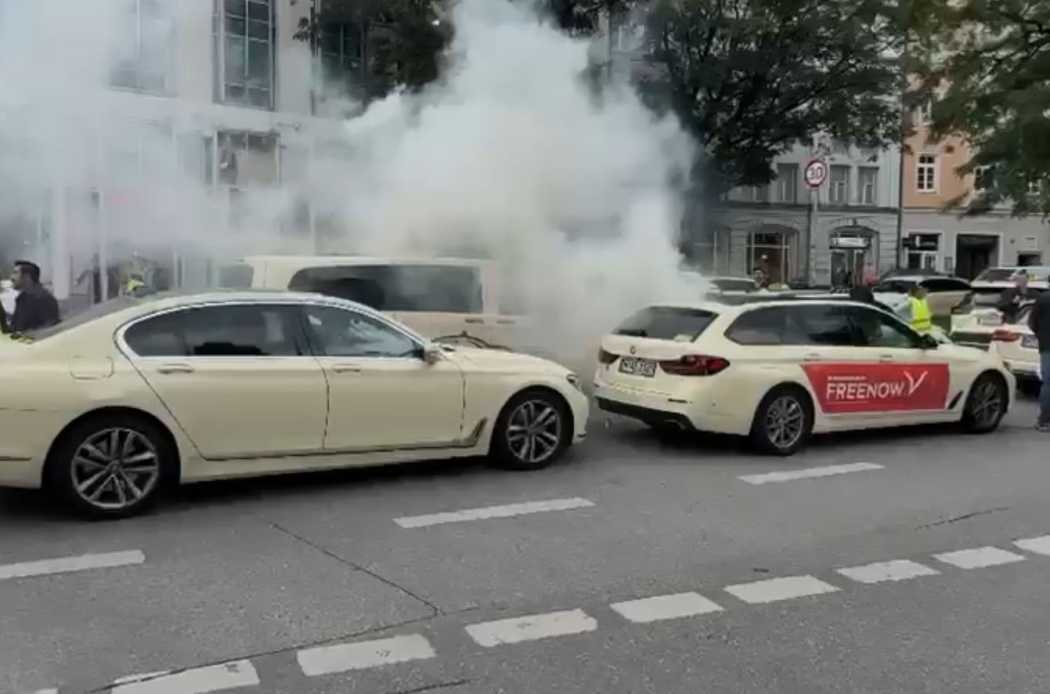
The Munich city center was firmly in the hands of the taxi industry on Tuesday morning. Countless taxis lined the streets around the town hall, with drivers demonstrating with banners and honking against the city council's decision. And the protests continue - the city's taxi industry is also demonstrating today, Wednesday.
"We announced that Uber Mayor Dieter Reiter will hear from us – and we are putting this into action today," announced Gregor Beiner, chairman of the Munich Taxi Association and board member of the Federal Association of Taxi and Rental Car (BVTM). "And we will not relent, because it is about our existence. Without minimum prices for all transport services, the taxi industry has no chance."
The protest on Tuesday was loud, but not surprising – because what happened in the town hall causes incomprehension in the industry. The city council had previously voted against a proposal that would have mandated a minimum price for rental car providers. Instead, the city administration is now supposed to engage in dialogue with the companies – the goal is to achieve voluntary agreements on price floors and minimum fees within a year.
Mayor Reiter, the SPD, and the CSU against Minimum Prices
The fact that the SPD supports this change in course causes discontent—not only among the Greens, their current coalition partner. Green Party city councilor and chairwoman of the Taxi Commission, Sibylle Stöhr, calls the decision “a bad day for fair wages and fair competition on our streets.” She views the rental car industry as a place of systematic disregard for labor law standards:
“This ruinous competition is causing the entire industry to bleed out. It is high time we put an end to it—but that was prevented today.”
The originally planned minimum price was not to follow the classic taxi model but a reduced tariff model. It proposed, among other things, a base price of 5.415 euros and a kilometer price of 2.565 euros—lower than for taxis, but high enough to make undercutting the minimum wage economically unattractive.
The fact that now, of all parties, the SPD, which had positioned itself in the election campaign as the party of the working population, is voting against the model, also attracts criticism from other factions. Marie Burneleit of The Left/The Party considers the new course naive:
```“Instead of the binding compliance with legal standards, compliance with minimum wages is now supposed to be checked through a private agreement with the rental car companies. The mayor's policy can’t get any more clueless.”
The disappointment is also growing within the taxi industry. Gregor Beiner spoke at the rally about a political signal that must be interpreted as follows:
“Without minimum prices for all transport services, the taxi trade stands no chance. The Uber principle of exploitation and social dumping will continue to spread.” The tone directed towards Mayor Dieter Reiter (SPD) became sharper: “The mayor is revealing himself as an Uber mayor.”
Reiter himself reacted to the protests with understanding, but also with an attempt to portray the decision as considered.
“The big taxi demonstration today is frankly no surprise, except perhaps in the very sharp tone,” he said on the sidelines of the meeting.
He had asked both sides – taxi companies and rental car providers – to come to the table, but a solution failed due to a lack of willingness to compromise.
"I find today's decision correct, namely not to try a quick fix, but to take a detailed look at the entire tariff structure."
Reiter advocated for a comprehensive reform. His "favorite solution" is to make prices cheaper for everyone – for example by eliminating minimum fees even for taxis. At the same time, Uber & Co. need to be held more accountable to guarantee fair working conditions for their drivers.
But how realistic is it to negotiate fair wages with platform operators? For Sibylle Stöhr, the idea is not very convincing:
"The idea of being able to negotiate fair wages with Uber and Co. is, to put it mildly, naive." In her opinion, it's no longer just about economic questions, but about justice. "People who safely drive us home, to a doctor's appointment, or to the train station must be able to live off their work – if they can't, ultimately our social security systems and thus the general public will pay for it."
Whether a voluntary agreement will be reached within a year is very unlikely. The political damage is already done: the trust of the taxi industry in the city leadership is noticeably shaken.
Content automatically translated."We will experience a decline in quality and reliability in passenger transport," notes Gregor Beiner. "Rental cars have no obligation to provide transportation, so they don't have to take patients to dialysis or drive grandmas around the corner for shopping. Also, the vast majority of Uber and Bolt vehicles are not suitable for wheelchair transport. Where is the commitment of the Social Democrats for those in the city who are having problems?"




Taxi-Fahrzeuge (Pkw) , Taxi-Newsletter, Taxameter, Taxi-Fahrer , BZP – Deutscher Taxi- und Mietwagenverband , Straßenverkehrsordnung (StVO) , Krankenbeförderung , Weiterbildung , Taxi-Konzessionen , Verkehrspolitik , Mietwagenbranche , Taxi-Apps , Berufskraftfahrer-Qualifikations-Gesetz BKrFQG) , Taxizentralen , Personal, Gehälter, Arbeitsschutz , Wirtschaftsnachrichten , Werbung , Taxi-Folierung , Taxi-Umrüster , Straßenverkehr , Elektromobilität, Taxifuhrpark und -flottenmanagement , Taxi-Versicherungen , Hybrid, Diesel, Erdgas , Taxi-Magazin